
In a recent LinkedIn post, Neil Patel questions the accuracy and utility of prompt tracking for businesses seeking to understand their performance on large language models (LLMs) compared to competitors. Patel highlights the growing corporate interest in this area, acknowledging that even his own company engages in such tracking.
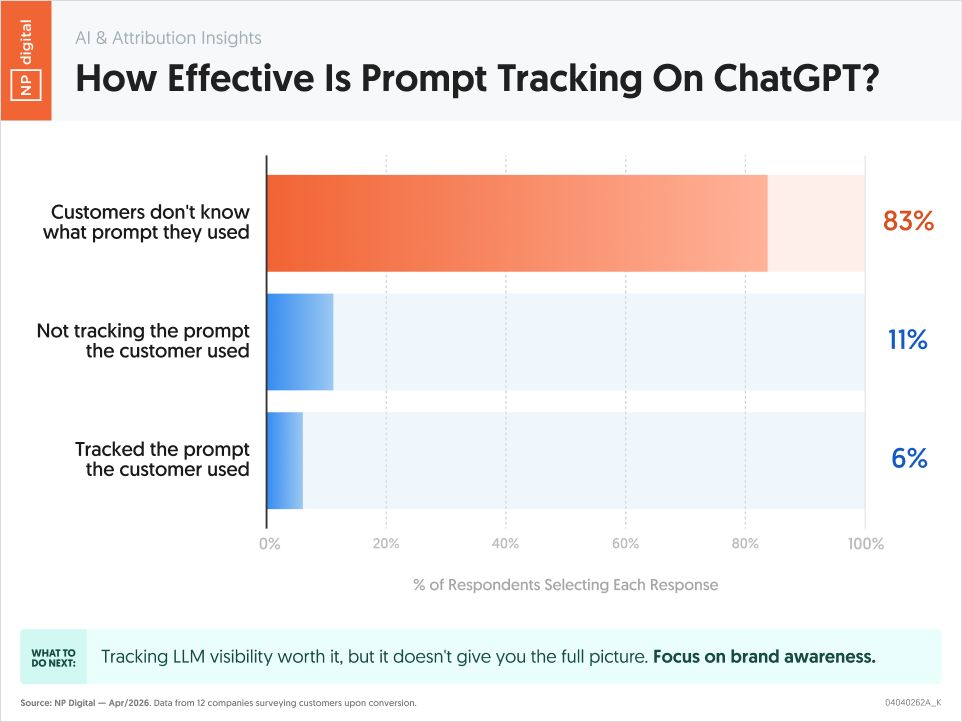
However, Patel raises significant doubts about the data’s reliability, citing a survey conducted by 12 companies. These companies surveyed customers at checkout to determine how they discovered the business.
“Of course, most people don’t respond to the surveys. But of the people who do, 83% didn’t know which prompt they used to find the company.”
This statistic, as Neil Patel points out, immediately casts a shadow on the precision of prompt tracking. Even among the respondents who did recall the prompt they used, further complexities emerged, according to Patel’s analysis.
The Challenges of User Recall and Tracking Gaps
Delving deeper into the survey results, Neil Patel illustrates the discrepancies that plague prompt tracking efforts. He notes that among the customers who could identify the prompts that led them to a company, a significant portion revealed flaws in the tracking mechanisms themselves.
“And for the people who knew the prompts, 11% weren’t being tracked, and 6% were.”
This data, according to Patel, suggests that even when users can recall their search queries, the systems in place may not be accurately capturing this information. This creates a dual problem: unreliable user input and potentially faulty tracking technology.
A Call for Caution with Prompt Data
Based on these findings, Neil Patel advocates for a cautious approach to interpreting prompt tracking data. While he concedes that tracking can offer a general sense of competitive positioning, he strongly advises against treating the numbers as definitive.
As Patel concludes:
“In other words, it’s worth tracking prompts as it gives you a sense of how you are performing compared to your competition, but take the data with a grain of salt, as it won’t be that useful until ChatGPT creates its own version of Google Search Console.”
In essence, Neil Patel argues that the current state of prompt tracking lacks the robustness and standardization seen in established analytics platforms like Google Search Console. Until LLM platforms offer more integrated and reliable analytics, businesses should temper their expectations regarding the actionable insights derived from prompt tracking. He suggests that the data is more indicative of general trends than precise performance metrics at this stage.
📝 About This Content
This article is based on insights shared by Neil Patel on LinkedIn.
📅 Originally posted on April 10, 2026 | View original post on LinkedIn →