
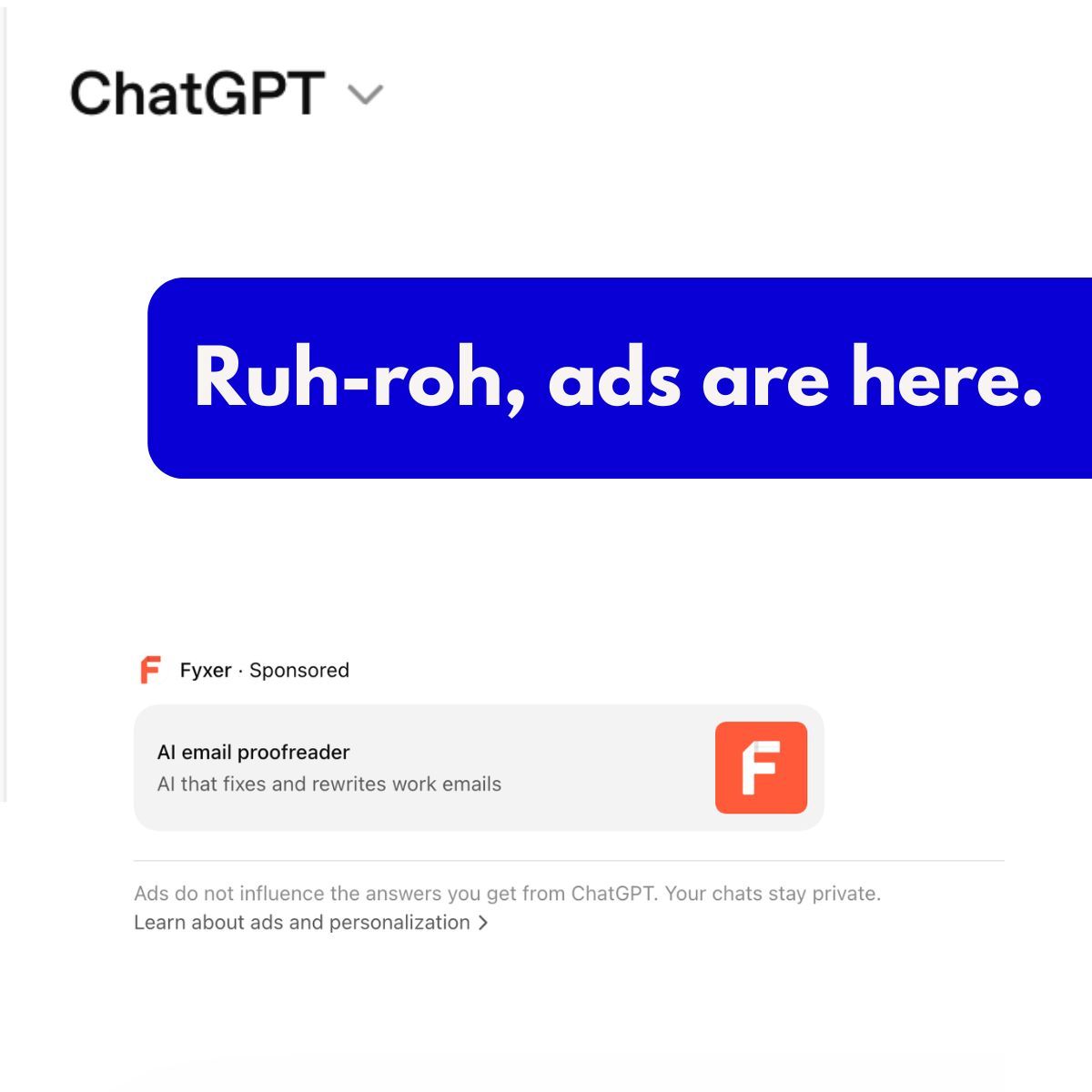
In a recent LinkedIn post, Alison McCauley discusses her experience with an AI-embedded advertisement and argues that current ad delivery models may be fundamentally at odds with how users engage with advanced AI tools. McCauley, an experienced professional in the business and technology space, shared her reaction to seeing an ad while participating in a workshop comparing free and paid ChatGPT versions.
The Disruption of Deep Work
McCauley recounts how the unexpected ad shattered her concentration during a period of intense cognitive engagement. She was actively using AI as a collaborative tool, pushing its capabilities and her own thinking, a state she describes as “deep thinking mode.” The interruption, she explains, pulled her out of this productive flow state, from which she found it difficult to return.
“When we are use AI right, we go into deep thinking mode, really working to get the most out of our AI by pushing it to push us. Our brains are ON. That’s where I was when the ad suddenly popped up and completely took me out of flow. And I couldn’t get back.”
This experience led McCauley to differentiate between using AI as an “answer machine”—akin to a traditional search engine—and employing it as a “deeper collaborator.” She contends that while users might tolerate ads during the lighter mental processing associated with quick information retrieval from search engines, the same approach is detrimental when engaging with AI for more profound collaboration.
AI as a Collaborator vs. Answer Machine
According to McCauley, treating AI solely as an answer machine not only fails to leverage its full potential but also risks “dumbing down your own brain.” She emphasizes that when users are interacting with AI in its intended capacity as a collaborative partner, they are often in a state of flow. In this heightened mental state, intrusive advertising can be particularly jarring and counterproductive.
“If we are using AI the way we should, we are more likely to be in flow, deep in thought. In that state, the ad just pissed me off.”
McCauley recounts her immediate reaction in the workshop, switching to a different AI tool to regain her focus. This anecdote underscores her central point: the current methods of ad delivery are ill-suited for the sophisticated, collaborative interactions users have with advanced AI.
Questioning the AI Monetization Model
While acknowledging the significant economic potential of AI, McCauley questions the viability of integrating traditional ad models into these deep-thinking sessions. She points out the risk of “killing the very moments where AI is most valuable.” The ad experience, in her view, was a clear failure in monetizing AI effectively without disrupting the user’s cognitive process.
“The economics of AI are staggering, and somehow it will have to be better monetized, but this approach risks killing the very moments where AI is most valuable, when users are deep in thought and working with AI as a collaborator.”
She concludes by posing critical questions to her audience about the future of AI monetization, asking how long it will take for platforms like OpenAI to reconsider their strategies and whether a completely different advertising model is required.
“I’m going to call current ad delivery a fail.”
McCauley’s insights prompt a broader discussion about balancing monetization with user experience in the rapidly evolving landscape of artificial intelligence, suggesting that innovation in advertising models must keep pace with the evolution of AI interaction.
📝 About This Content
This article is based on insights shared by Alison McCauley on LinkedIn.
📅 Originally posted on April 9, 2026 | View original post on LinkedIn →