
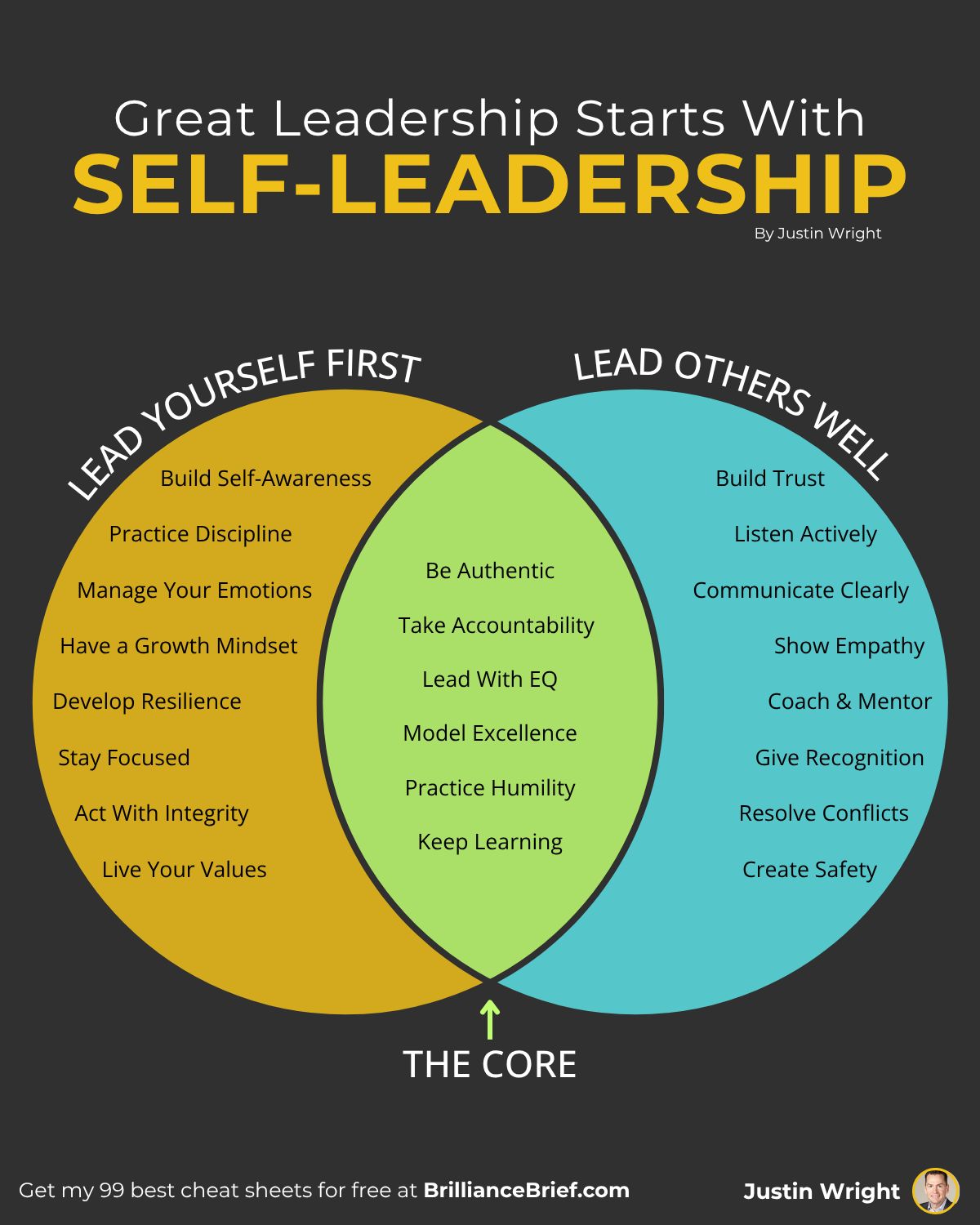
In a recent LinkedIn post, Justin Wright explores a fundamental, yet often overlooked, aspect of effective leadership: the paramount importance of self-leadership. Wright argues that the most impactful leadership lessons are not found in academic theories but in the practical, internal work of managing oneself.
Wright recounts a pivotal moment early in his career, stemming from a performance review where his boss stated, “You can’t lead others if you can’t lead yourself.” This feedback, he explains, cut through the theoretical knowledge he had acquired, including strategic planning, change management, and organizational behavior.
“I had all the theories: Strategic planning ✓ Change management ✓ Organizational behavior ✓ But I couldn’t manage my own: Emotions during pressure Discipline with priorities Ego when challenged”
The Internal Foundation of External Influence
Wright emphasizes that true leadership development is less about mastering people management techniques and more about cultivating inner discipline and self-awareness. He posits that leaders often attempt to inspire and guide their teams while struggling with their own internal challenges.
As Justin Wright notes, the journey of leadership begins internally. “It starts with you,” he asserts, highlighting that foundational leadership qualities are built from within before they can be effectively extended to others. This internal work, according to Wright, is the bedrock upon which external influence is built.
Building Trust Through Self-Mastery
The post details a progression of self-development that mirrors the development of trust and connection with a team. Wright argues that before a leader can foster trust, they must cultivate self-awareness. Similarly, the practice of humility is a prerequisite for offering genuine recognition, and the ability to listen is essential before one can demonstrate empathy.
“Before you can build trust with others, you need self-awareness. Before you can give recognition, you need to practice humility. Before you can show empathy, you need to learn to listen.”
In Wright’s view, the leader’s internal state directly impacts their team’s environment and motivation. He explains that a leader’s self-discipline serves as inspiration for their team, their integrity sets the standard, and their resilience provides a sense of safety.
The Leader’s Internal State as a Team’s Compass
Wright suggests that the most valuable investment a leader can make is in their own personal growth. “The best investment you can make as a leader? Work on yourself first,” he advises, adding that this is an ongoing commitment, “(I still do every day.)”
This principle, he concludes, is rooted in the idea that leaders cannot guide their teams to places they themselves have not journeyed. The personal experiences and growth of the leader become the roadmap for the team’s collective progress.
“Because you can’t take your team somewhere you haven’t been yourself.”
Wright encourages his network to share the post, aiming to inspire other leaders to focus on their internal development as a cornerstone of their leadership practice.
📝 About This Content
This article is based on insights shared by Justin Wright on LinkedIn.
📅 Originally posted on April 9, 2026 | View original post on LinkedIn →