
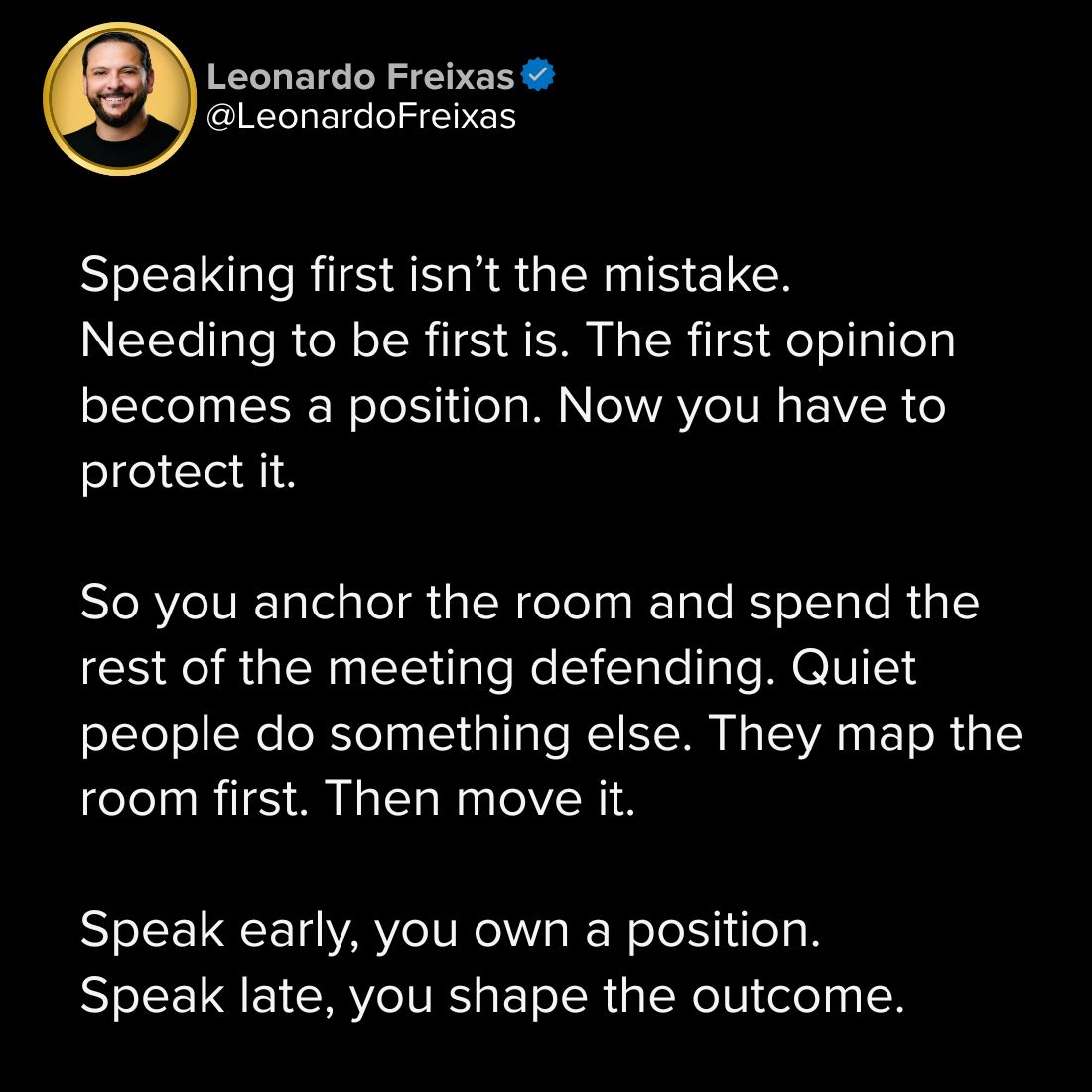
In a recent LinkedIn post, Leonardo Freixas explores the subtle yet significant difference between speaking first and needing to be first in professional discussions. Freixas, a proponent of strategic communication, highlights how the timing of one’s contribution can dramatically alter their influence and effectiveness in meetings.
Freixas begins by challenging a common assumption about meeting dynamics, suggesting that the act of speaking first is not inherently problematic. The real issue, he posits, lies in the compulsion to hold the initial viewpoint. This, according to Freixas, can lead to a defensive posture rather than a constructive one.
“Speaking first isn’t the mistake. Needing to be first is.
The first opinion becomes a position. Now you have to protect it.”
As Leonardo Freixas points out, this need to defend an early-stated position can consume valuable meeting time and energy, detracting from the core objective of moving discussions forward. This contrasts with a more effective approach that Freixas observes in those who truly drive decisions.
The Power of Strategic Silence
Freixas argues that effective decision-makers employ a strategy of waiting, not out of politeness or indecision, but to gain a clearer understanding of the evolving landscape of the discussion. This deliberate pause allows them to assess the full context and identify opportunities for influence.
According to Leonardo Freixas, the choice between speaking early and speaking late has direct consequences for one’s role in shaping outcomes. He elaborates on this distinction:
“Speak early, you own a position. Speak late, you shape the outcome.”
This core insight suggests that by allowing others to speak first, individuals can gather information, understand different perspectives, and then strategically interject to guide the conversation towards a desired resolution. Freixas frames this as a matter of timing rather than simply reaching others.
Timing Over Reach
In his post, Leonardo Freixas contrasts the common pursuit of ‘reach’ with the less common, but more impactful, cultivation of ‘timing.’ While many may focus on being heard widely or quickly, Freixas advocates for the more nuanced skill of knowing *when* to be heard.
He emphasizes that this strategic approach to communication is about building influence through thoughtful participation. As Freixas notes:
“Most people chase reach. Few build timing.”
This observation underscores a critical aspect of leadership and influence: the ability to discern the opportune moment for intervention. Freixas suggests that mastering this ‘timing’ is key to not just participating in discussions, but actively shaping their direction and ultimate success.
Leonardo Freixas offers further insights on this topic through his weekly idea posts, encouraging professionals to consider the strategic implications of their communication habits.
📝 About This Content
This article is based on insights shared by Leonardo Freixas on LinkedIn.
📅 Originally posted on April 8, 2026 | View original post on LinkedIn →