
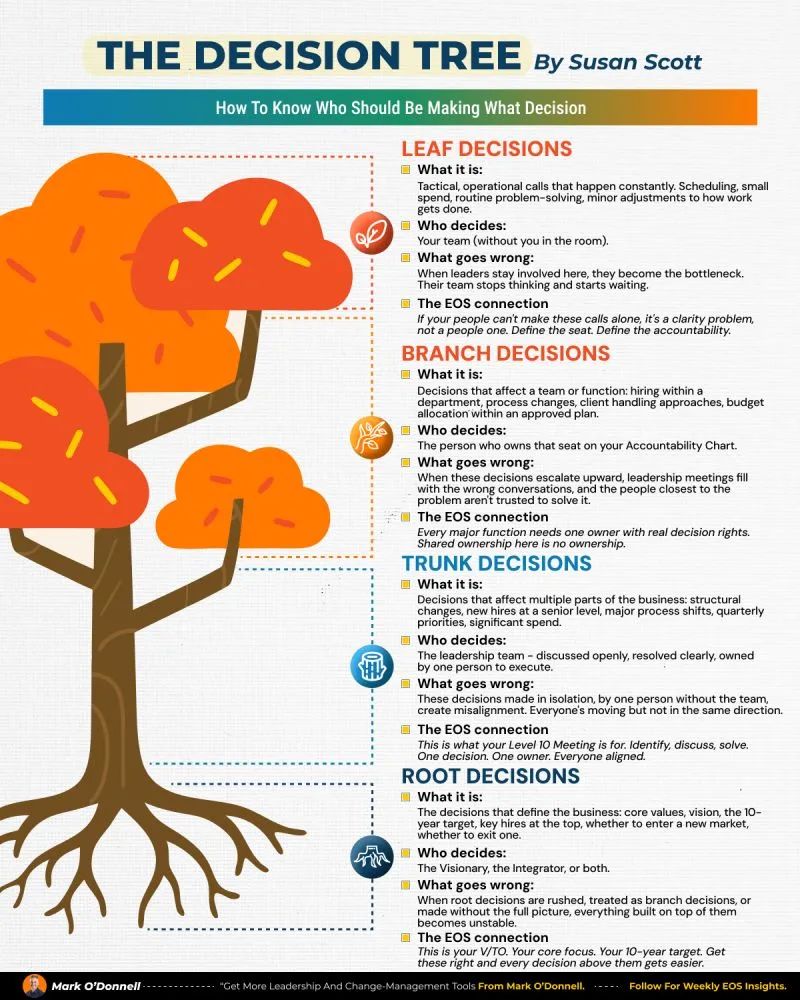
In a recent LinkedIn post, Alvin Huang explores a common leadership pitfall: the paralysis of capable teams due to a lack of clarity around decision-making ownership. Huang argues that founders and leaders often inadvertently become bottlenecks by failing to delegate effectively, not because their teams lack talent, but because the decision-making framework is unclear.
Huang highlights a critical issue many leaders face: “A team full of capable people can still be completely paralyzed. All because there’s no clarity on who owns what.” He elaborates on the common scenario where meetings result in apparent agreement but no concrete decisions, leading the founder to make every call and subsequently wonder why delegation is impossible.
The Bottleneck of Unclear Ownership
Huang emphasizes that this lack of clarity stunts team growth and leader effectiveness. He draws upon Susan Scott’s concept from “Fierce Conversations,” suggesting that decisions exist at different levels and that teams often falter when the lines of responsibility are not clearly defined. “And most teams are stuck because nobody’s ever drawn the line between what’s theirs to own and what needs to go up the chain,” Huang states.
Understanding the Decision Tree Framework
To address this, Alvin Huang introduces a “Decision Tree” framework, categorizing decisions into four types:
Leaf Decisions
These are the day-to-day, tactical choices. According to Huang, these should be made by anyone on the team. The breakdown occurs when leaders remain involved in these minor decisions, preventing team members from taking ownership.
Branch Decisions
Branch decisions impact a specific team or function. Huang asserts that the person owning that particular function should be the one deciding. He cautions that escalating these to higher levels “fill up with the wrong conversations” at the leadership level.
Trunk Decisions
These decisions affect multiple parts of the business. Huang specifies that these should be made collaboratively by the leadership team. A common failure point, he notes, is when “one person makes these alone and everyone else finds out after.”
Root Decisions
Representing foundational elements like core values, vision, and long-term direction, root decisions require careful consideration by senior leaders. Huang warns against treating these fundamental calls as if they were less significant, stating, “when root decisions get treated like branch decisions.”
The Founder’s Dilemma: Leading vs. Running
Huang directly addresses founders and leaders, pointing out the danger of getting bogged down in lower-level decisions. “If you’re spending your day stuck in leaf and branch decisions, you’re not leading the business. You’re running it,” he argues. He concludes this thought by stating, “And that’s exactly how you become the ceiling.” This powerful analogy suggests that by not delegating appropriately, leaders limit their team’s and the company’s potential growth.
Alvin Huang’s insights, presented through the lens of a decision tree, offer a practical framework for leaders to identify where decisions should reside, thereby empowering their teams and enabling more effective leadership. His post serves as a valuable guide for those looking to improve delegation and unlock the full potential of their workforce.
📝 About This Content
This article is based on insights shared by Alvin Huang on LinkedIn.
📅 Originally posted on April 7, 2026 | View original post on LinkedIn →