
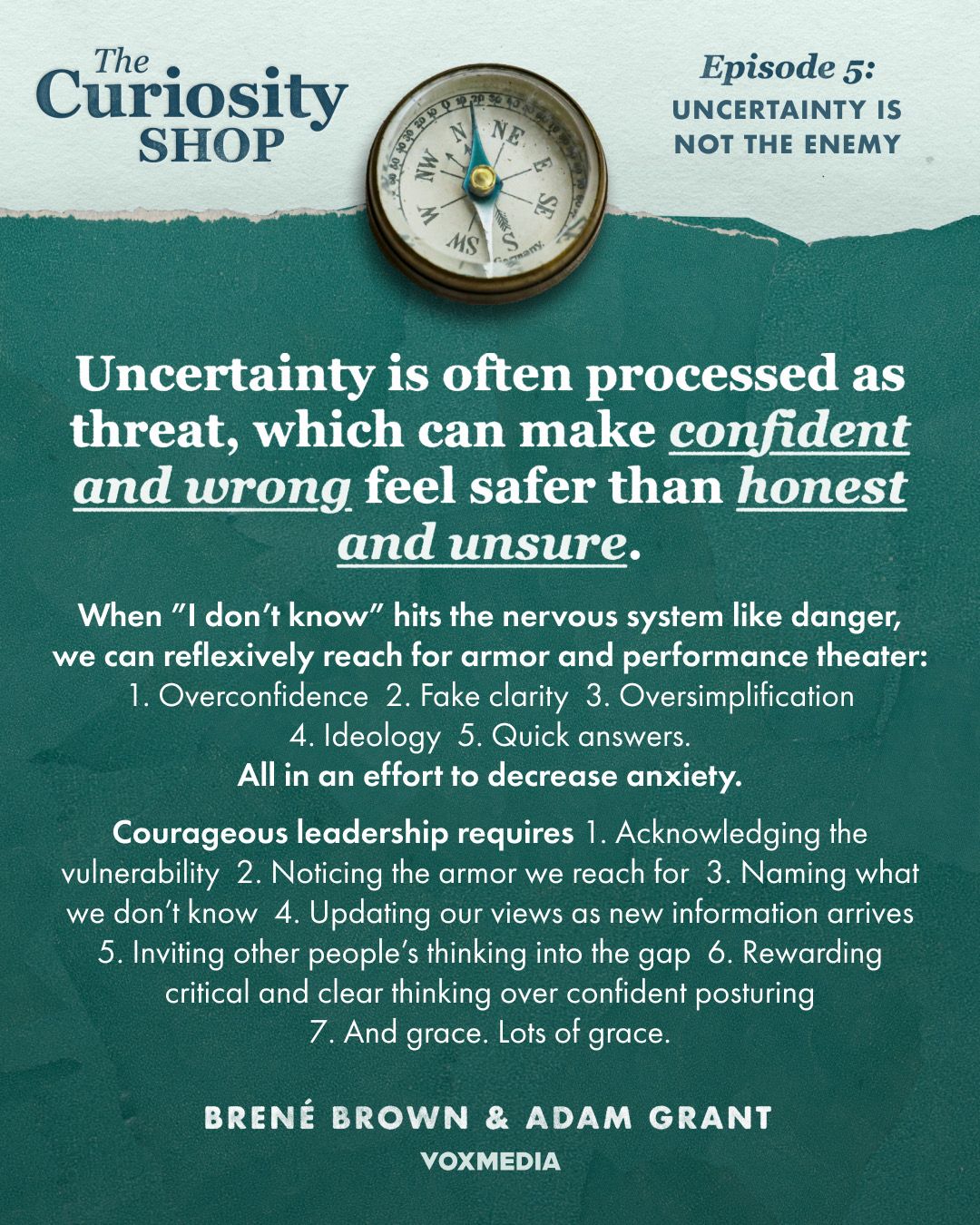
In a recent LinkedIn post, Brené Brown discusses the human inclination towards certainty and its significant impact on both professional conduct and societal engagement, particularly during turbulent times. Brown, a research professor and author known for her work on courage, vulnerability, shame, and empathy, argues that this deep-seated need for certainty can lead to detrimental outcomes in various aspects of life.
According to Brené Brown, this drive for certainty shapes our interactions in profound ways:
“We’re wired to grab onto certainty—especially when the world feels off the rails—and that shapes how we show up both at work and in the world.”
The Perils of ‘Fake Clarity’ in Professional Settings
Brown highlights how the pursuit of certainty in the workplace can manifest as a detrimental force. Instead of fostering genuine understanding and honest assessment, it can lead to superficial solutions and poor decision-making. As she notes, this often results in leaders who project an image of unwavering confidence rather than acknowledging the complexities and uncertainties inherent in their work.
Brené Brown argues that this phenomenon contributes significantly to workplace stress and exhaustion:
“Professionally, it can push us toward fake clarity, bad bets, and leaders who perform confidence instead of telling the truth, and it’s a huge driver of burnout.”
This pursuit of an artificial sense of certainty, Brown suggests, prevents authentic leadership and hinders the ability to navigate complex challenges effectively. It creates an environment where true issues are masked, leading to increased pressure and eventual burnout for individuals and teams.
Uncertainty and Its Impact on Civic Engagement
Beyond the professional sphere, Brené Brown extends her analysis to the realm of civic life, where the craving for certainty can make individuals more susceptible to manipulation. In an era of information overload and polarized discourse, simplistic narratives and misinformation can appear more appealing because they offer a sense of clarity, however illusory.
Brown points out the broader societal risks associated with this dynamic:
“As citizens, it makes us more vulnerable to simplistic narratives, misinformation, and empty promises from authoritarian leaders that actually raise the real risks we’re facing.”
In her view, embracing uncertainty is not a sign of weakness but a necessary skill for robust citizenship. The appeal of authoritarian figures often lies in their promise of simple answers to complex problems, a promise that can obscure or even exacerbate the real dangers individuals and societies face.
Cultivating Capacity for Uncertainty
Addressing the challenge of navigating uncertainty, Brown emphasizes that it requires deliberate effort and practice. It is not an innate skill but one that can be developed over time through conscious application.
According to Brené Brown, building this capacity involves several key elements:
- Disciplined skill-building
- Heightened self-awareness
- Consistent practice
- Generosity and grace
She concludes with a powerful reminder of the emotional component involved, stating, “A ton of grace. ♥️” This suggests that approaching uncertainty with self-compassion and understanding, both for oneself and others, is crucial for developing resilience. Brown also noted that further discussion on this topic is available in a new podcast episode, accessible on major listening platforms and YouTube.
📝 About This Content
This article is based on insights shared by Brené Brown on LinkedIn.
📅 Originally posted on April 17, 2026 | View original post on LinkedIn →