
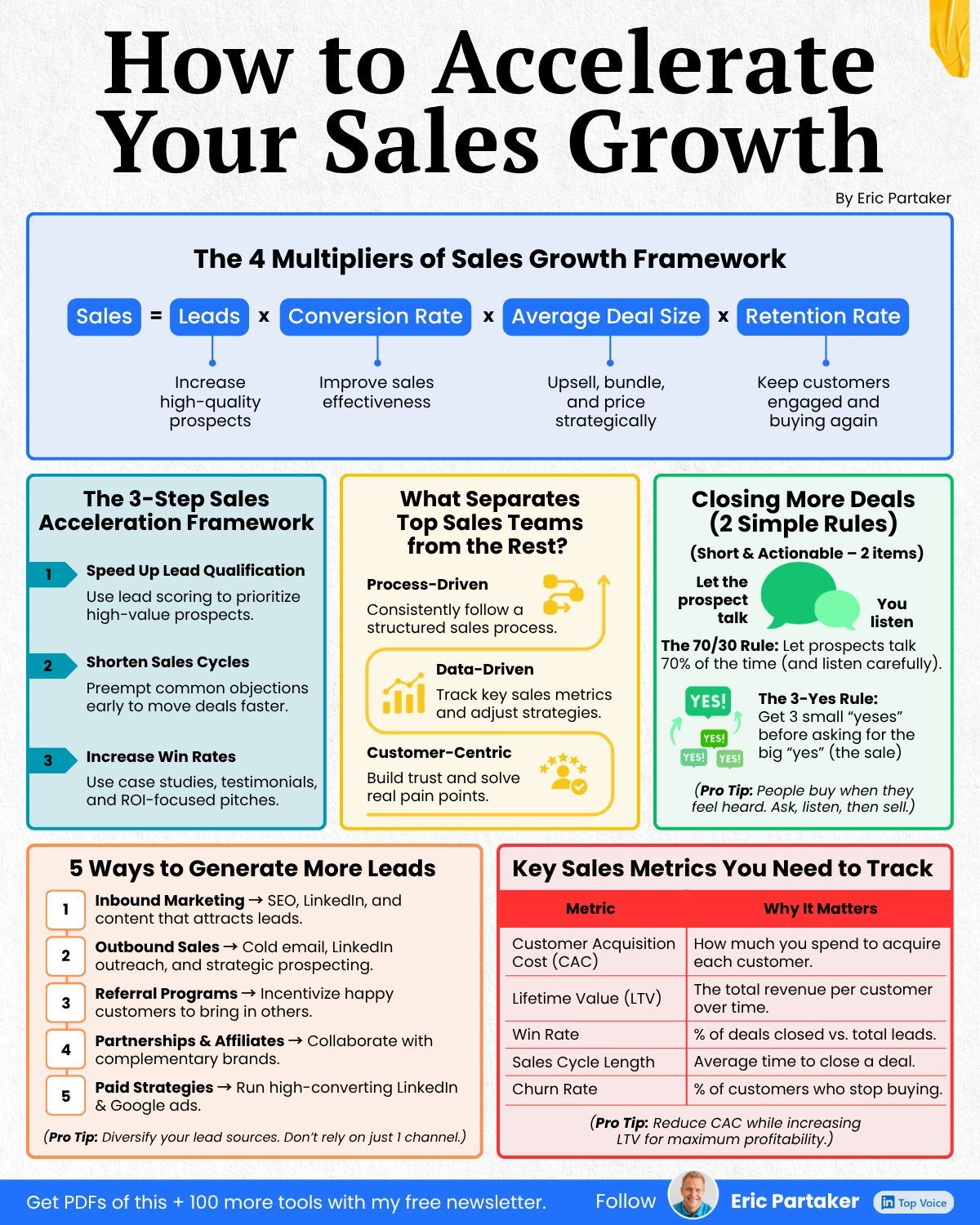
In a recent LinkedIn post, Eric Partaker offers a compelling perspective on revenue growth, arguing that the key often lies not in superior products or aggressive sales tactics, but in the underlying systems that support the sales process. Partaker, who coaches CEO clients, posits that a lack of revenue growth is frequently a symptom of systemic issues rather than product deficiencies.
“if your revenue isn’t growing, chance are… It’s not your product. It’s your system.”
He elaborates on this idea by highlighting distinctions in how top-performing sales teams operate compared to their less successful counterparts. According to Partaker, the fastest-growing companies prioritize robust systems over simply hiring better closers.
The Math of Revenue Growth
Partaker breaks down revenue growth into a fundamental equation, emphasizing a data-driven approach. He states that revenue is a function of multiple variables:
Revenue = Leads × Conversion Rate × Deal Size × Retention
As Eric Partaker points out, focusing on and improving any single variable can yield growth, but optimizing all four is what truly accelerates a business. “That’s not a hack. That’s math,” he asserts, underscoring the predictable outcomes of a systematic approach.
Shifting from Pitching to Understanding
A significant theme in Partaker’s post is the shift from traditional pitching to genuine customer engagement. He argues that effective sales professionals spend less time talking and more time listening.
“People don’t buy when they understand. They buy when they feel understood.”
This emphasis on empathy and understanding the buyer’s perspective is crucial, according to Partaker. He suggests that the best reps listen intently to identify needs and pain points, fostering a connection that moves beyond a mere product presentation.
Qualifying and Protecting Resources
Partaker also addresses the importance of efficient lead qualification. He criticizes the common practice of engaging in endless demos or pursuing low-fit leads, which he views as a drain on valuable resources. Instead, he advocates for rapid qualification, scoring prospects early, and focusing efforts on buyers who are genuinely ready to engage.
The Cost of Inaction
Furthermore, Partaker introduces the concept of selling the ‘cost of inaction’ rather than just the product itself. He explains that a powerful pitch focuses on what a buyer stands to lose by doing nothing, thereby highlighting the urgency and value of the proposed solution.
“A great pitch isn’t about what you do. It’s about what your buyer loses by doing nothing.”
This involves clearly illustrating the pain points a potential customer faces and then positioning the product or service as the obvious remedy.
The Power of Purposeful Follow-Up
The post concludes by emphasizing the critical role of persistent and valuable follow-up. Partaker notes that a significant majority of deals are closed after the fifth follow-up, yet many sales professionals abandon their efforts much earlier.
He advises sales teams to “Win the deal by staying in the game. And bring value every time you follow up.” This approach, he suggests, moves beyond mere persistence to strategic engagement that provides ongoing value.
Ultimately, Eric Partaker’s insights suggest that building scalable sales success requires moving away from reliance on individual ‘heroics’ and focusing instead on establishing clear systems, tracking the right key performance indicators (KPIs), and making it easy for customers to make a purchase. This systematic approach, he concludes, is the foundation for building a true ‘revenue machine’.
📝 About This Content
This article is based on insights shared by Eric Partaker on LinkedIn.
📅 Originally posted on April 17, 2026 | View original post on LinkedIn →