
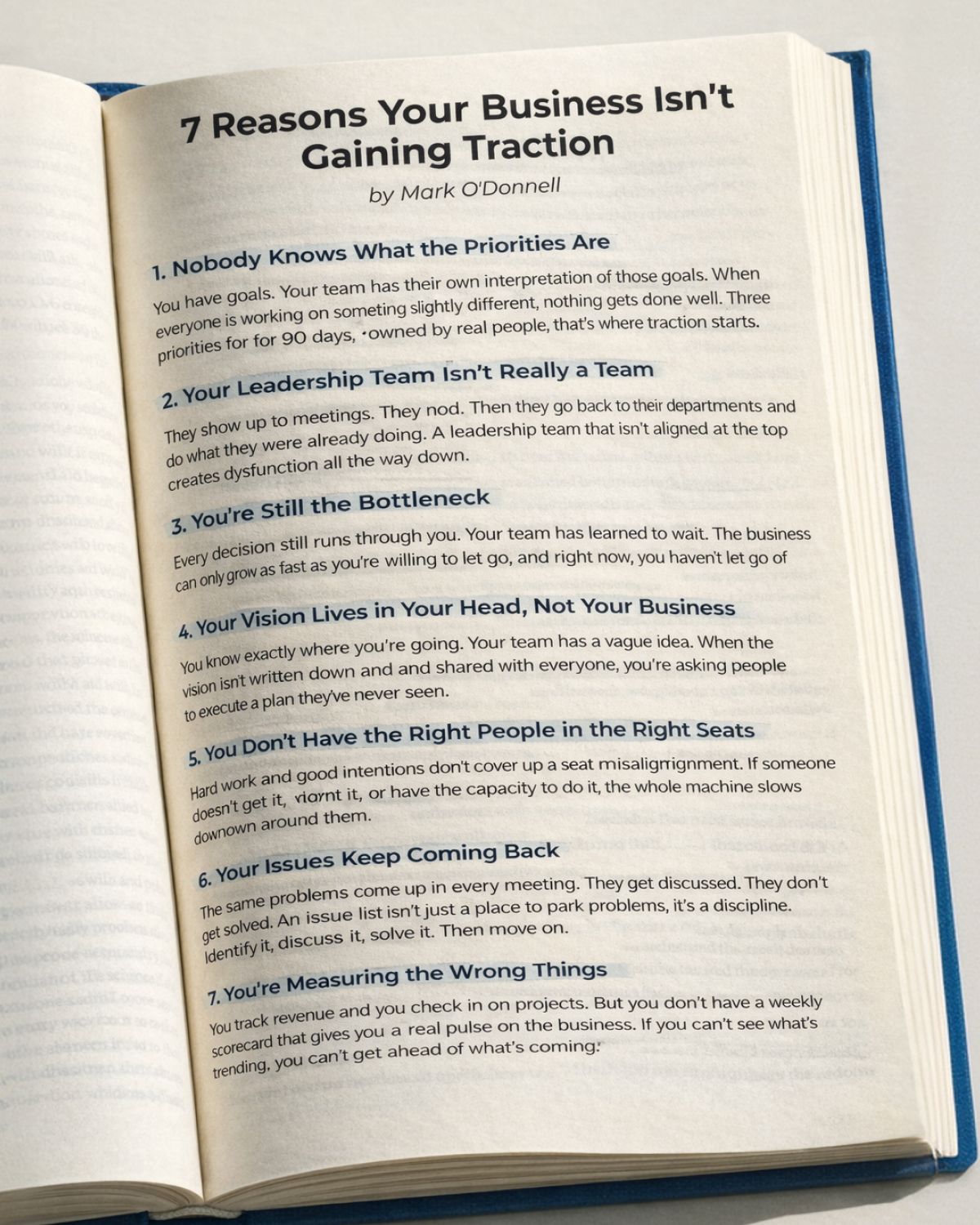
In a recent LinkedIn post, Mark O’Donnell discusses a common paradox: leadership teams that are fully committed yet find their businesses going nowhere. O’Donnell, a proponent of systems-based leadership, highlights a recurring pattern he observes in stalled companies, attributing their lack of progress not to external factors like market conditions or poor strategy, but to an internal disconnect.
According to O’Donnell, the core issue is often a gap between what the leadership team professes to value and their actual weekly actions. He frames this disconnect as the primary reason for a lack of traction, defining traction as the consistent execution of the right activities with the right people.
“Traction is just closing that gap. Doing the right things, with the right people, consistently enough that the business actually moves.”
The Seven Breakdown Points Identified by O’Donnell
Mark O’Donnell outlines seven critical areas where this vital gap typically emerges, preventing businesses from moving forward. He emphasizes that these are not rare occurrences but common pitfalls for many organizations.
1. Unclear Priorities
One of the most frequent issues O’Donnell identifies is a lack of clarity regarding organizational priorities. He argues that when the top few objectives for the quarter are not clearly assigned and owned, employees become busy with tasks that don’t contribute to overarching goals, leading to a feeling of urgency without meaningful completion.
“When the top three things that matter this quarter aren’t clearly owned by specific people, everything feels urgent and nothing gets finished.”
O’Donnell stresses that establishing clear ownership of a handful of 90-day priorities is the foundational step towards achieving traction.
2. Non-Functioning Leadership Teams
Another significant breakdown point, as highlighted by O’Donnell, is when a leadership team fails to operate cohesively. He observes that team members may agree in meetings but revert to departmental silos afterward. This lack of true alignment at the top, O’Donnell contends, inevitably breeds confusion throughout the rest of the organization.
3. The Founder Bottleneck
O’Donnell points to founders or top leaders who remain central to every significant decision as a major impediment to growth. He notes that if a leader’s team learns to wait for their input on most matters, their own problem-solving initiative diminishes. O’Donnell’s perspective is that business growth is capped by a leader’s willingness to delegate and step back.
4. Vision Confined to Leadership’s Heads
A business cannot execute a plan it hasn’t truly seen, according to O’Donnell. He argues that when a company’s vision exists only in the leader’s mind and is not explicitly documented, shared, and consistently referenced, the team is essentially operating without a clear roadmap.
5. Misaligned Talent
O’Donnell addresses the critical issue of having the wrong people in key roles. He states that hard work cannot compensate for a fundamental mismatch between an individual and their position. If someone doesn’t understand the role, desire it, or possess the capacity to perform it well, their struggles create drag on the entire team and business operations.
6. Recurring Unresolved Issues
The persistence of the same problems across meetings is another symptom of a stalled business, O’Donnell observes. He criticizes the approach of merely discussing issues without resolving them, stating that an issues list should not be a perpetual holding area for problems. Instead, issues need to be surfaced, worked through, solved, and then moved past.
“An issues list isn’t simply a parking lot for problems. Surface it, work through it, solve it, move on.”
7. Neglecting Key Metrics
Finally, O’Donnell emphasizes the importance of measuring what truly matters. He identifies revenue as a lagging indicator and argues that without a weekly scorecard tracking the critical numbers that signal trends, businesses are perpetually in a reactive mode. As he puts it, “You can’t get ahead of what you can’t see.”
Mark O’Donnell’s analysis provides a clear framework for leaders to identify and address the systemic issues that hinder progress, suggesting that with the right structures, these common roadblocks are indeed fixable.
📝 About This Content
This article is based on insights shared by Mark O'Donnell on LinkedIn.
📅 Originally posted on April 17, 2026 | View original post on LinkedIn →