
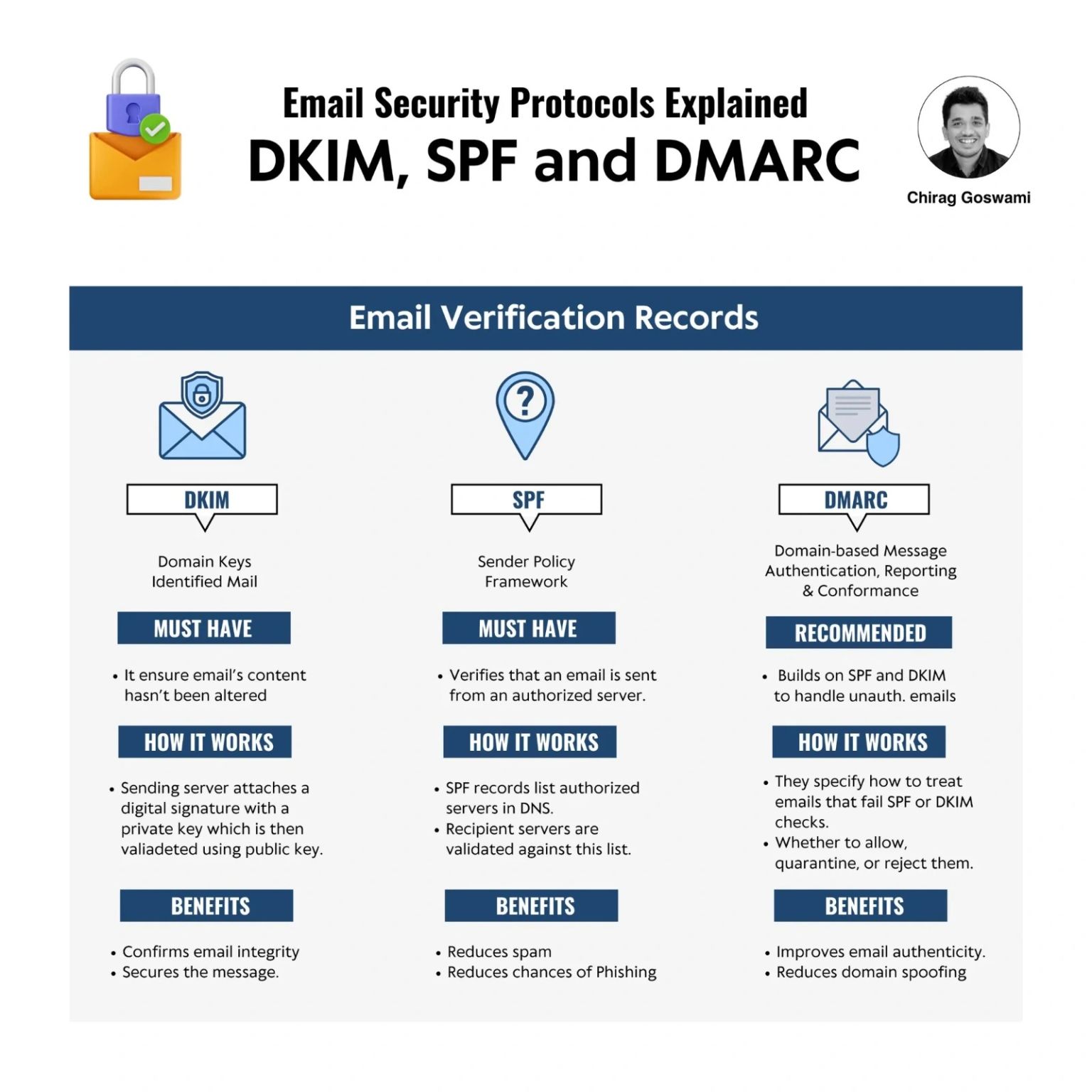
In a recent LinkedIn post, Chirag Goswami discusses a critical, yet often overlooked, aspect of digital security: the vulnerability of email domains. Goswami emphasizes that without proper configuration of specific DNS records, a company’s email domain can be easily exploited by malicious actors, leading to significant risks for both the organization and its customers.
Goswami highlights the essential role of three key records in fortifying email security:
“SPF Tells the world which servers can send email for your domain.”
Sender Policy Framework (SPF) is explained by Goswami as a mechanism that authorizes specific mail servers to send emails on behalf of a domain. This prevents unauthorized servers from using the domain for sending deceptive messages.
“DKIM Adds a digital signature so receivers know the email wasn’t altered.”
DomainKeys Identified Mail (DKIM), as outlined by Goswami, provides an additional layer of verification by adding a digital signature to outgoing emails. This signature allows recipient servers to confirm that the email has not been tampered with during transit, ensuring message integrity.
“DMARC Tells receiving servers what to do if SPF or DKIM fails (allow, quarantine, reject).”
Goswami further elaborates on Domain-based Message Authentication, Reporting, and Conformance (DMARC) as the policy layer that dictates how receiving mail servers should handle emails that fail SPF or DKIM checks. This includes options to allow, quarantine, or outright reject such emails, giving domain owners control over potential abuses.
The Perils of Neglecting Email Domain Security
Chirag Goswami warns of the serious consequences that arise when these records are not properly configured. According to Goswami, the absence of robust SPF, DKIM, and DMARC policies leaves organizations exposed to several significant threats:
- Spoofed Emails: Goswami points out that without these safeguards, it becomes alarmingly easy for attackers to send emails that appear to originate from a legitimate company domain.
- Increased Phishing Risk: The ability to spoof domains significantly elevates the risk of phishing attacks, where cybercriminals impersonate trusted entities to trick individuals into revealing sensitive information.
- Damaged Trust and Deliverability: As Chirag Goswami notes, a lack of proper email authentication can lead to poor email trust and deliverability rates. This means legitimate emails from the company might be marked as spam or rejected by recipient servers, harming communication and business operations.
- Brand Damage: Ultimately, Goswami argues, the inability to control email spoofing and phishing attempts can lead to substantial damage to a company’s reputation and brand image.
A Call to Action for Domain Owners
Goswami concludes his post with a direct question to his audience, prompting reflection on their current security posture: “If someone spoofed your company domain today, would you know?” This rhetorical question underscores the urgency for businesses to proactively assess and secure their email domains.
For organizations that may lack the expertise or resources to implement these crucial security measures, Goswami offers a solution, stating, “Need help securing your email domain properly? We can help assess and configure it.” This indicates a clear pathway for businesses seeking to bolster their defenses against email-based threats.
In summary, Chirag Goswami’s LinkedIn post serves as a vital reminder for businesses to prioritize the configuration of SPF, DKIM, and DMARC records. By implementing these foundational email security measures, organizations can protect themselves from spoofing, phishing, and brand damage, thereby maintaining trust and ensuring reliable communication channels.
📝 About This Content
This article is based on insights shared by Chirag Goswami on LinkedIn.
📅 Originally posted on April 21, 2026 | View original post on LinkedIn →