
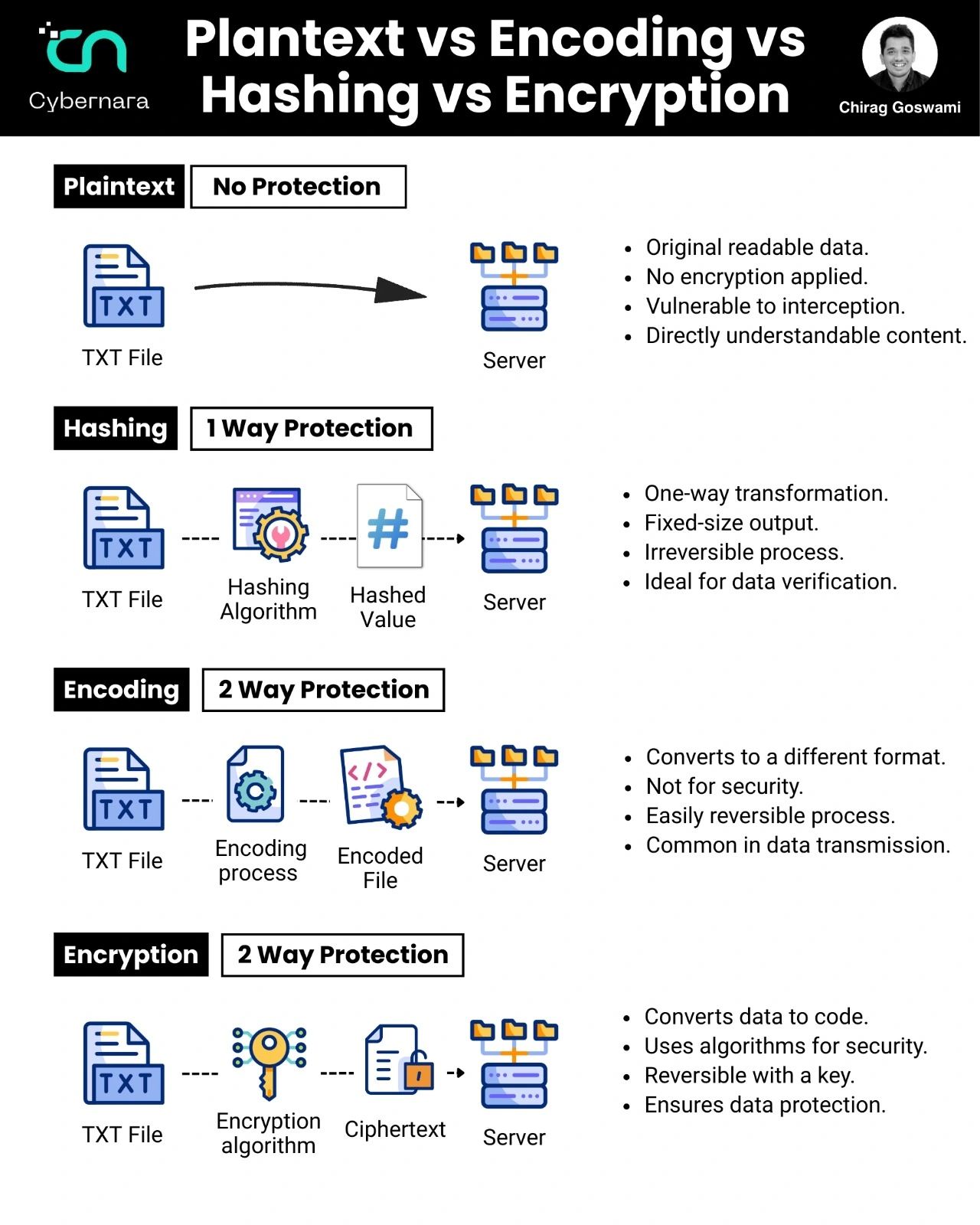
In a recent LinkedIn post, Chirag Goswami tackles a common point of confusion in the digital security landscape: the distinct meanings and applications of plaintext, encoding, encryption, and hashing. Goswami, founder of Cybernara, a company focused on improving security controls, uses his platform to educate professionals on these fundamental concepts, emphasizing the critical differences that impact real-world data protection.
Goswami begins by highlighting the pervasive mixing of these terms, stating:
“A lot of people mix these four terms. They are not the same.”
He then proceeds to offer a clear breakdown of each concept, starting with plaintext, which he defines as data in its readable, unprotected form.
Understanding the Nuances of Data Protection
Chirag Goswami’s post provides a concise explanation of each term, differentiating their purpose and security implications. He explains encoding as a method of changing data format for storage or transmission, explicitly stating that it is “Not meant for security.” This is a crucial distinction, as many may mistakenly believe encoded data offers protection.
Encryption, on the other hand, is presented as a genuine security mechanism. According to Goswami:
“Scrambles data using a key. Only someone with the correct key can decrypt and read it.”
He cites common applications like HTTPS and VPNs to illustrate its practical use in securing sensitive information. Encryption, Goswami emphasizes, involves a key-based process to render data unreadable to unauthorized parties.
The Role of Hashing in Secure Systems
The discussion then moves to hashing, a concept Goswami describes as a “one-way transformation.” He elaborates on its primary function:
“Used to verify data or store passwords securely. You compare hashes, not reverse them.”
This one-way nature is key to its security application, particularly in password management. Unlike encryption, which can be reversed with the correct key, hashing is designed to be irreversible. This makes it ideal for verifying data integrity and securely storing passwords, as even if the hash is compromised, the original password cannot be easily recovered.
Real-World Security Implications
Goswami underscores the practical importance of these distinctions with a direct warning to businesses and individuals alike. He points out a significant security vulnerability:
“If a company stores passwords in plaintext or simple encoding, that is a major security risk.”
He advocates for robust security practices, recommending “salted password hashing + strong encryption where needed” as the gold standard for modern data protection. This layered approach, combining the irreversibility of salted hashing for passwords with the confidentiality of encryption for other sensitive data, represents best practices in cybersecurity.
Chirag Goswami’s clarity on these fundamental security terms serves as a valuable reminder for anyone involved in managing or protecting digital information. By distinguishing between encoding, encryption, and hashing, he empowers his audience to better understand and implement effective cybersecurity measures.
📝 About This Content
This article is based on insights shared by Chirag Goswami on LinkedIn.
📅 Originally posted on April 22, 2026 | View original post on LinkedIn →