
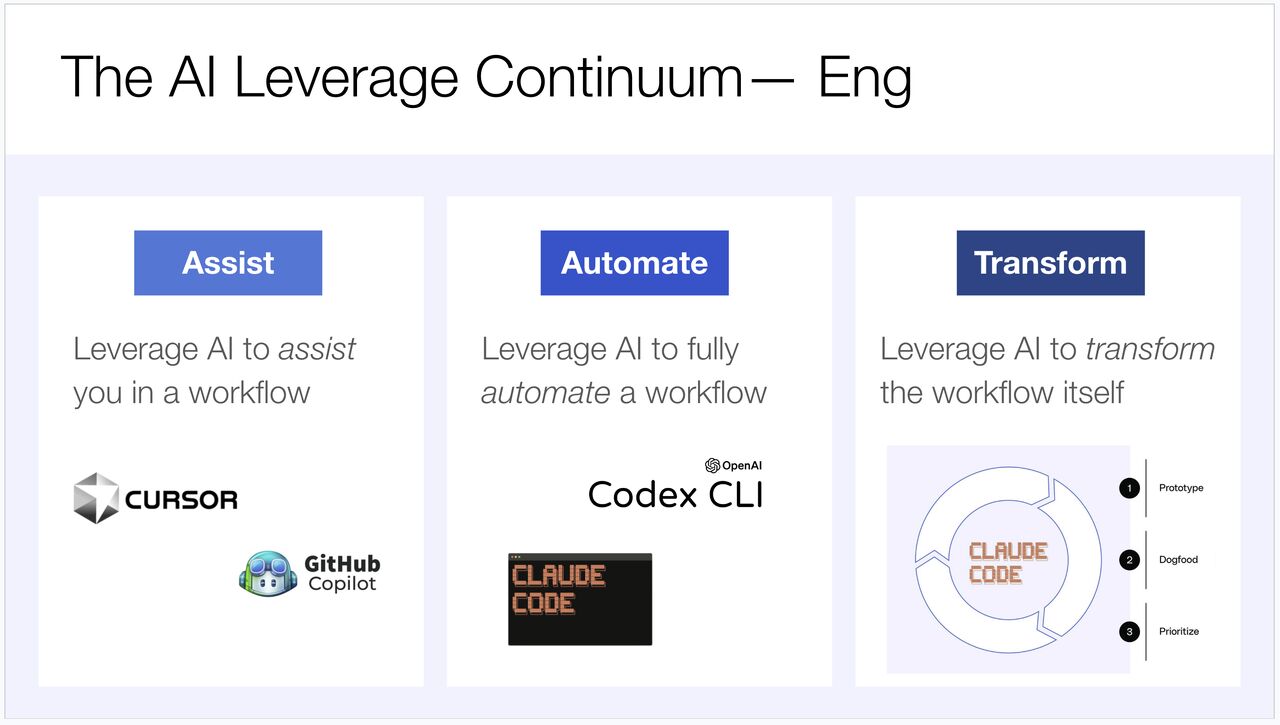
In a recent LinkedIn post, Sachin Rekhi explores a framework for understanding and advancing the utilization of artificial intelligence, moving beyond basic assistance to transformative applications. Rekhi, who teaches this concept in his course, outlines a three-level “AI leverage continuum” designed to help individuals and organizations maximize their AI adoption.
Rekhi begins by introducing the core idea: constantly evaluating how to elevate one’s use of AI. He notes that the majority of current AI usage falls into the initial stage.
“ASSIST – Leveraging AI to assist as input in accomplishing a larger task. This is how the majority of people use AI today. For example, opening up Claude and asking a question, doing a bit of research, or writing some text.”
This “Assist” level, as Rekhi describes it, involves using AI as a tool to supplement existing workflows, such as generating text or answering queries. While valuable, it represents the foundational step in AI integration.
From Automation to Transformation
The second level of Rekhi’s continuum is “Automate.” This stage involves using AI to streamline or entirely manage end-to-end workflows, reducing manual intervention. Rekhi provides an example of building a specific skill within an AI platform to handle a task from start to finish.
However, Rekhi emphasizes that the ultimate goal is to reach the “Transform” stage. This level signifies a fundamental reimagining of processes and tasks, leveraging the unique capabilities that AI unlocks. According to Rekhi, this requires a deeper understanding of what AI can uniquely enable, leading to entirely new ways of operating.
AI’s Impact on Engineering Workflows
To illustrate his framework, Sachin Rekhi details how the AI leverage continuum is manifesting in the field of engineering. He explains that the initial phase, “Assist,” was seen when engineers began using tools for code auto-completion. As Rekhi highlights:
“ASSIST – We started by leveraging tools like Cursor to auto-complete our code. We’d start writing a line of code, press tab, and watch AI complete the line or function for us.”
Following this, Rekhi points out the progression to automation. He states that engineering teams realized coding agents could do more than just assist. This led to the next phase:
“AUTOMATE – We then realized coding agents could do far more than that. And we stopped writing the code and instead leveraged coding agents to fully automate code generation.”
The most advanced application, according to Rekhi, is the “Transform” stage. He argues that AI-native engineering teams are now fundamentally altering their product development processes. As an example, Rekhi describes a shift from extensive roadmap prioritization to a more iterative approach:
“TRANSFORM – The most AI-native engineering teams are now fully redefining their product development process because of AI’s unique capabilities. For example, instead of spending all this time prioritizing a roadmap, they instead start by building lots of prototypes, releasing them internally, then simply prioritizing the prototypes that resonate for public release. This is only now possible because AI has made writing code cheap.”
Rekhi concludes his post by encouraging readers to apply this thinking to their own use of AI. He prompts them to consider how they can ascend the continuum from ‘Assist’ to ‘Automate’ and ultimately to ‘Transform’ in their respective tasks and workflows.
📝 About This Content
This article is based on insights shared by Sachin Rekhi on LinkedIn.
📅 Originally posted on April 22, 2026 | View original post on LinkedIn →