
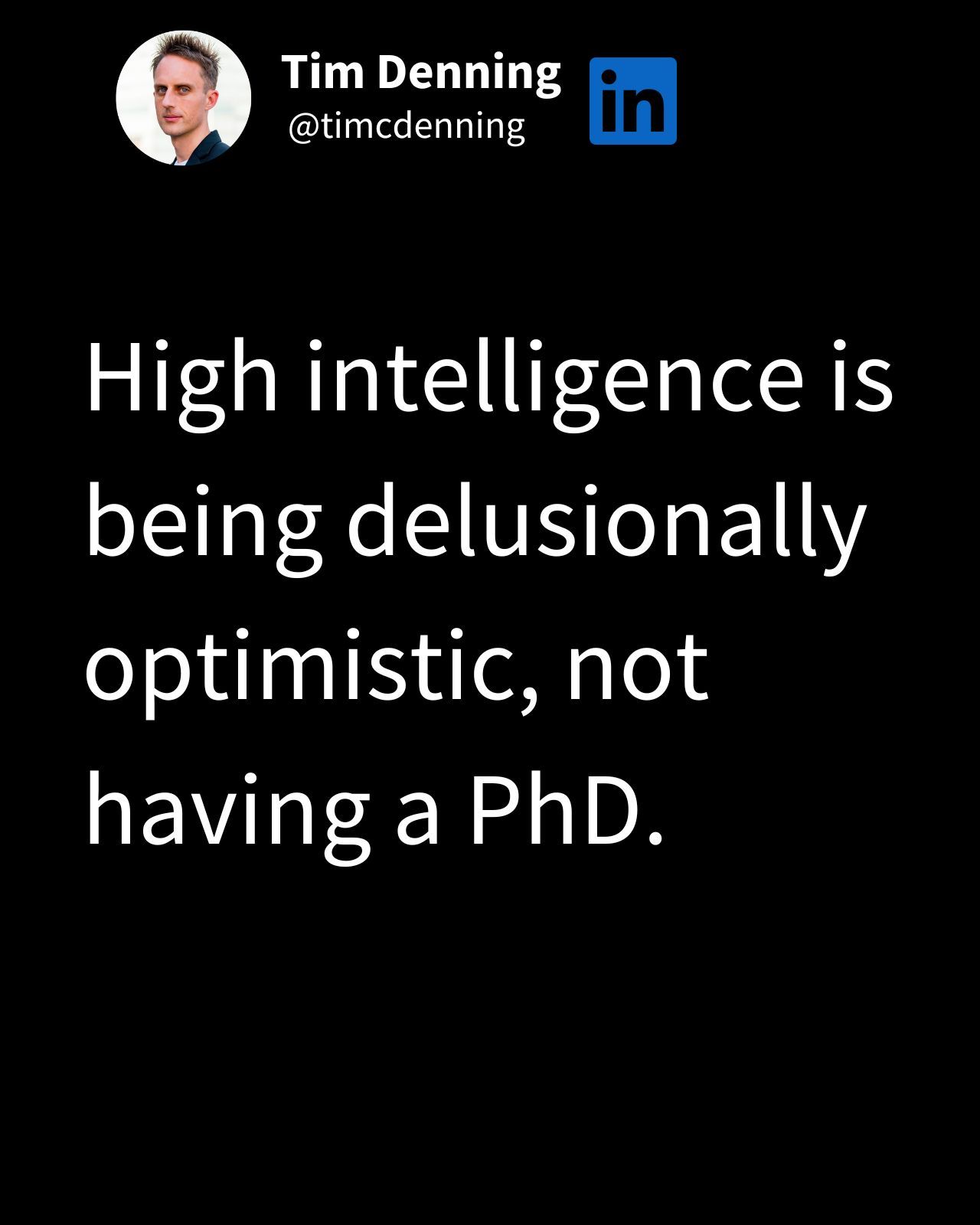
In a recent LinkedIn post, Tim Denning challenges conventional notions of intelligence and success, arguing that ‘delusional optimism’ and a focus on outcomes are more critical drivers of achievement than traditional credentials. Denning contrasts the paths of formally educated professionals with those who pursued practical experience and self-belief, suggesting the latter often achieve greater success.
The Limits of Formal Education
Denning begins by recounting the story of a high school dropout who built a $30 million tech company, a stark contrast to many who, despite advanced degrees, struggle with uncertainty and complain about their jobs. He reflects on his own time in banking, surrounded by individuals with prestigious qualifications like MBAs and CFAs, who, while knowledgeable in theory, faltered when faced with unexpected challenges.
According to Denning, the individuals who truly build businesses are not necessarily the most traditionally intelligent. Instead, they possess a unique ability to envision and pursue outcomes that do not yet exist. “They saw possibilities where everyone else saw problems. They kept going when the data said stop,” Denning writes, defining this trait as “delusional optimism.”
“A PhD tells you someone can study a subject deeply. It doesn’t tell you they can build something from nothing. It doesn’t tell you they can handle rejection and keep going. It doesn’t tell you they can bet on themselves when everyone around them thinks they’re crazy.”
Personal Experience and the Power of Necessity
Denning shares his personal journey, admitting to past insecurities about lacking a college degree. However, he found that facing adversity, such as being fired and needing to survive without corporate backing, forced him to develop the very qualities he now champions. This period required him to adopt “delusional optimism” simply to manage daily life and build his own business with no initial proof of concept.
He observes that those with extensive credentials can sometimes be less adaptable in uncertain situations, having been conditioned to follow established frameworks. “They’d been trained to follow frameworks and wait for instructions. When the framework broke they had nothing to fall back on,” Denning explains.
“I had to become delusionally optimistic just to pay rent. I had to believe I could build something when I had zero proof it would work. I had to ignore the voice in my head saying I wasn’t qualified.”
Focusing on Outcomes Over Credentials
The core of Denning’s argument is a call to shift focus from acquiring qualifications to achieving tangible results. He posits that the world rewards action and self-reliance over seeking external validation or permission.
“The world doesn’t reward people who wait for permission. It rewards people who act like they already have it.”
His conclusion is a direct challenge to readers: “Stop chasing credentials. Start chasing outcomes.” Denning encourages introspection by asking his audience to consider their own experiences with self-belief, posing the question: “What’s the most delusional bet you’ve ever made on yourself?” Through his post, Tim Denning advocates for a mindset shift, emphasizing that unconventional intelligence and unwavering self-belief can be the most powerful assets in achieving significant business success.
📝 About This Content
This article is based on insights shared by Tim Denning on LinkedIn.
📅 Originally posted on April 21, 2026 | View original post on LinkedIn →