
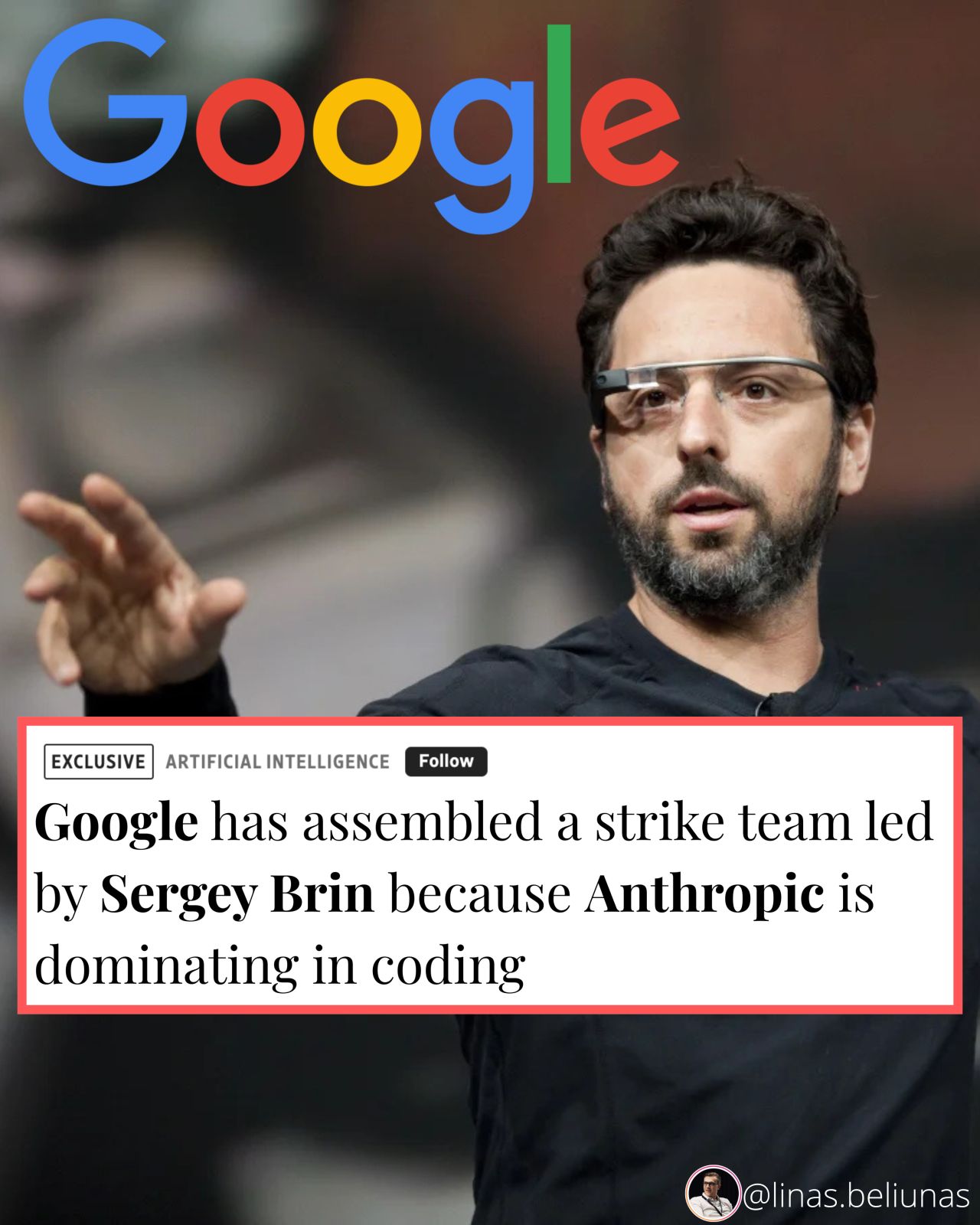
In a recent LinkedIn post, Linas Beliūnas highlights a significant shift in the artificial intelligence landscape, focusing on the emergent race to develop AI systems capable of improving themselves. Beliūnas draws attention to a reported internal assessment at Google that suggests Anthropic’s Claude AI agent is outperforming Google’s Gemini in complex software development tasks, prompting a strong reaction from Google itself.
Google’s Strategic Response to AI Advancements
Beliūnas points out that Google has formed a dedicated strike team, reportedly led by co-founder Sergey Brin, in response to Claude’s perceived superiority in real-world coding and system development. This move underscores the competitive pressure within the AI industry, moving beyond theoretical benchmarks to practical output.
“Claude’s AI agents outperform Gemini on messy, multi-step engineering tasks. Not benchmarks. Real code. Real systems. Real output.”
The author emphasizes the stark difference in AI adoption rates within these tech giants, noting that Google currently has approximately 50% of its code written by AI, while Anthropic is reportedly at 100%. This disparity, Beliūnas suggests, is a key driver behind Google’s accelerated efforts.
The True Frontier: AI Improving AI
A central theme in Beliūnas’s analysis is the redefined goal for AI development. He argues that the ultimate objective is shifting from AI as a mere assistant (like copilots) to AI systems that can autonomously write, test, debug, and enhance their own capabilities. This concept of an AI improving AI is presented as the critical differentiator for future success.
The Winner in the AI Arms Race
Linas Beliūnas posits that the future AI champion will not necessarily be the one with the most sophisticated underlying language model, but rather the first organization to successfully create an AI that can iteratively improve itself. He states:
“The winner won’t be the best LLM. It’ll be the first lab where AI improves AI.”
Beliūnas further elaborates on the competitive dynamics, noting that despite Google’s substantial advantages in resources—including compute power, data, and talent—the company has felt compelled to react to Anthropic’s progress. This reaction, in his view, speaks volumes about the disruptive potential of Anthropic’s approach.
“Google has more compute. More data. More talent. And yet it still had to react to Anthropic. That tells you everything.”
The post concludes with a strong statement about the impact of this AI evolution, suggesting that the paradigm of AI agents taking on core development roles is poised to reshape the industry. Beliūnas frames this as a significant moment, indicating that the race for self-improving AI is on, and the implications are profound for the future of software development and beyond.
📝 About This Content
This article is based on insights shared by Linas Beliūnas on LinkedIn.
📅 Originally posted on April 21, 2026 | View original post on LinkedIn →