
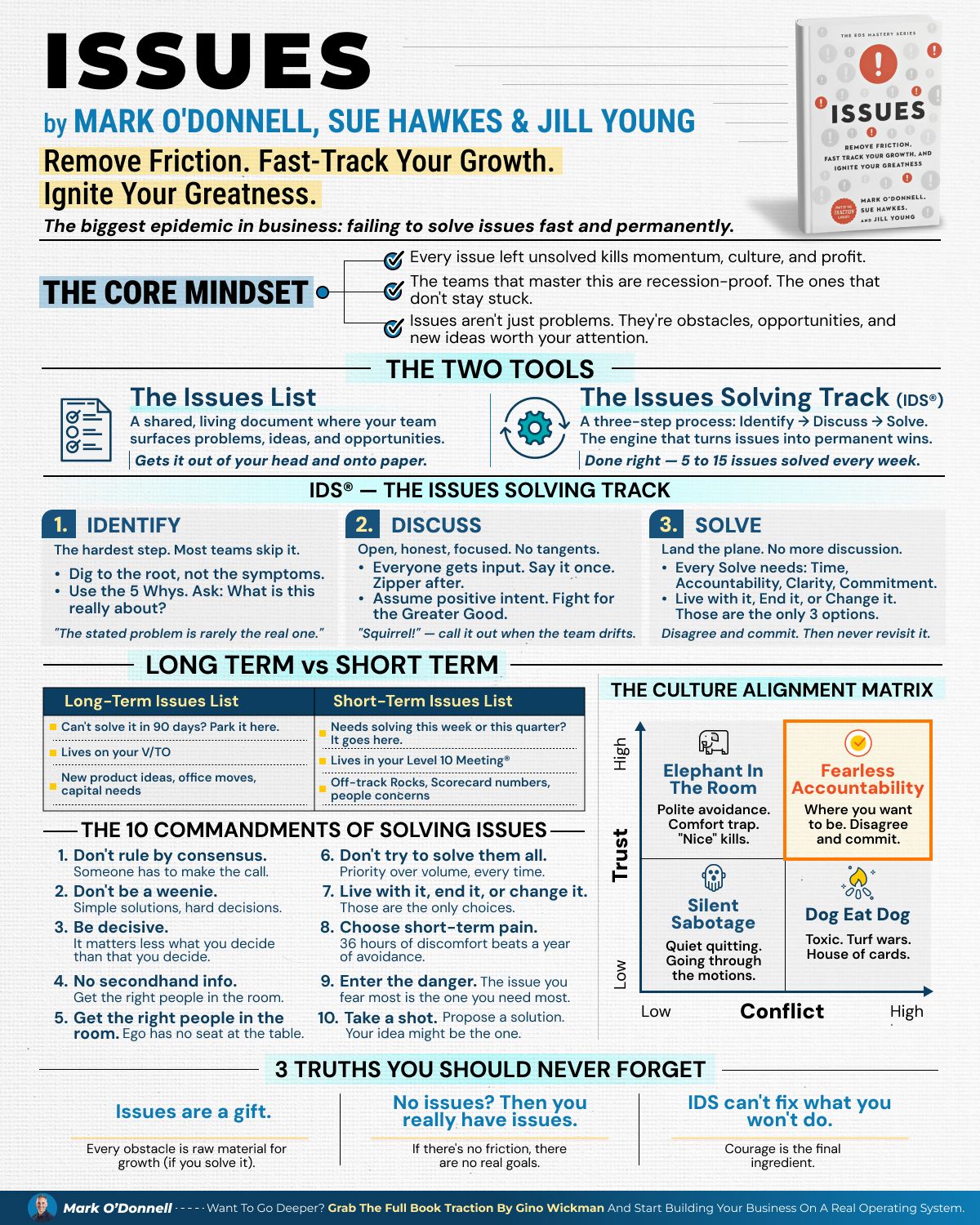
In a recent LinkedIn post, Mark O’Donnell explores the persistent challenge businesses face with unresolved issues and introduces a structured approach to tackle them effectively. O’Donnell highlights that while raising a problem might be quick, achieving a permanent solution requires a robust process that many teams lack.
O’Donnell states:
“There’s an issue on your list right now that’s been there longer than it should have. You know the one. Everyone on the team knows it exists. It comes up, creates friction, and then gets parked until next quarter. Nobody’s ignoring it on purpose. There’s just no clean way to close it.”
The IDS Framework for Permanent Solutions
O’Donnell introduces his book, “Issues,” co-authored with Sue Hawkes and Jill Young, which presents a core tool called IDS: Identify, Discuss, Solve. This framework is designed to move teams beyond merely acknowledging problems to truly resolving them.
Identify: Digging for the Root Cause
According to O’Donnell, many teams fall into the trap of addressing only the symptoms of a problem, rather than its underlying cause. He emphasizes the importance of persistent inquiry to uncover the true root of an issue.
“Most teams fix the symptom and move on. The stated issue is rarely the real one. Keep digging until you hit the root cause. That’s what you’re solving.”
Discuss: Focused and Efficient Communication
The ‘Discuss’ phase, as outlined by O’Donnell, is about ensuring everyone has a voice but that conversations remain focused and productive. He stresses the need to avoid tangents and circular discussions, keeping the team centered on the actual issue until it’s ready for resolution.
Solve: Decisive Action and Ownership
O’Donnell’s ‘Solve’ stage is characterized by clear decision-making, assignment of a single owner, and a firm deadline. He advocates for a ‘disagree and commit’ approach, where a decision is made and then respected, preventing the same issue from resurfacing.
The 10 Commandments of Solving Issues
Beyond the IDS framework, O’Donnell shares key principles from his book, referred to as the “10 Commandments of Solving Issues.” These rules are designed to differentiate high-performing teams that consistently close issues from those that merely discuss them.
O’Donnell highlights several of these commandments, noting:
“It matters less what you decide than that you decide.”
He further elaborates on the mindset required for effective issue resolution, pointing out that avoiding a problem often means it’s the one that needs the most attention. O’Donnell argues that embracing short-term discomfort is preferable to the recurring pain of an unresolved issue.
“Short-term discomfort beats the same problem showing up again next quarter.”
Another critical tenet O’Donnell shares is the need for decisive leadership, stating:
“Don’t rule by consensus. Someone has to make the call.”
Ultimately, O’Donnell’s message is that while issues are a natural part of teamwork, the ability to close them consistently and properly is a hallmark of successful teams. His framework and guiding principles aim to equip leaders with the tools to transform how their teams handle challenges, fostering a more efficient and productive environment.
📝 About This Content
This article is based on insights shared by Mark O'Donnell on LinkedIn.
📅 Originally posted on April 26, 2026 | View original post on LinkedIn →