
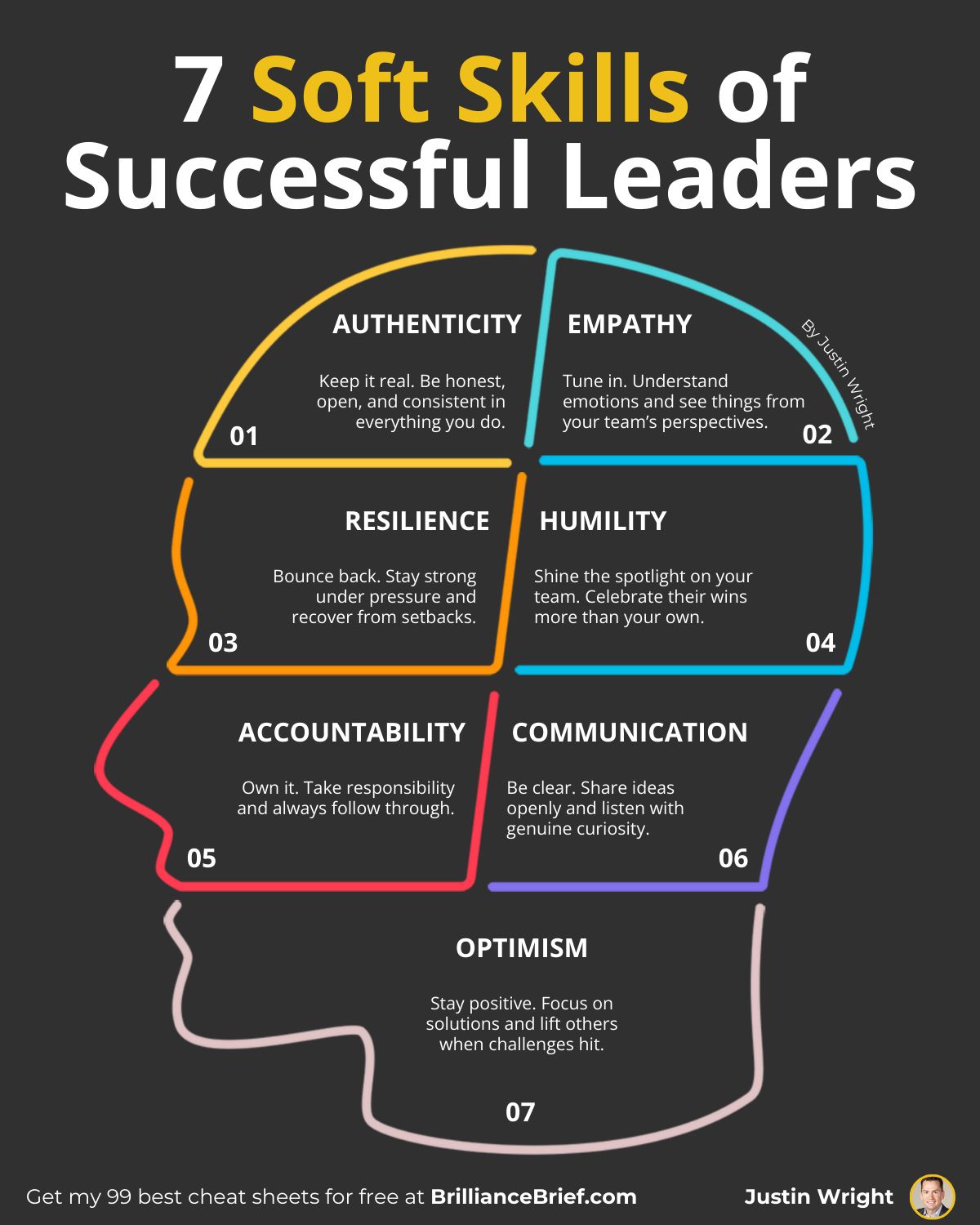
In a recent LinkedIn post, Justin Wright discusses the critical skills that differentiate effective leaders, moving beyond traditional notions of intelligence to highlight the power of what he terms ‘success skills.’ Wright argues that while a high IQ might secure a position, it is a distinct set of interpersonal and character-driven abilities that truly determine a leader’s capacity for excellence.
Wright begins by asserting the foundational importance of these skills, stating:
“Your IQ may get you the role, but these ‘soft’ skills decide if you’ll excel in it.”
The post then breaks down these essential leadership attributes into seven core components, each elaborated with a brief explanation of its significance.
The Seven Pillars of Effective Leadership
Justin Wright identifies authenticity as the first crucial skill. He advocates for leaders to shed pretense and be genuine, emphasizing that trust is built on realness rather than an unattainable ideal of perfection. As Wright puts it:
“People follow leaders they trust, not perfect robots.”
Empathy follows, with Wright underscoring the importance of recognizing team members as individuals first. He advises leaders to practice active listening, focusing on understanding rather than merely preparing their next statement.
Navigating Challenges with Resilience and Humility
Resilience is highlighted as the capacity not to avoid difficulties, but to guide a team through them. Wright frames leadership as a journey through adversity, not an escape from it. Complementing this is humility, which Wright defines not as self-deprecation, but as recognizing that true leadership success is measured by the team’s collective growth and achievements, rather than the leader’s individual accomplishments.
“Great leaders know success isn’t about them. It’s measured by the growth and achievements of their team.”
Accountability, Communication, and Optimism
Wright also emphasizes accountability, stressing the importance of taking ownership when things falter and giving credit where it is due when successes occur. Clear communication is presented as paramount, with the adage “Clear beats clever every time” underscoring the need for straightforward messaging. He reiterates the value of listening by advising leaders to “Listen twice as much as you speak.” Finally, optimism is presented not as a facade of positivity, but as a fundamental belief in the potential for challenges to be transformed into opportunities.
Redefining ‘Soft Skills’
A central theme in Wright’s analysis is the reclassification of these vital attributes. He concludes by challenging the traditional designation of these skills as ‘soft,’ proposing instead that they are the definitive ‘success skills’ of modern leadership. This reframing suggests a shift in perspective for aspiring and established leaders alike, urging a focus on developing these crucial interpersonal and character strengths.
Wright invites further discussion, asking readers to consider which of these skills they find most critical for leadership success.
📝 About This Content
This article is based on insights shared by Justin Wright on LinkedIn.
📅 Originally posted on April 30, 2026 | View original post on LinkedIn →