
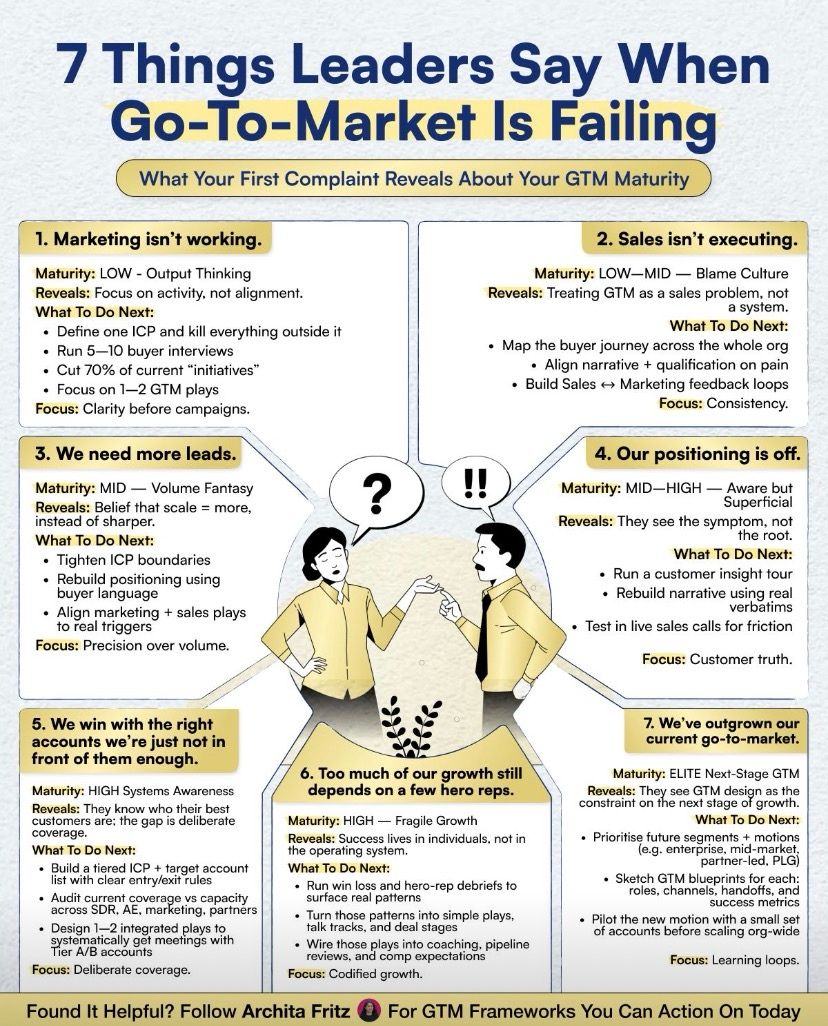
In a recent LinkedIn post, Archita Fritz examines a common paradox within private equity-backed companies: the hiring of “change agents” who are subsequently set up for failure by the very systems they are meant to transform.
Fritz, a seasoned observer of go-to-market (GTM) strategies, highlights a recurring scenario where new leadership – CEOs, CROs, CMOs, Heads of GTM, or Chiefs of Staff – are brought in with the expectation of driving significant change. However, upon arrival, these leaders often encounter a familiar refrain of issues.
“Marketing isn’t working.”
“Sales isn’t executing.”
“We need more leads.”
“We’ve outgrown our GTM.”
According to Fritz, the root cause of these persistent complaints often lies not in the skills of the new hires or the existing teams, but in deeper systemic and leadership issues.
The Misdiagnosis of GTM Failures
Archita Fritz argues that companies frequently misattribute GTM failures to individual performance rather than structural limitations. The post points out that the “change agent” becomes an easy scapegoat when underlying problems related to organizational alignment, growth-averse systems, and a lack of emotional capacity in existing leadership are not addressed.
The Role of Honesty and Emotional Capacity
Fritz proposes a compelling framework for understanding the true potential for growth within an organization, particularly in the context of private equity. This model emphasizes two critical, often overlooked, factors:
- The degree of honesty within the organization regarding its challenges and limitations.
- The emotional capacity of the existing leadership and team to absorb and implement change.
Fritz encapsulates this idea with a formula: the real multiple for growth is determined by multiplying these two factors. This suggests that if either honesty or emotional capacity is near zero, the potential for significant improvement also approaches zero.
“Your model won’t go further than your honesty or your team’s emotional bandwidth.”
As Archita Fritz notes, this means the perceived ceiling for growth is fundamentally limited by the organization’s willingness to be truthful about its state and its leaders’ ability to handle the ensuing transformation.
Blame vs. Systemic Change
The post critiques the tendency to blame individuals when GTM strategies falter. Fritz suggests that the pressure to show quick returns, often characteristic of private equity environments, can lead to a superficial approach to problem-solving.
“And then the ‘change agent’ becomes the easiest person to blame.”
Archita Fritz advocates for a more profound examination, urging leaders to confront uncomfortable truths about their operational systems and the psychological readiness of their teams. Without addressing these fundamental aspects, Fritz implies, any new hire, no matter how skilled, will struggle to make a meaningful impact.
Fritz concludes by posing a direct question to PE professionals and leaders of growth-focused companies, inviting them to reflect on which aspects of this framework resonate most and where they might disagree, particularly concerning whether issues are truly people-related or systemic.
📝 About This Content
This article is based on insights shared by Archita Fritz on LinkedIn.
📅 Originally posted on April 28, 2026 | View original post on LinkedIn →