
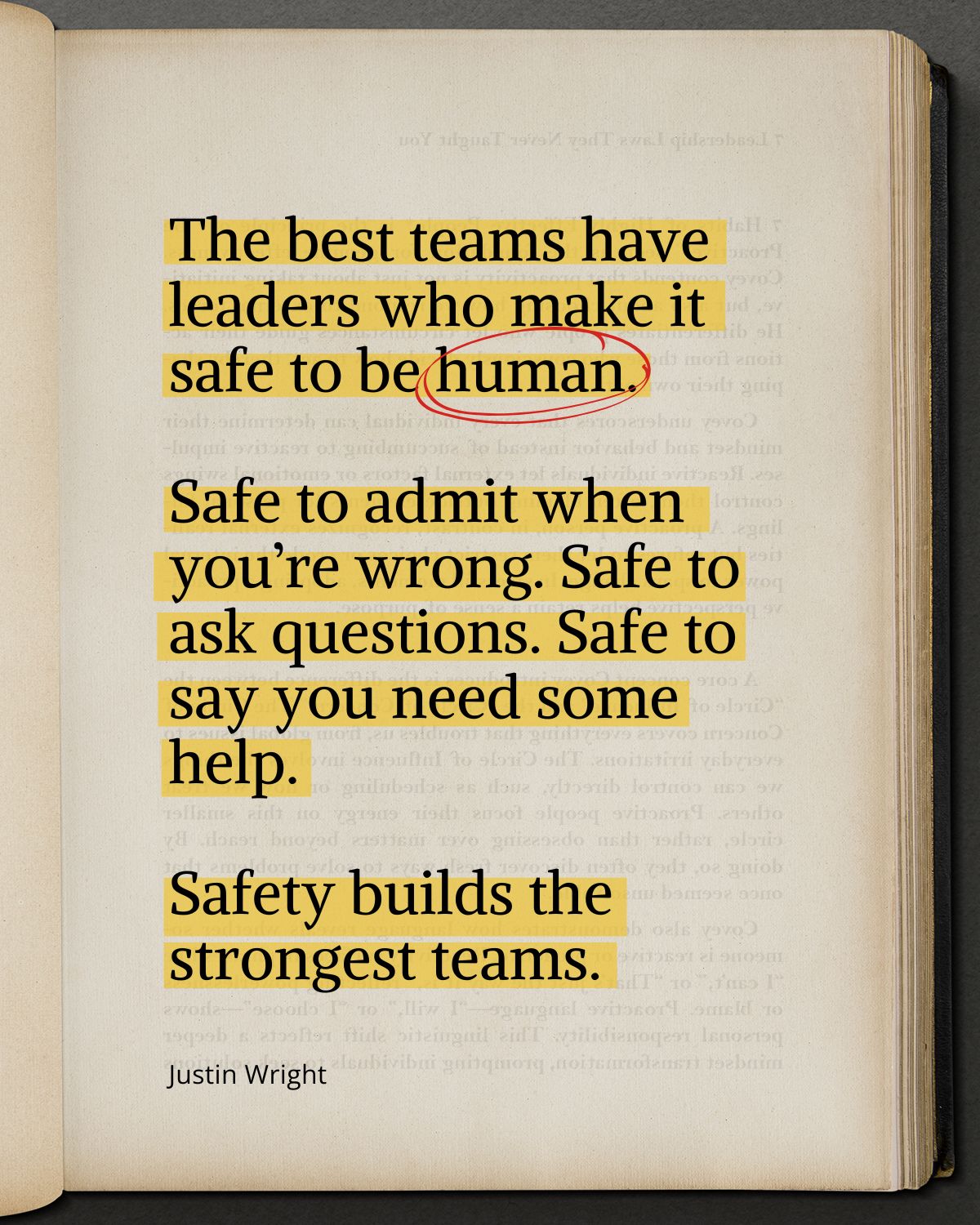
In a recent LinkedIn post, Justin Wright explores the critical role of psychological safety in building high-performing teams, challenging the conventional focus on talent and strategy alone. Wright, drawing from a personal anecdote and referencing Google’s extensive research, argues that creating an environment where team members feel secure is paramount to success.
Wright recounts a pivotal moment in his career: “I remember the day our star performer broke down in tears during a team meeting. She’d made a mistake that cost us a client, and everyone waited to see how I’d react.” This incident, he explains, underscored a fundamental leadership principle: true safety isn’t about avoiding difficult conversations, but about fostering a space where vulnerability is embraced and mistakes are treated as learning opportunities.
The Primacy of Psychological Safety
Citing Google’s “$80 million study on high-performing teams,” Wright highlights a surprising finding: psychological safety was a more significant predictor of team success than talent, resources, or strategy. As Justin Wright notes, “In the best teams, psychological safety mattered more than talent. More than resources or strategy.” This suggests a paradigm shift for leaders, moving the focus from individual prowess to the collective environment.
“Teams thrive when people feel safe to: ⇢ Speak up without fear ⇢ Fail without shame ⇢ Be themselves without pretense”
Five Pillars of Team Safety
To cultivate this essential environment, Wright outlines five actionable strategies for leaders:
1. Model Vulnerability
Wright emphasizes the importance of leaders leading by example. “Share your own mistakes before asking others to be open,” he advises. By demonstrating their own fallibility, leaders can create a precedent for honesty and openness within the team.
2. Respond to Failure with Curiosity
Instead of assigning blame, Wright advocates for a curious approach. “Ask ‘What can we learn?’ not ‘Who’s to blame?'” he urges. This reframes setbacks as valuable learning experiences, encouraging a growth mindset.
3. Protect Your People Publicly
According to Justin Wright, leaders must act as a shield for their team. “Take the heat when things go wrong. Share credit when they go right,” he states. This public support builds trust and reinforces the team’s sense of security.
4. Make Space for Emotions
Acknowledging the human element is crucial. Wright points out that leaders should “Acknowledge that everyone has bad days. Your team is human first, employees second.” This empathetic approach allows individuals to bring their whole selves to work.
5. Follow Through on Your Word
Trust is foundational, and Wright warns that “Trust dies when promises don’t.” Consistency in actions and commitments, no matter how small, is vital for maintaining credibility.
Leadership Redefined
Returning to his initial anecdote, Wright explains how he handled the situation by thanking the employee for her honesty and working through the problem collaboratively. This approach, he learned, demonstrated that “safety was real, not just talk.” Ultimately, Wright concludes that a leader’s true job isn’t to be perfect, but to “make it safe for others to be imperfect.” It is within this framework of safety and imperfect humanity that genuine teams are forged.
📝 About This Content
This article is based on insights shared by Justin Wright on LinkedIn.
📅 Originally posted on May 9, 2026 | View original post on LinkedIn →