
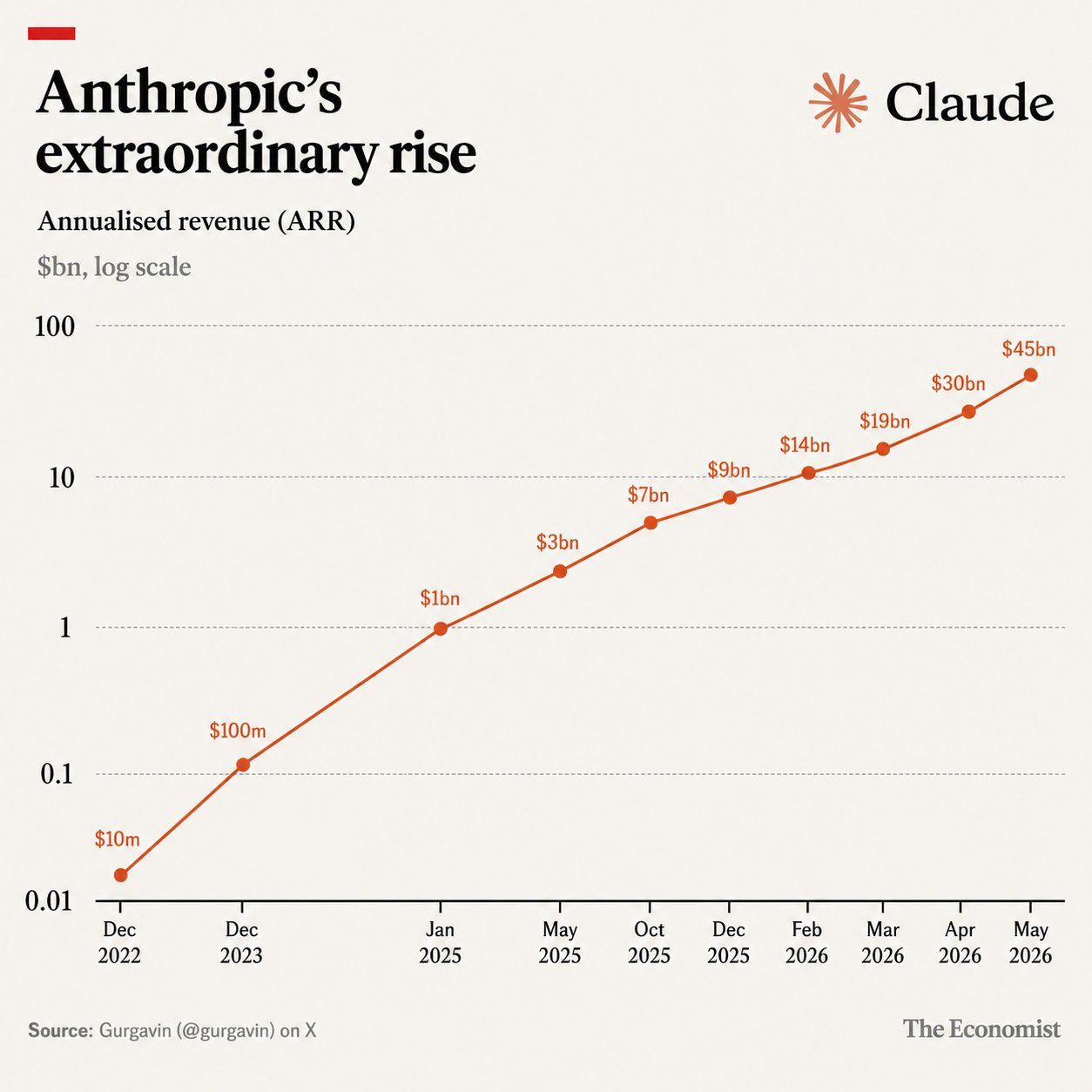
In a recent LinkedIn post, Linas Beliūnas discusses the astonishing revenue growth of AI company Anthropic, suggesting it may represent the fastest-growing software business in history. Beliūnas highlights the company’s reported $45 billion annual revenue run rate, a figure that surpasses even established tech giants like Salesforce.
He points out the sheer speed of this ascent, contrasting it with the ongoing debates about the production readiness of AI agents in many other companies. Beliūnas provides a timeline of Anthropic’s reported revenue: starting at approximately $10 million ARR in late 2022, surging to $1 billion by January 2025, $14 billion by early 2026, and reaching the $45 billion mark by May 2026.
“That is not a normal SaaS curve. That is a software company learning how to sell software that writes software.”
The Claude Code Catalyst
Central to this rapid expansion, according to Beliūnas, is Anthropic’s focus on its coding AI, Claude Code. He notes its significant contribution to the company’s revenue, with Claude Code reportedly achieving a $2.5 billion run rate in under a year.
Enterprise Focus Drives Revenue
Beliūnas emphasizes that Anthropic’s strategy has been to target enterprise clients directly, rather than pursuing consumer-level virality. This approach, he argues, has led to a substantial increase in high-value enterprise deals.
As Linas Beliūnas highlights:
“Enterprise customers spending $1M+/year allegedly doubled from ~500 to ~1,000 in just 2 months. And more than 80% of Anthropic’s revenue is now enterprise.”
This focus on enterprise, with its recurring budgets and deeply integrated developer workflows, has created a strong revenue stream that is difficult for clients to disengage from. Beliūnas terms this the “monetization gap,” where Anthropic achieves dramatically higher spend per customer compared to competitors, even with fewer overall users.
Shifting the SaaS Paradigm
The implications of Anthropic’s growth trajectory extend beyond the company itself, according to Beliūnas. He suggests that this level of scaling challenges traditional Software as a Service (SaaS) financial models.
Beliūnas posits that the initial expectation of AI being merely a feature within existing software has been overturned. Instead, AI is increasingly becoming a foundational replacement for core software components.
“We thought AI would be a feature inside software. Instead, it’s replacing parts of it.”
This shift, if sustained, could redefine the landscape of major tech winners. Beliūnas argues that the most successful entities in the AI era might not be the end-user applications, but rather the foundational layers upon which everything else operates.
The Rise of the ‘Operating System’ Layer
In Beliūnas’s view, the current foundational layer is represented by what he calls “ClaudeOS.” He draws a parallel to Anthropic’s strategic pivot from selling AI to Wall Street to becoming Wall Street’s operating system, indicating a move towards providing essential infrastructure rather than just a tool.
According to Linas Beliūnas:
“If this trajectory holds, the biggest winners in AI won’t be the apps. It will be those who own the A layer everything else runs on.”
The rapid revenue growth, driven by enterprise adoption of AI for code generation and workflow integration, suggests a powerful new model for software business development that other companies may need to emulate or adapt to.
📝 About This Content
This article is based on insights shared by Linas Beliūnas on LinkedIn.
📅 Originally posted on May 11, 2026 | View original post on LinkedIn →