
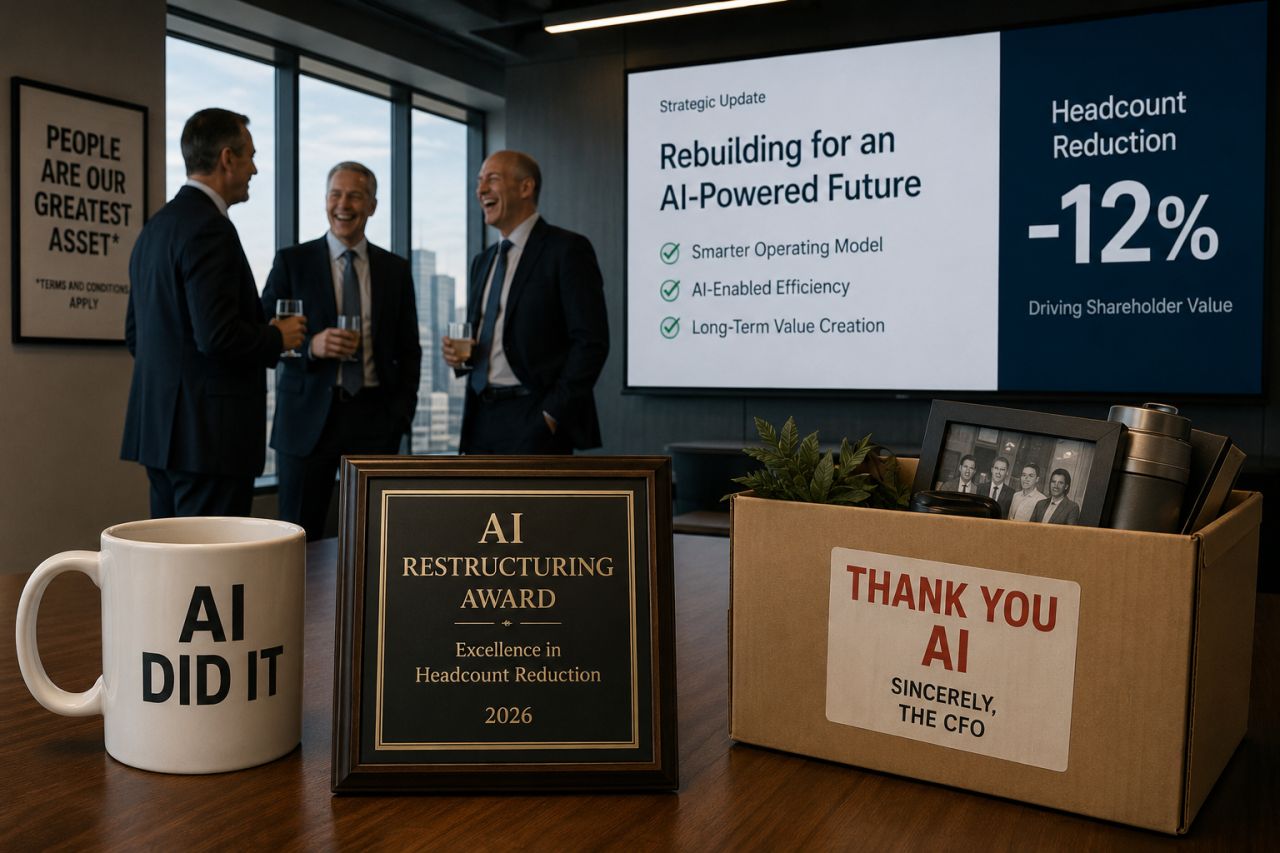
In a recent LinkedIn post, Lee McCabe offers a critical perspective on the increasing use of “AI restructuring” as a corporate strategy, suggesting it often serves as a rebranding for traditional cost-cutting measures. McCabe argues that while Artificial Intelligence is a genuine force for efficiency in some sectors, its name is being co-opted to mask decisions that companies might have made regardless of technological advancements.
McCabe highlights the common corporate narrative surrounding job cuts and operational changes, pointing out a trend where straightforward cost-saving is being reframed with AI-centric language. He notes the phenomenon where companies announce layoffs or restructuring, attributing them to a new “AI enabled operating model” rather than plain financial discipline.
“AI has become the corporate fog machine for decisions companies were probably going to make regardless.”
The post elaborates on the underlying actions often disguised by AI terminology. As McCabe outlines:
- Flatten management layers.
- Move work to cheaper talent.
- Pause hiring in bloated functions.
- Reduce service cost.
- Close underused offices.
- Consolidate teams.
- Cut roles that somehow survived the last three rounds of “transformation.”
McCabe contends that this linguistic shift is not about genuine AI adoption but about presenting familiar business strategies in a more palatable, forward-looking light. He observes a pattern across various companies:
“Nobody is cutting headcount anymore. They are ‘reallocating resources toward AI capability.’ Nobody is reducing management bloat. They are ‘building a more agile, AI ready organization.’ Nobody is doing ordinary cost discipline. They are ‘capturing the AI productivity dividend.'”
While acknowledging that AI is indeed capable of driving significant cost reductions and improvements in areas like customer service, sales support, and coding, McCabe cautions against the gap between pronouncements and reality. He suggests that for many organizations, the next year will see less genuine AI-driven restructuring and more conventional cost-cutting efforts with enhanced public relations.
The Disconnect Between AI Hype and Reality
McCabe’s analysis points to a disconnect between the publicized benefits of AI implementation and the actual outcomes. He suggests that the narrative of AI driving these changes allows leadership to present a modern, innovative image to stakeholders, even when the core decisions are based on older management principles.
“The dividend is usually paid by the people who used to do the work.”
According to McCabe, the true beneficiaries of these “AI restructurings” are often not the employees or even the customers, but rather the financial reports and investor relations departments, which can present a more favorable picture.
The Role of AI in Genuine Efficiency
It is important to note that McCabe does not dismiss AI’s potential entirely. He concedes that in specific business functions, AI is demonstrably taking out significant costs while simultaneously improving customer experiences. These are areas where AI is delivering tangible results, a point he credits.
“There are real examples where companies are removing 20 to 30 percent of cost and improving the customer experience at the same time. That deserves credit.”
However, McCabe’s core argument remains that the widespread application of the term “AI restructuring” is often a misnomer. He predicts that by 2027, many companies will not possess a distinct AI advantage but will instead have leaner workforces and more polished investor communications, a testament to effective branding rather than true technological transformation.
📝 About This Content
This article is based on insights shared by Lee McCabe on LinkedIn.
📅 Originally posted on May 11, 2026 | View original post on LinkedIn →