
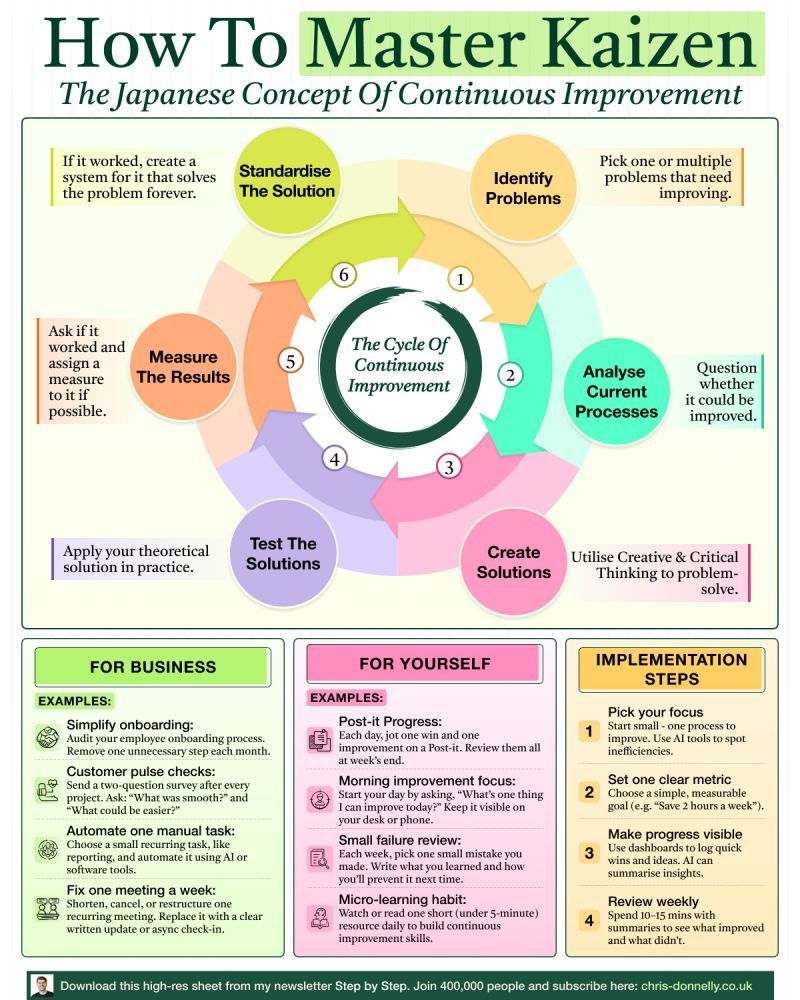
In a recent LinkedIn post, Florence Divet ☀️ explores the profound impact of incremental change, or Kaizen, on leadership effectiveness. Divet argues that many leaders falter not from a lack of ambition, but from attempting to overhaul too many aspects of their team or organization simultaneously. Instead, she champions the Kaizen philosophy of making tiny, consistent changes that compound over time, drawing parallels to the principle that a 1% daily improvement can lead to a more than 37-fold increase in a year.
Florence Divet ☀️ introduces the concept by stating:
Most leaders don’t fail because they lack ambition. They fail because they try to change everything… all at once.
This foundational idea sets the stage for her breakdown of how Kaizen principles can be applied across various facets of leadership.
Kaizen Your Presence First
Divet emphasizes that a leader’s strategic initiatives are often doomed if the team does not feel safe. She suggests a practical exercise for leaders: reflecting on the first 90 seconds of post-meeting interactions. By identifying how these initial moments set the tone, leaders can then select a single, small tweak for the next meeting, such as starting with clarity, care, or ownership.
As Florence Divet ☀️ notes:
If your team doesn’t feel safe with you, your strategy stays just an idea.
This focus on presence, she contends, is a critical first step before diving into strategy implementation.
Transforming Conversations and Decisions
Leadership, according to Divet, fundamentally happens in conversations. She advocates for replacing common, autopilot phrases with more impactful alternatives. For instance, swapping “Any questions?” for “What’s unclear or risky here?” or “Keep me posted” for “What do you need from me to move?” can immediately shift the dynamic and foster a more proactive environment.
Divet also addresses decision-making, highlighting that leaders often delay action due to a pursuit of certainty. Kaizen, in this context, encourages making smaller, reversible bets to facilitate faster learning. She proposes a simple rule:
Before a decision, ask: “What’s the smallest reversible step we can take in 7 days?” If it’s reversible, speed up. If it’s irreversible, slow down. This single rule saves careers.
This approach, she suggests, minimizes risk and accelerates progress.
Cultivating Culture Through Consistent Behavior
Florence Divet ☀️ posits that organizational culture is defined not by stated values, but by what is tolerated. To shift culture effectively, she recommends focusing on one specific behavior at a time for a sustained period, such as “We name trade-offs out loud” or “We disagree without attacking.” Consistency in reinforcing these behaviors, without needing a costly rebrand, is key to genuine cultural transformation.
Divet identifies several scenarios where Kaizen is particularly powerful, including scale-ups, organizations with burnt-out teams, low-trust environments, and for new managers. She concludes by reinforcing that lasting change in people comes not from grand pronouncements, but from consistently making their daily work easier through small, targeted improvements.
📝 About This Content
This article is based on insights shared by Florence Divet ☀️ on LinkedIn.
📅 Originally posted on May 13, 2026 | View original post on LinkedIn →