
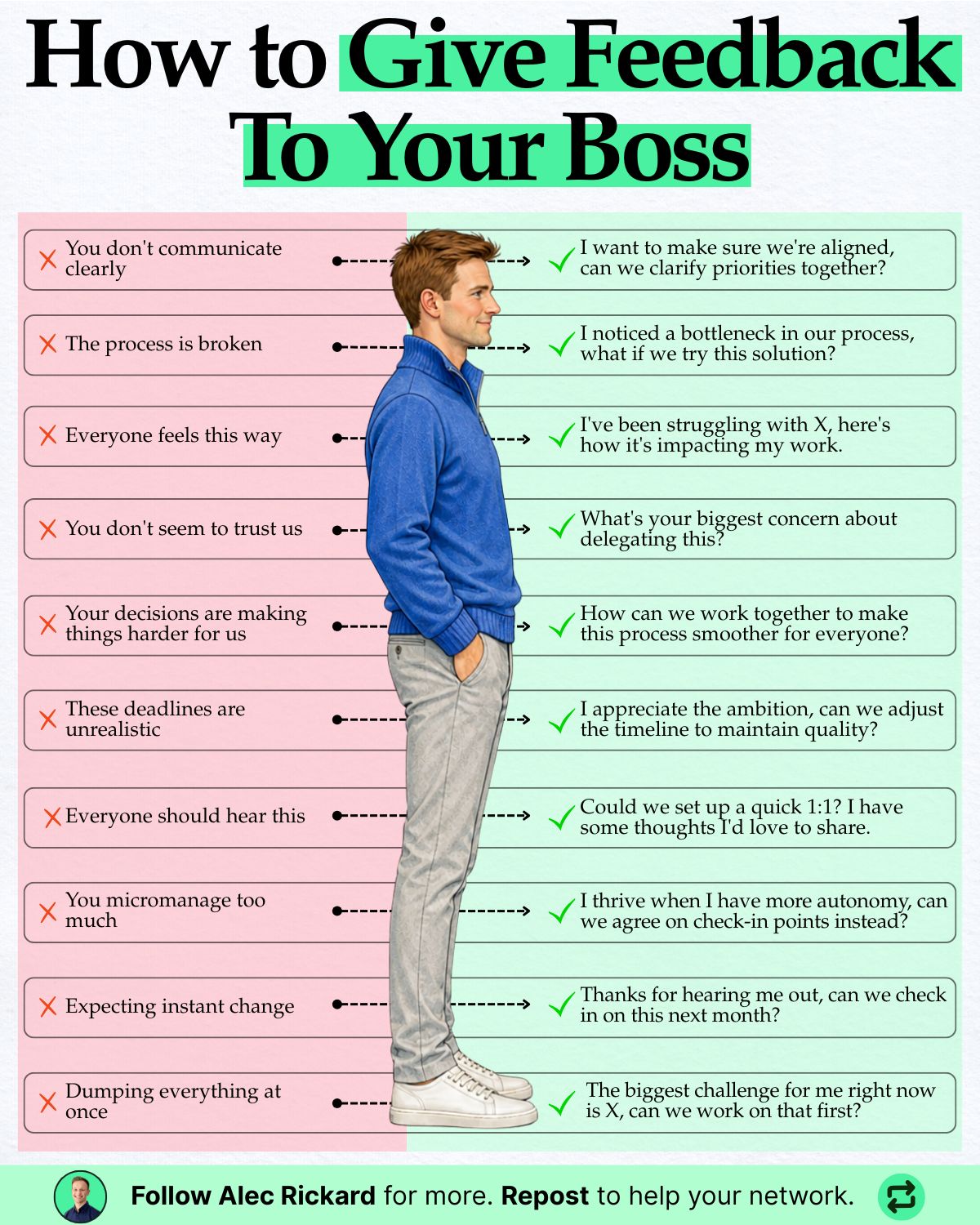
In a recent LinkedIn post, Alec Rickard explores the critical skill of providing feedback to one’s superior, highlighting how the delivery can significantly impact career progression. Rickard emphasizes that while upward feedback can be a powerful tool for growth, it carries inherent risks if not handled with care.
He begins by stating the high stakes involved: “Giving feedback to your boss can accelerate your career. Or quietly damage it.” Rickard elaborates on this dichotomy, explaining that missteps can lead to being perceived as difficult, while successful communication can signal leadership potential.
“I’ve watched brilliant people stall in their careers because they couldn’t raise hard things at work. Because every time they spoke up, it came out as a complaint.”
According to Rickard, the core issue often lies not in the validity of the feedback itself, but in the choice of words used to convey it. He argues that the framing of feedback is paramount to its reception.
The Nuance of Upward Communication
Rickard’s post provides a practical guide, offering ten reframing strategies designed to make upward feedback more palatable and actionable for managers. He stresses the importance of moving away from accusatory language and towards collaborative problem-solving.
Shifting from Complaint to Collaboration
A key theme in Rickard’s advice is the transition from stating problems to proposing solutions collaboratively. For instance, instead of saying “you don’t communicate clearly,” he suggests framing it as a shared goal: “I want to make sure we’re aligned, can we clarify priorities together?” This approach invites the manager into a partnership rather than positioning them as the problem.
“The words you choose decide how the message lands.”
This sentiment underscores the entire framework Rickard presents. He provides several examples illustrating this principle:
- Instead of “the process is broken,” try “I noticed a bottleneck in our process, what if we try this solution?”
- Instead of “these deadlines are unrealistic,” try “I appreciate the ambition, can we adjust the timeline to maintain quality?”
- Instead of “you micromanage too much,” try “I thrive when I have more autonomy, can we agree on check-in points instead?”
These examples, as highlighted by Rickard, aim to shift the focus from blame to mutual understanding and improvement.
Delivering Feedback Effectively
Rickard further advises on managing expectations and the delivery itself. He suggests avoiding the urge to present all issues at once or expecting immediate change. Instead, he recommends a phased approach.
“The hardest part of career growth isn’t having the right thoughts. It’s learning how to deliver them in a way people can actually hear.”
This concluding thought from Rickard encapsulates his core message: developing the ability to communicate constructive criticism effectively is as vital for career advancement as identifying the issues themselves. He encourages readers to save his list for future one-on-one meetings, positioning the advice as a practical tool for professional development.
📝 About This Content
This article is based on insights shared by Alec Rickard on LinkedIn.
📅 Originally posted on May 13, 2026 | View original post on LinkedIn →