
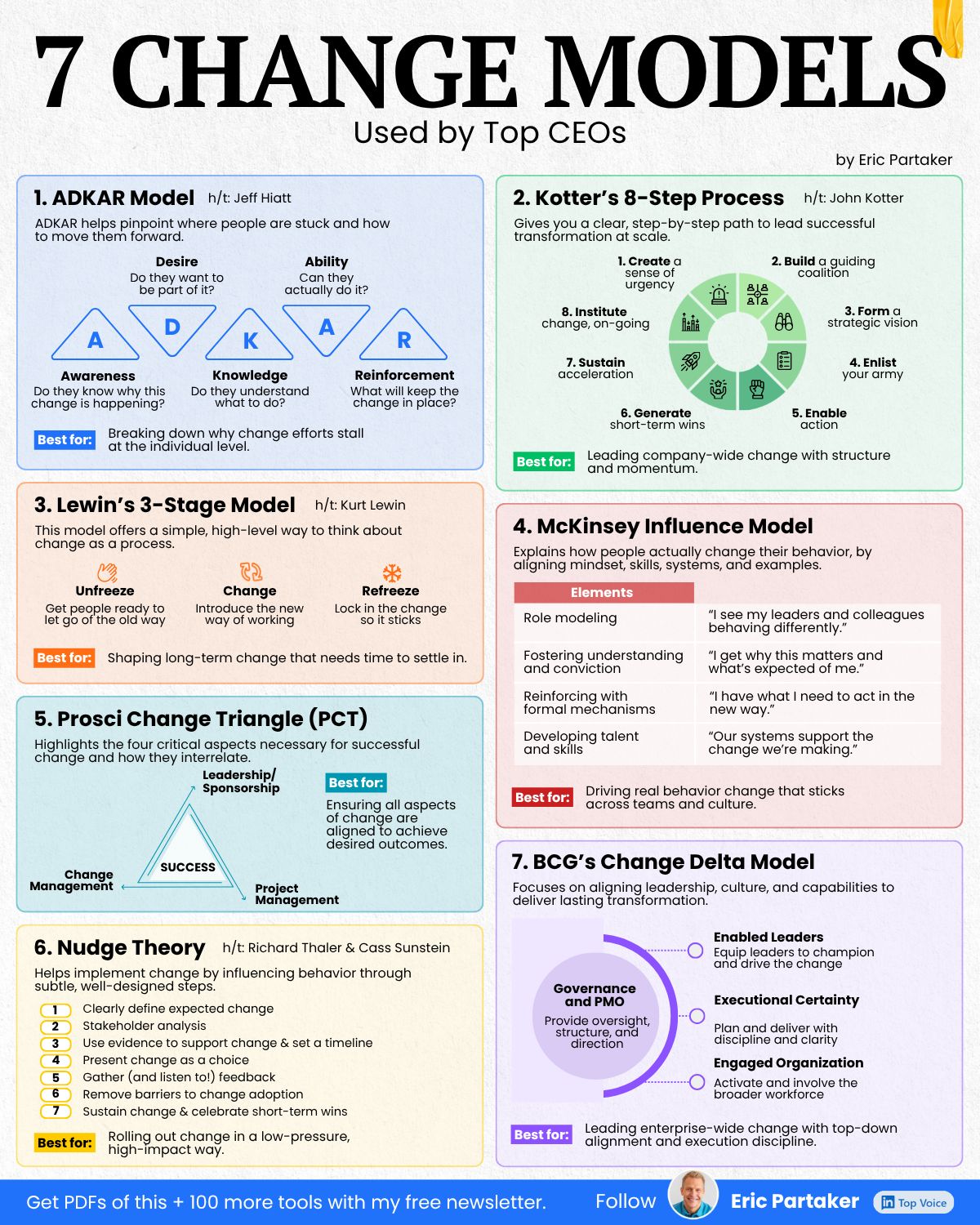
In a recent LinkedIn post, Eric Partaker delves into the common reasons why organizational change efforts falter, attributing failure not to flawed ideas but to the misapplication of change models. As Partaker highlights, a significant hurdle in successful transformation is when leaders select an inappropriate framework for the specific change they aim to implement.
“70% of change efforts fail. And it’s rarely because the idea was bad. The real killer: CEOs pick the wrong change model for the job.”
Partaker, a seasoned coach and leader, draws on his experience to illustrate how this mismatch can lead to wasted resources, team burnout, and damaged trust. He emphasizes that the scale and nature of the change dictate the most effective approach. Attempting to use individual coaching methods for company-wide shifts, for instance, is inefficient, as Partaker notes, “200 people change. 2,000 don’t.” Conversely, employing a lengthy, multi-step program for a simple process adjustment can lead to frustration and stalled progress.
The Perils of Mismatched Change Models
The post details three real-world examples from CEOs Partaker has coached, showcasing the impact of choosing the right versus the wrong model. For a startup pivoting its product, the application of Lewin’s 3-stage model resulted in a smooth, aligned transition within three months. In contrast, an enterprise undertaking a digital transformation benefited significantly from Kotter’s 8-step process, which built urgency and enabled action, ultimately leading to substantial revenue growth.
Partaker also illustrates the power of subtle interventions, citing a sales team’s adoption of a new CRM. By leveraging Nudge Theory—making the old system harder to access and setting the new system as the default homepage—the team achieved 95% adoption in just two weeks. This contrasts sharply with top-down mandates that can breed resentment and rebellion. As Partaker warns,
“Wrong model = wasted months and burned trust.”
Identifying the Warning Signs
To help leaders avoid these pitfalls, Partaker outlines five key warning signs that indicate the wrong change model is in play:
- High activity but low progress.
- Team members comply but do not commit.
- Changes revert shortly after implementation.
- Team energy decreases despite increased effort.
- A sense of futility pervades the team, where “this too shall pass” becomes a common sentiment.
Partaker advocates for a more strategic approach, suggesting specific models tailored to different change scenarios. He proposes:
- Nudging for small behavioral shifts.
- Utilizing the ADKAR model for individual performance improvements.
- Employing the McKinsey Influence Model for cultural shifts.
- Applying Kotter’s model for full transformations.
- Leveraging the BCG Change Delta for enterprise-wide overhauls.
The core message from Partaker is clear: leaders must move beyond defaulting to the first change model they learned and instead build a diverse toolkit. As he concludes,
“The next time your team pushes back on a change initiative, check the playbook you’re using.”
By carefully matching the change model to the specific context and scale of the initiative, organizations can significantly improve their chances of achieving sustained success and fostering genuine commitment rather than mere compliance.
📝 About This Content
This article is based on insights shared by Eric Partaker on LinkedIn.
📅 Originally posted on May 20, 2026 | View original post on LinkedIn →