
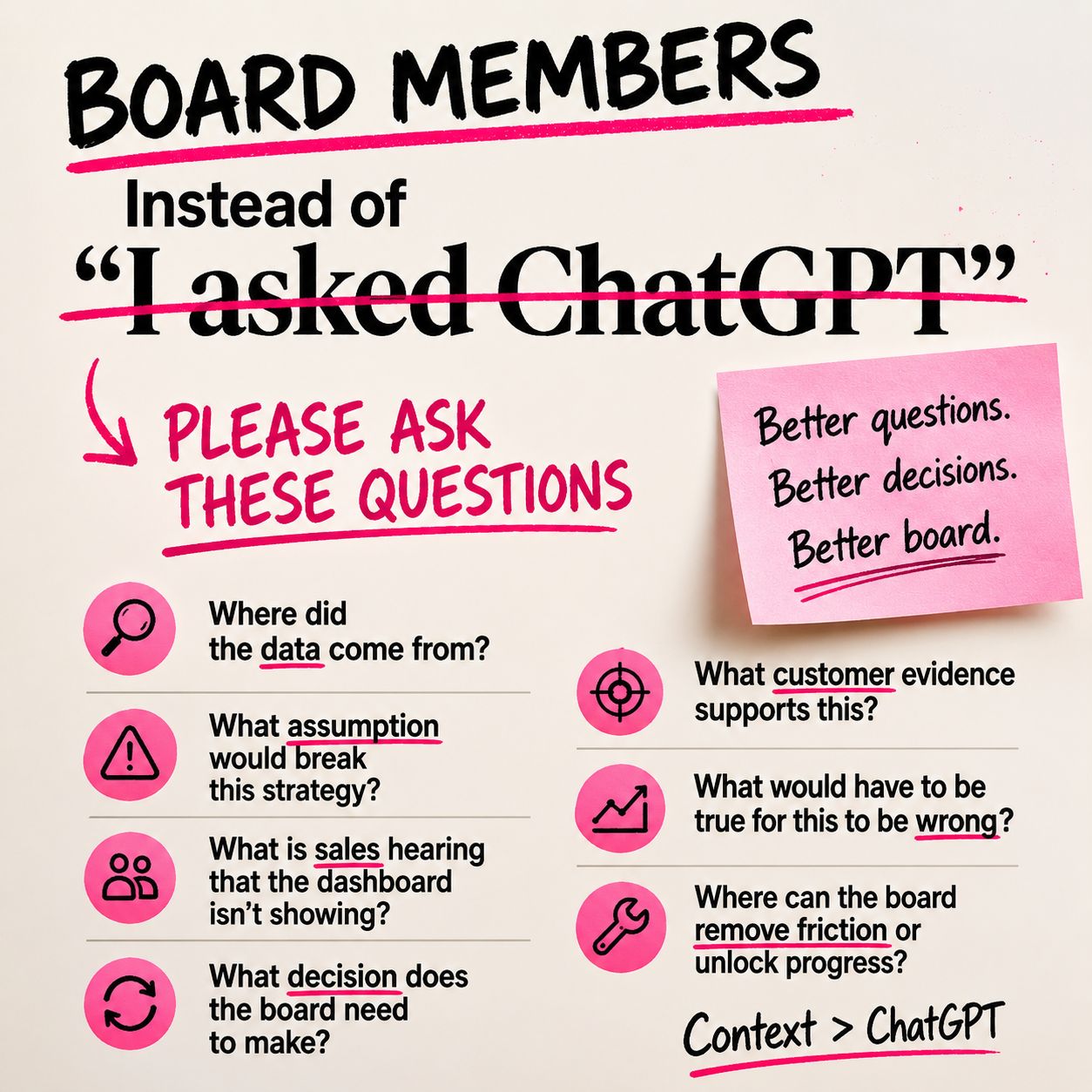
In a recent LinkedIn post, Archita Fritz addresses a growing trend among some board members: using artificial intelligence, specifically ChatGPT, as a tool to challenge management teams during strategic discussions. Fritz, who identifies as a board member herself, cautions against this approach, emphasizing the difference between responsible AI use for preparation and its deployment as a superficial “gotcha” tactic.
“I asked ChatGPT into the room like it’s a gotcha. ‘I asked ChatGPT and it said…’ Please don’t be this person.”
Archita Fritz argues that this behavior, while now often manifested through AI, is not entirely new. She draws a parallel to past instances where individuals would cite information from books, podcasts, or even social media to challenge strategic decisions without sufficient context. The core issue, according to Fritz, lies in presenting generic AI-generated answers in a boardroom setting where management teams possess deep, contextual knowledge derived from weeks of customer interactions, sales data, and market analysis.
The Pitfalls of Context-Free AI Challenges
Fritz elaborates on the disconnect that occurs when AI outputs are used without proper consideration for the specific circumstances of a business. “The issue is that you walk into a strategy conversation with a generic answer based on a prompt that lacks context, and make the management team defend weeks of customer calls, pipeline reviews, sales feedback, market work, and company context against it,” she writes. This, in Fritz’s view, distracts from genuine strategic progress and can undermine the efforts of those who have a nuanced understanding of the company’s operations and market position.
Shifting the Focus to Better Questions
Instead of relying on AI for simple challenges, Archita Fritz proposes a more constructive approach for board members and C-suite leaders. She outlines a series of “better questions” that encourage deeper analysis and a more thorough understanding of recommendations. These questions aim to uncover underlying assumptions, data sources, customer evidence, and the potential impact of decisions.
Fritz suggests that effective board engagement involves asking questions such as:
- “What source is this based on?”
- “What assumptions sit underneath this recommendation?”
- “What data did we use?”
- “What customer evidence supports it?”
- “What does the sales team believe?”
- “What would have to be true for this to be wrong?”
- “What decision does this actually change?”
- “What risk are we taking if we ignore it?”
- “Where can the Board help remove friction?”
The True Role of Board Members
According to Archita Fritz, the fundamental responsibility of a board member or C-suite leader is not to seek out “gotcha” moments. Instead, the focus should be on facilitating informed decision-making and supporting the management team’s strategic initiatives. “That, my friends, is the job. Not chasing little gotcha moments inside the company,” Fritz emphasizes.
“Your competition is not sitting in that boardroom.”
Fritz concludes by reiterating that the real challenges and competition lie outside the boardroom, underscoring the importance of productive, context-aware strategic discussions. Her post serves as a call to action for leaders to leverage AI and their own insights more effectively, fostering environments where informed debate leads to better business outcomes.
📝 About This Content
This article is based on insights shared by Archita Fritz on LinkedIn.
📅 Originally posted on May 22, 2026 | View original post on LinkedIn →