
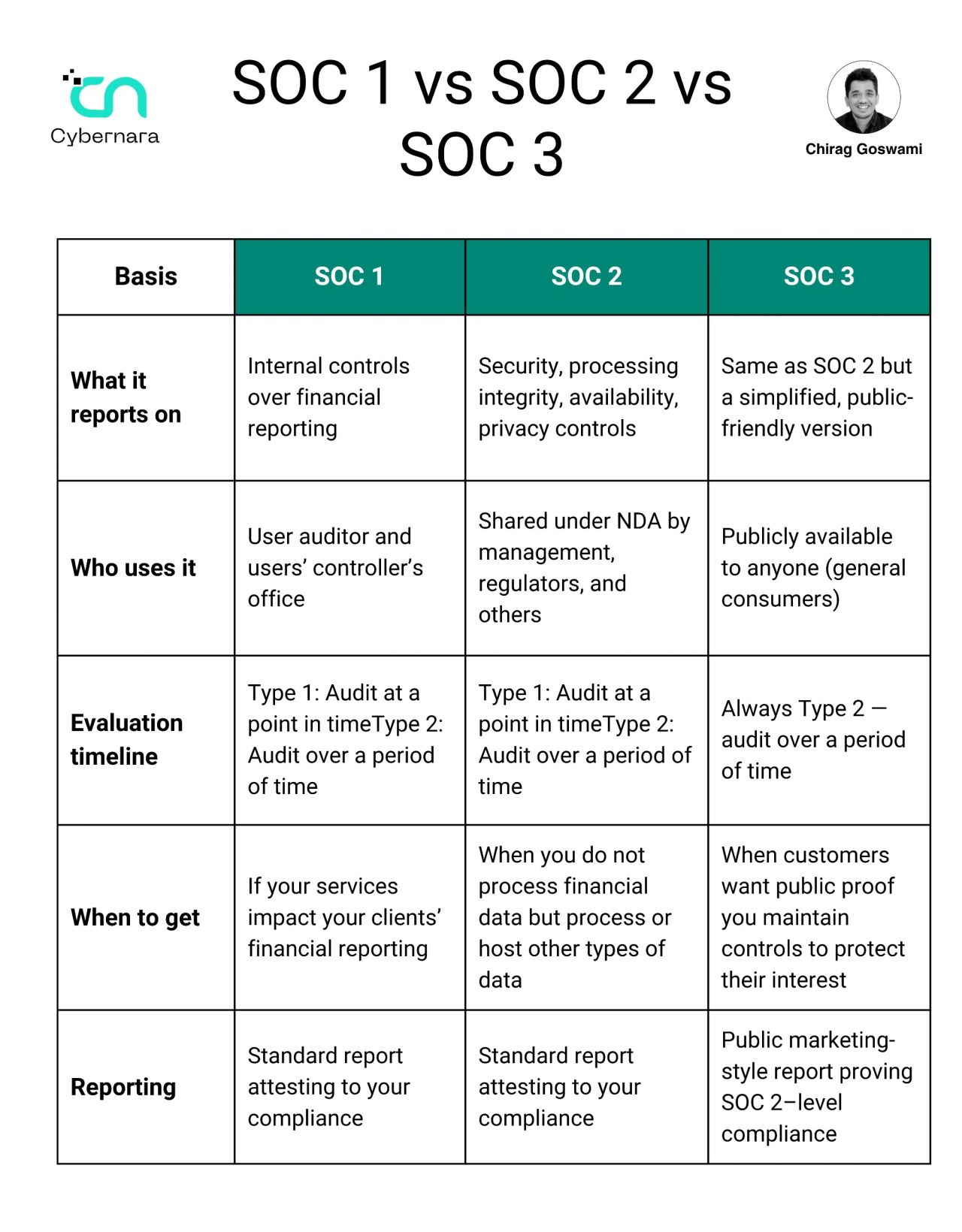
In a recent LinkedIn post, Chirag Goswami provides a clear and concise breakdown of the different types of SOC (System and Organization Controls) reports, highlighting their distinct purposes and growing importance in vendor selection. Goswami aims to alleviate common confusion surrounding SOC 1, SOC 2, and SOC 3 reports, explaining that while they may seem similar, each serves a unique role in establishing trust and compliance.
Goswami begins by outlining the core focus of each report:
“SOC 1
Focused on controls that impact financial reporting.
Usually important for payroll providers, accounting platforms, or financial service vendors.”
This distinction is crucial for businesses that handle sensitive financial data or integrate with financial systems. As Goswami points out, the primary audience for SOC 1 reports are those concerned with the accuracy and reliability of financial statements.
Understanding SOC 2 and its Broader Scope
The post then delves into SOC 2, which Goswami identifies as a more common standard for technology-focused companies. He emphasizes its broader scope, encompassing critical areas beyond financial reporting.
According to Goswami:
“SOC 2
Focused on security, availability, privacy, and data protection controls.
Most SaaS, cloud, and technology companies go for SOC 2.”
This focus on security, availability, processing integrity, confidentiality, and privacy makes SOC 2 a vital certification for any company operating in the cloud or offering Software-as-a-Service (SaaS) solutions. Goswami further clarifies the relationship between SOC 2 and SOC 3, noting that SOC 3 is essentially a public-facing version.
SOC 3: The Public-Facing Assurance
Goswami explains the utility of the SOC 3 report:
“SOC 3
A public-friendly version of SOC 2.
Used mainly for marketing, trust, and customer assurance.”
This report is designed for general distribution, allowing companies to showcase their commitment to robust security and data handling practices without revealing the detailed controls outlined in a SOC 2 report. This makes it an effective tool for building customer confidence and enhancing marketability.
The Evolving Landscape of Compliance
A significant point raised by Goswami is the increasing prevalence of SOC reports in vendor selection processes. He observes that in today’s market, these reports are becoming a standard requirement rather than an optional add-on.
Chirag Goswami argues that:
“In today’s market, many enterprise customers now ask for SOC reports before onboarding vendors. Compliance is slowly becoming a business requirement, not just a security requirement.”
This shift signifies a broader trend where robust compliance and security postures are viewed as fundamental business enablers, directly impacting a company’s ability to partner with larger enterprises. The insights provided by Goswami underscore the critical need for businesses, particularly in the technology and SaaS sectors, to understand and pursue the appropriate SOC certifications to meet market demands and build stakeholder trust.
📝 About This Content
This article is based on insights shared by Chirag Goswami on LinkedIn.
📅 Originally posted on May 19, 2026 | View original post on LinkedIn →