
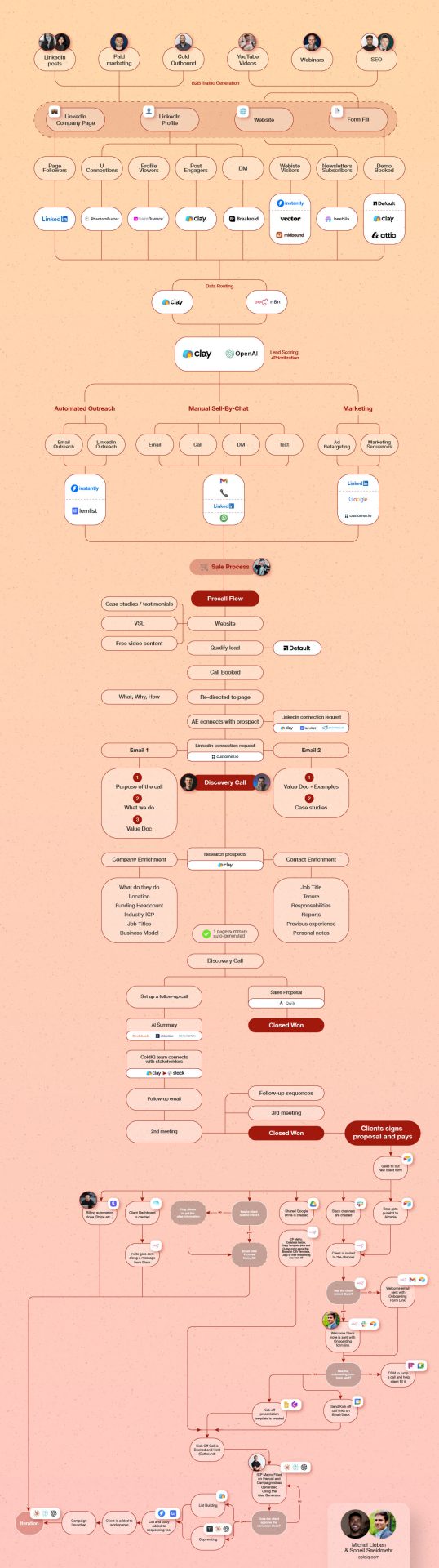
In a recent LinkedIn post, Michel Lieben 🧠 shares a detailed breakdown of the operational mechanics behind a highly successful Go-To-Market (GTM) agency generating $7,000,000 annually. Lieben 🧠 meticulously dissects the agency’s growth engine, from initial customer acquisition through to service delivery, offering a transparent look at the strategies and technologies employed.
The post highlights the multifaceted nature of the agency’s success, emphasizing that robust growth is built on a series of interconnected systems. As Michel Lieben 🧠 notes:
“The anatomy of a $7,000,000/year GTM agency: From acquisition → to conversion → to service delivery 👇”
Lieben 🧠 structures the analysis into four key pillars: the Marketing Engine, Lead Capture, Sales Engine, and Client Delivery. This framework provides a clear roadmap for other businesses looking to scale.
The Power of a Multi-Channel Marketing Engine
The agency’s marketing engine, which reportedly drives over 45,000 visits per month, is a sophisticated blend of organic and paid efforts. Michel Lieben 🧠 details how different channels contribute to this traffic:
- LinkedIn: Approximately 14,000 visits are generated through a dedicated team publishing over 150 posts monthly, leveraging tools like Taplio and Scripe, with infographics designed by Pilar Varela.
- SEO: Around 11,000 visits stem from programmatic SEO efforts led by Yevhen, involving long-form content, programmatic landing pages, and free micro-tools. The tech stack includes AirOps, Ahrefs, and Claude Code.
- Paid Ads: An investment of roughly $10,000 per month, managed by Ivan, targets channels like LinkedIn, Meta, and Google for testing purposes, utilizing tools such as Fibbler and Usermaven.
- Cold Outreach: Internal outbound efforts, led by Kenny, employ strategies like lookalike account targeting and inbound-led outbound, supported by a suite of tools including Clay and Instantly.ai.
- Other Channels: Approximately 11,000 visits come from a weekly newsletter via beehiiv, managed by Monika, and a webinar program led by Harry, with ongoing experiments on TikTok and AEO.
According to Michel Lieben 🧠, this diverse marketing approach is crucial for sustained traffic generation.
Streamlining Lead Capture and Sales Conversion
Transitioning traffic into actionable pipeline requires a well-defined lead capture system. Lieben 🧠 explains the layered approach used:
Midbound and Vector are employed to identify anonymous traffic, while Customer.io manages lifecycle emails. Lead magnet pop-ups and email-capturing micro-tools also play a significant role. All data is funneled through n8n and scored using Clay, OpenAI, and PredictLeads.
The sales engine, spearheaded by Dujam and Jan, is primarily sales-led, with average retainers ranging from $5,000 to $10,000. Michel Lieben 🧠 outlines the typical sales flow:
“Pre-call: case studies, VSL, free content → prospects routed to the right AE. Discovery: AE meets the prospect, fires off a LinkedIn connect. Enrichment: account research in Clay (funding, headcount, tech, tenure, reports). Proposal → (follow-up) → Closed Won”
The sales team leverages tools like Attention for AI notes, Hyperline for CPQ, Attio for CRM, Qwilr for proposals, and Stripe for payments.
Efficient Client Delivery at Scale
Scaling service delivery, especially when onboarding over 30 new accounts per quarter, demands significant operational efficiency. Soheil leads this crucial aspect, implementing automated onboarding workflows via n8n. Michel Lieben 🧠 highlights the integration of key systems:
“Automated onboarding workflows via n8n. Synced GSuite ↔ Supabase ↔ Stripe ↔ Slack. Offloaded admin (Slack invites, onboarding links, secondary domain provisioning)… so our GTM Engineers focus only on what moves the needle for clients (custom ICP matrix, creative campaign ideas, copy…),” he notes.
This automation allows GTM Engineers to concentrate on high-value client work, such as developing custom ICP matrices and creative campaign ideas, rather than administrative tasks. The technology stack supporting client delivery includes Airtable, n8n, Slack, Google Suite, and Supabase.
Michel Lieben 🧠’s comprehensive post offers invaluable insights into the intricate systems that underpin a high-growth GTM agency, providing a blueprint for others aiming for similar success.
📝 About This Content
This article is based on insights shared by Michel Lieben 🧠 on LinkedIn.
📅 Originally posted on May 27, 2026 | View original post on LinkedIn →