
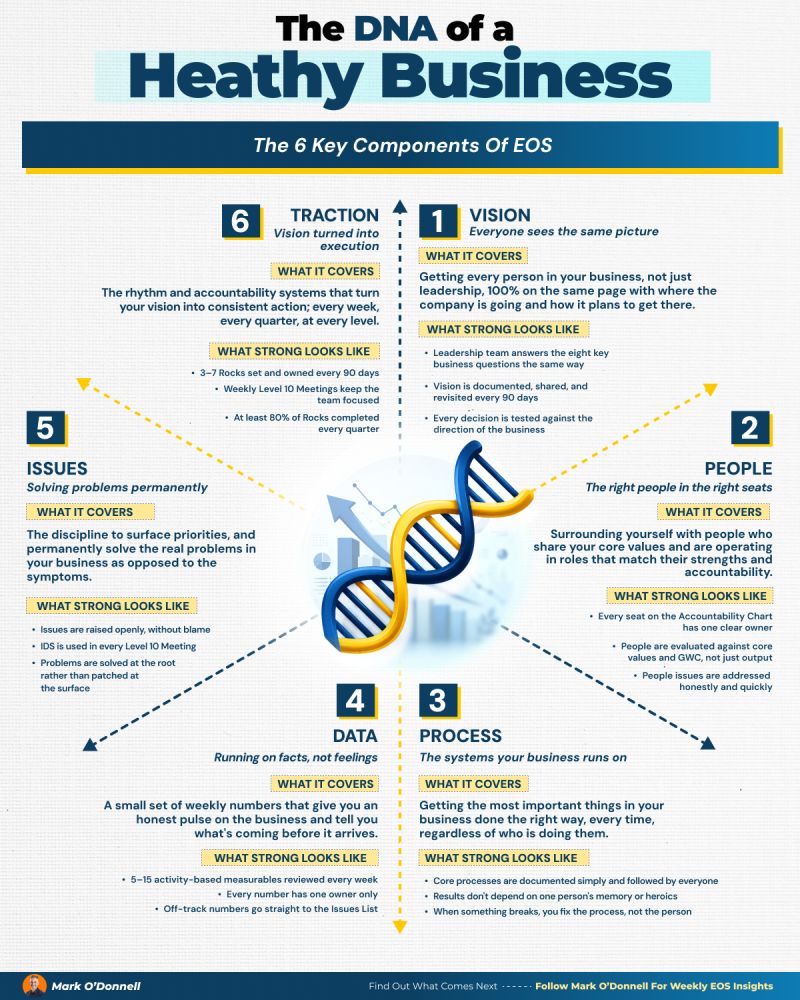
In a recent LinkedIn post, Mark A Odonnell explores a foundational framework for diagnosing and improving business performance, emphasizing the interconnectedness of key operational areas. Odonnell argues that persistent business problems often stem from a single, overlooked root cause within six critical components of any organization. He stresses that addressing only the most obvious issues is insufficient, as weakness in one area can negatively impact the entire system.
The Interconnectedness of Business Pillars
Odonnell’s central thesis is that true business improvement comes from ensuring all six core areas are functioning at a sufficient level, rather than striving for unattainable perfection. He states that aiming for each component to be “80% strong” is the key to a business running effectively on its systems rather than on the efforts of a few individuals.
“A weak component pulls on everything connected to it. Get all six to 80% strong and the business runs the way it should.”
This perspective challenges the common leadership tendency to focus only on the most visible problems, suggesting a more holistic approach is required for sustainable growth and operational efficiency. As Mark A Odonnell notes, “Most leaders already know which one or two are broken. So they fix those and expect things to improve. But they usually don’t, because these six don’t work in isolation.”
Deconstructing the Six Pillars
Mark A Odonnell breaks down these six essential areas, providing a clear roadmap for leaders to assess their own organizations:
1. Vision
This pillar focuses on establishing a clear, documented direction that is consistently communicated and actionable for every employee. Odonnell suggests tools like V/TO (Vision/Traction Organizer) can assist in this area.
2. People
According to Odonnell, this involves having the “right people in the right seats.” The “right person” is defined by sharing core values, while the “right seat” means the role aligns with their inherent strengths. Tools like the People Analyzer and GWC (Get Right Seat, Grow, Own) are mentioned as relevant resources.
3. Data
Odonnell advocates for running a business based on quantifiable metrics rather than intuition. He emphasizes the importance of tracking 5-15 weekly measurables to maintain an accurate pulse on business health, with the Scorecard tool being a key component.
“Running the business on numbers rather than gut feel.”
4. Issues
This element centers on the discipline of addressing problems at their root cause. Odonnell highlights the need to openly surface, prioritize, and permanently solve issues, referencing the IDS (Identify, Discuss, Solve) process within Level 10 Meetings as a practical application.
5. Process
For Odonnell, process is about ensuring the most critical work is consistently performed correctly. He stresses that these documented processes should be followed by everyone and not reside solely in the knowledge of one individual. Core Processes are identified as a key tool here.
“Getting the most important work done the right way, every time.”
6. Traction
This final pillar bridges vision and execution. Odonnell explains that setting clear 90-day priorities (Rocks) and utilizing tools like the Meeting Pulse and Level 10 Meetings are crucial for keeping the team accountable and driving progress.
Achieving Systemic Strength
Mark A Odonnell concludes by reiterating that the goal is not perfection but a robust system. By strengthening each of these six areas to at least 80%, leaders can create a business that operates efficiently and reliably, freeing themselves from constant firefighting and the burden of being the sole linchpin. He prompts leaders to consider which of these six areas represents the weakest link in their own operations.
📝 About This Content
This article is based on insights shared by Mark A Odonnell on LinkedIn.
📅 Originally posted on May 25, 2026 | View original post on LinkedIn →