
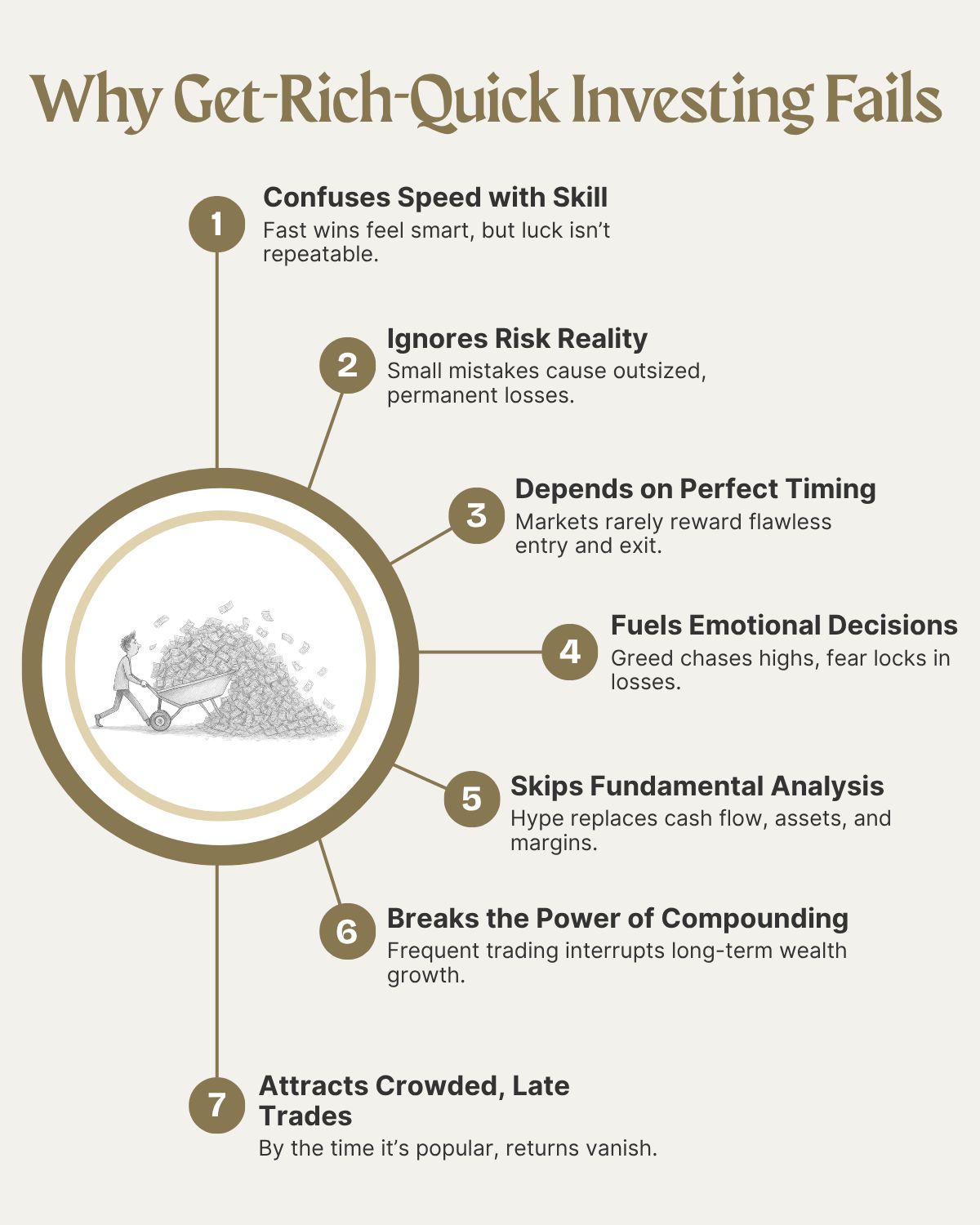
In a recent LinkedIn post, Michael Merlin discusses the inherent pitfalls of “get-rich-quick” investment strategies, arguing that they often lead to disappointment rather than sustainable wealth. Merlin, a proponent of patient, consistent investing, highlights how the allure of speed in financial markets can be a significant detriment to long-term success.
Merlin begins by contrasting the promise of speed with the usual outcome of disappointment. He outlines several consequences of chasing fast money, including:
- Fragile gains that are prone to disappearing
- Losses that can take years to recover
- Decisions driven by emotion rather than logic
As Michael Merlin notes, the core issue often lies in mistaking speed for skill.
Get-rich-quick investing promises speed. It usually delivers disappointment.
Merlin elaborates on why these hurried approaches consistently fail, breaking down the problem into several key principles that investors often overlook.
The Illusion of Skill and the Reality of Luck
One of the primary traps, according to Merlin, is the confusion between speed and genuine investment skill. Early successes in fast-paced markets can often be attributed to luck, a factor that does not compound or provide a reliable foundation for future growth. “Early wins often come from luck,” Merlin states, emphasizing that “Luck does not compound.” This distinction is critical, as it suggests that a series of fortunate events is not a repeatable strategy.
Underestimating Risk and the Importance of Survival
Merlin also points out that get-rich-quick schemes frequently lead investors to underestimate the associated risks. In the pursuit of rapid returns, small errors can escalate into permanent damage to an investment portfolio. He argues that in the long run, survival in the market is far more important than chasing high, potentially fleeting, returns. “Survival matters more than returns,” Merlin asserts, highlighting a fundamental principle often neglected in the quest for quick profits.
Risk Gets Underestimated — Small errors can create permanent damage
The Futility of Market Timing and Emotional Decision-Making
The post further critiques the strategy of relying on market timing. Merlin argues that achieving perfect entry and exit points consistently is exceptionally rare. Instead, he suggests that markets reward patience over precision. Furthermore, Merlin identifies emotions like greed and fear as major drivers of poor investment decisions. Greed can lead investors to buy at inflated prices, while fear can cause them to sell at a loss, both of which are detrimental to building wealth. “Greed buys high — Fear sells low,” he observes, illustrating the destructive cycle driven by unchecked emotions.
Ignoring Fundamentals and the Power of Compounding
Merlin also highlights the tendency to ignore fundamental financial principles when chasing quick gains. Hype and speculation often take precedence over tangible metrics like cash flow and profit margins. He warns that while exciting stories might temporarily outperform spreadsheets, this is not sustainable. Another crucial element that gets interrupted by frequent trading, according to Merlin, is the power of compounding. “Time in the market beats activity,” he concludes, advocating for a buy-and-hold strategy that allows investments to grow steadily over time.
Fundamentals Get Ignored — Hype replaces cash flow and margins
In conclusion, Michael Merlin’s analysis on LinkedIn underscores that true wealth is built through patient, consistent effort, not through urgent, high-risk strategies. He posits that quiet consistency ultimately outperforms the excitement often associated with get-rich-quick schemes.
📝 About This Content
This article is based on insights shared by Michael Merlin on LinkedIn.
📅 Originally posted on June 24, 2026 | View original post on LinkedIn →