
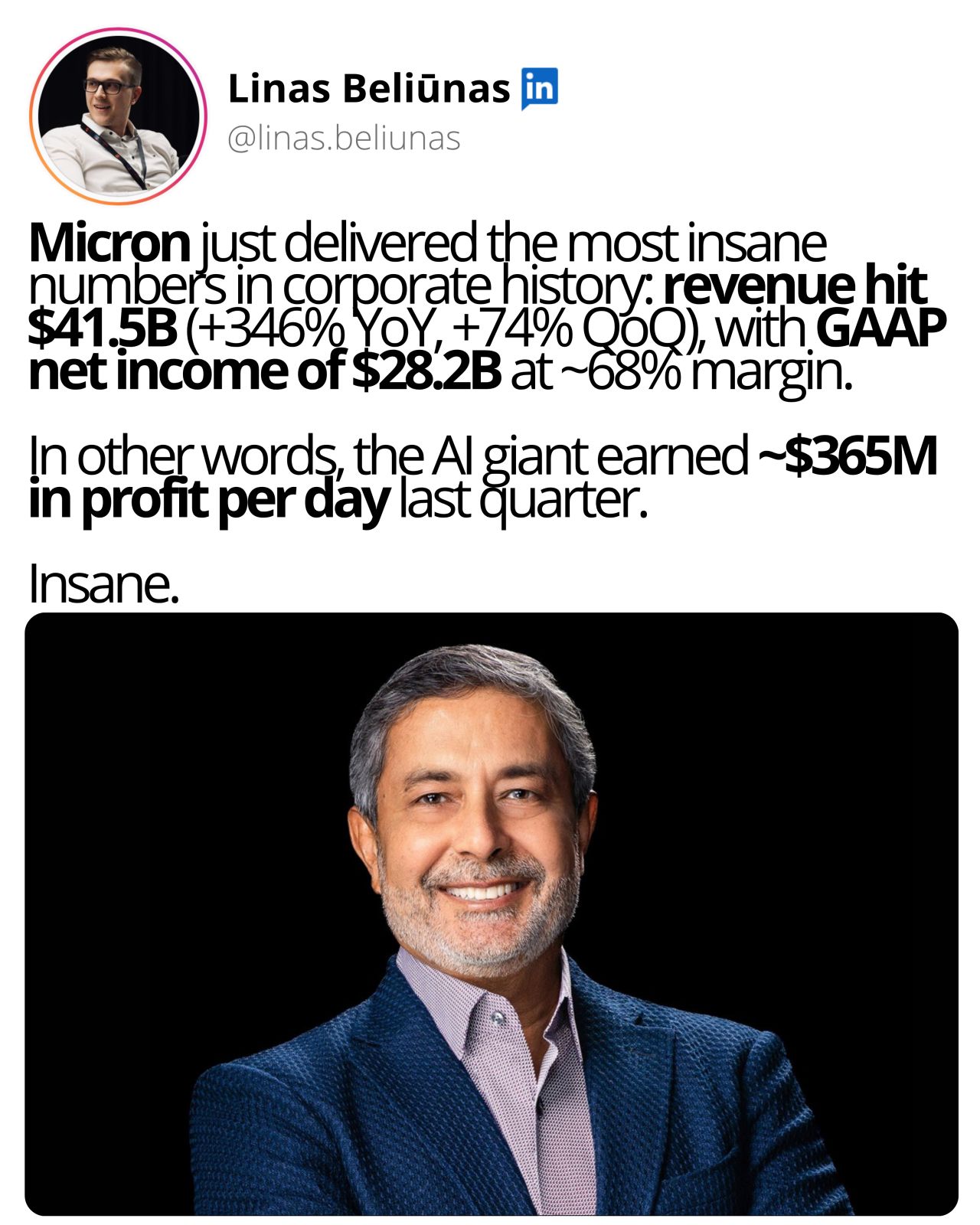
In a recent LinkedIn post, Linas Beliūnas highlights the extraordinary financial performance of AI giant Micron Technology, framing it not just as a story of AI demand but as a fundamental shift in the memory market. Beliūnas points out that memory is transitioning from a mere commodity to a critical, contracted bottleneck in the AI supply chain.
Beliūnas shared the staggering Q3 FY2026 numbers released by Micron, noting:
“Wild: AI giant Micron just delivered the most insane numbers in corporate history: revenue hit $41.5B (+346% YoY, +74% QoQ), with GAAP net income of $28.2B at ~68% margin 😳”
He further breaks down the implications of these figures, emphasizing the daily profit generated by the company and drawing attention to the strategic customer agreements Micron has established. As Beliūnas articulates, the dynamic has changed from simple chip purchasing to securing essential resources.
The Evolution of Memory from Commodity to Bottleneck
Beliūnas argues that the core narrative behind Micron’s success lies in the evolving role of memory in the tech landscape. The post details how Micron has secured 16 Strategic Customer Agreements that include take-or-pay commitments, deposits, and pricing floors. This move indicates a significant change in how hyperscalers are engaging with memory suppliers.
“Simply put, hyperscalers are not “buying chips” anymore. They are reserving oxygen,” Beliūnas states, underscoring the critical nature of memory supply for AI infrastructure development.
Record Financial Performance and Future Guidance
The analysis delves into specific financial metrics that underscore Micron’s exceptional performance. Beliūnas highlights key figures from Micron’s Q3 FY2026 results, including a non-GAAP gross margin of 84.9% and an operating margin of 81.2%. The post also points to a substantial free cash flow of $18.3 billion after capital expenditures of $7.1 billion.
Looking ahead, Beliūnas notes Micron’s optimistic guidance for Q4, which projects even higher revenue and earnings per share. This forward-looking data is further bolstered by customer commitments totaling approximately $22 billion to secure future supply.
“Customers have committed ~$22B to lock in supply”
Broader Implications for the AI Stack
Beyond the immediate financial results, Beliūnas broadens the perspective to the entire AI infrastructure stack. While the spotlight often remains on GPUs, he contends that the bottleneck effect is expanding to other crucial components.
“So while everyone talks about GPUs, the bottleneck is spreading: Power, packaging, networking, cooling, memory,” Beliūnas writes. He posits that as AI models continue to scale, these often-overlooked elements of the technology stack are increasingly becoming critical control points, akin to ‘monopoly toll booths’.
Beliūnas also draws a connection between these observations and the work of Leopold Aschenbrenner, particularly his AI hedge fund Situational Awareness and its focus on AI bottlenecks. This connection suggests a wider industry recognition of these emerging supply chain challenges within the rapidly advancing AI sector.
📝 About This Content
This article is based on insights shared by Linas Beliūnas on LinkedIn.
📅 Originally posted on June 25, 2026 | View original post on LinkedIn →