
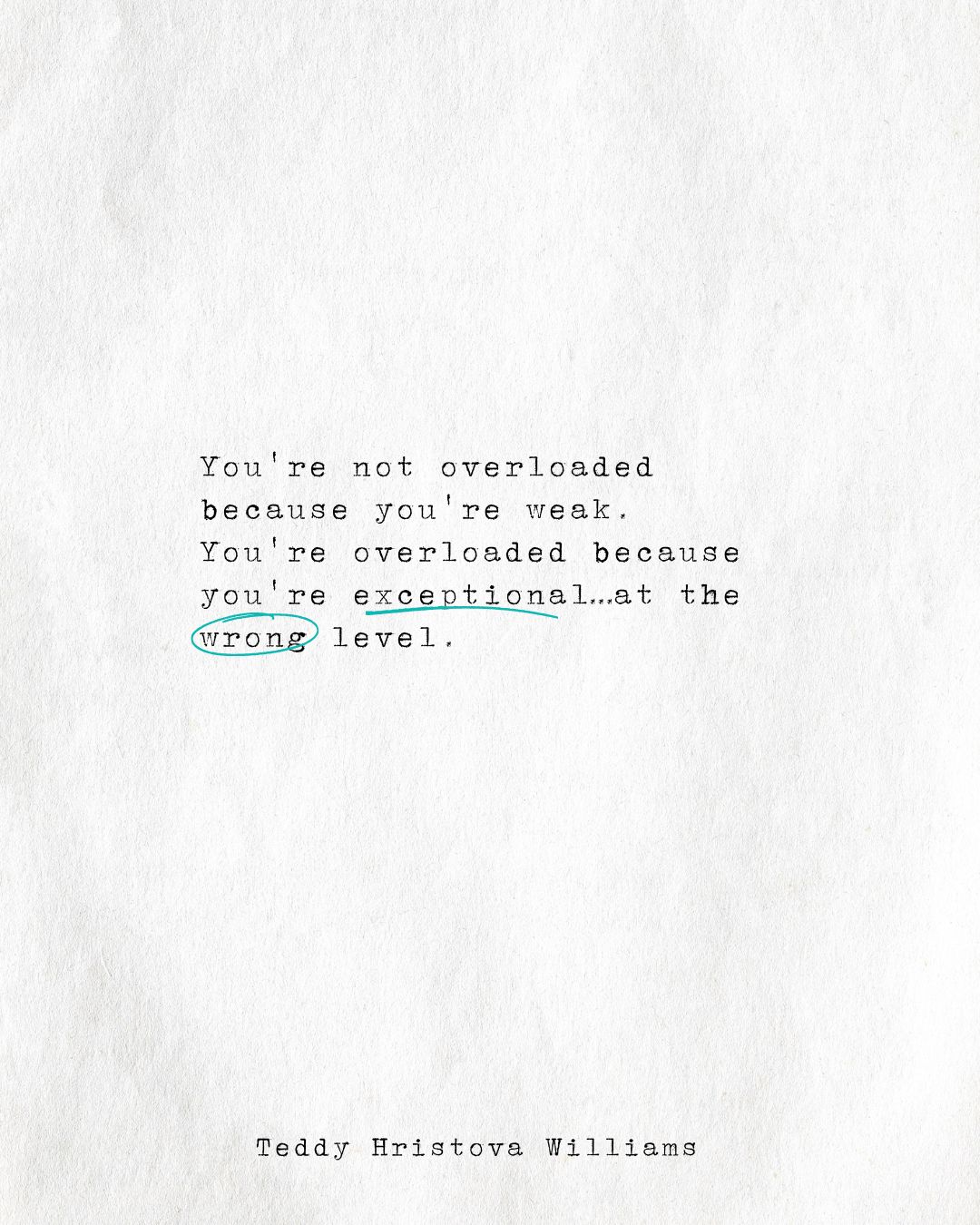
In a recent LinkedIn post, Teddy Hristova Williams explores a common paradox faced by high-achieving professionals: feeling perpetually overloaded not due to a lack of capability, but because their exceptional skills are being applied at the wrong organizational level.
Williams challenges the notion that overload is a sign of weakness, instead framing it as a consequence of exceptional talent that has outpaced the scope of one’s current role. The post suggests that the tendency to “fix,” “catch,” and “step in” is not a character flaw but a skill that has become misaligned.
“You’re not overloaded because you’re weak. You’re overloaded because you’re exceptional …at the wrong level.”
The core of Williams’ argument centers on the evolving nature of responsibility, particularly how the act of “caring” transforms as one progresses in their career. While the intention to care remains constant, the practical application shifts dramatically.
The Misalignment of Skills and Roles
Teddy Hristova Williams highlights a critical disconnect that often goes unaddressed for many high performers. These individuals, driven by a strong sense of responsibility and a desire to contribute, find themselves engaging in tasks that are more suited to a lower level of the organizational hierarchy. This “fixing” and “catching” behavior, while indicative of a proactive and engaged employee, can lead to burnout when it becomes the default mode of operation.
According to Williams, the issue isn’t that these professionals care too much, but rather that the expression of that care is not adapting to the increasing complexity and strategic demands of higher roles.
“The problem isn’t that you care too much. The problem is that caring looks the same at every level but what caring actually requires changes completely.”
This misalignment, as Teddy Hristova Williams points out, is often a key reason why high performers struggle to keep pace. They are expending significant energy on operational tasks that could, or should, be handled elsewhere, leaving less time and capacity for the strategic thinking and design required at their level.
From Doing to Designing
Williams draws a clear distinction between the demands of different career stages. At earlier levels, demonstrating commitment and effectiveness often involves direct action and “doing.” However, as professionals advance, the expectation shifts towards “designing” – creating systems, processes, and strategies that enable others to do their work effectively and efficiently.
“At one level, caring means doing. At the next, it means designing.”
This transition is frequently not explicitly communicated or supported, leaving many exceptional individuals feeling stuck and overwhelmed. They continue to operate under the “doing” paradigm, which is fundamentally incompatible with the strategic “designing” required at higher levels. As Teddy Hristova Williams states, “Most high performers never get told that. They just wonder why they can’t catch up.” This lack of clarity on evolving expectations contributes significantly to the feeling of being overloaded.
Reframing Professional Overload
Teddy Hristova Williams’ post offers a valuable reframing of professional overload. Instead of viewing it as a personal failing or an indicator of being overwhelmed by sheer volume, it suggests a more nuanced perspective: one of skill misapplication. This insight encourages leaders and employees alike to consider whether high performers are truly struggling with their workload, or if their workload is a symptom of their skills being directed towards the wrong objectives.
The implication for organizations is clear: they must provide clarity on the evolving expectations associated with different roles and ensure that high performers are equipped and encouraged to shift from “doing” to “designing.” For individuals, it’s an invitation to self-assess whether their current contributions align with the strategic needs of their role and to seek opportunities that allow their exceptional skills to be applied at the level where they can have the greatest impact.
📝 About This Content
This article is based on insights shared by Teddy Hristova Williams on LinkedIn.
📅 Originally posted on June 29, 2026 | View original post on LinkedIn →