
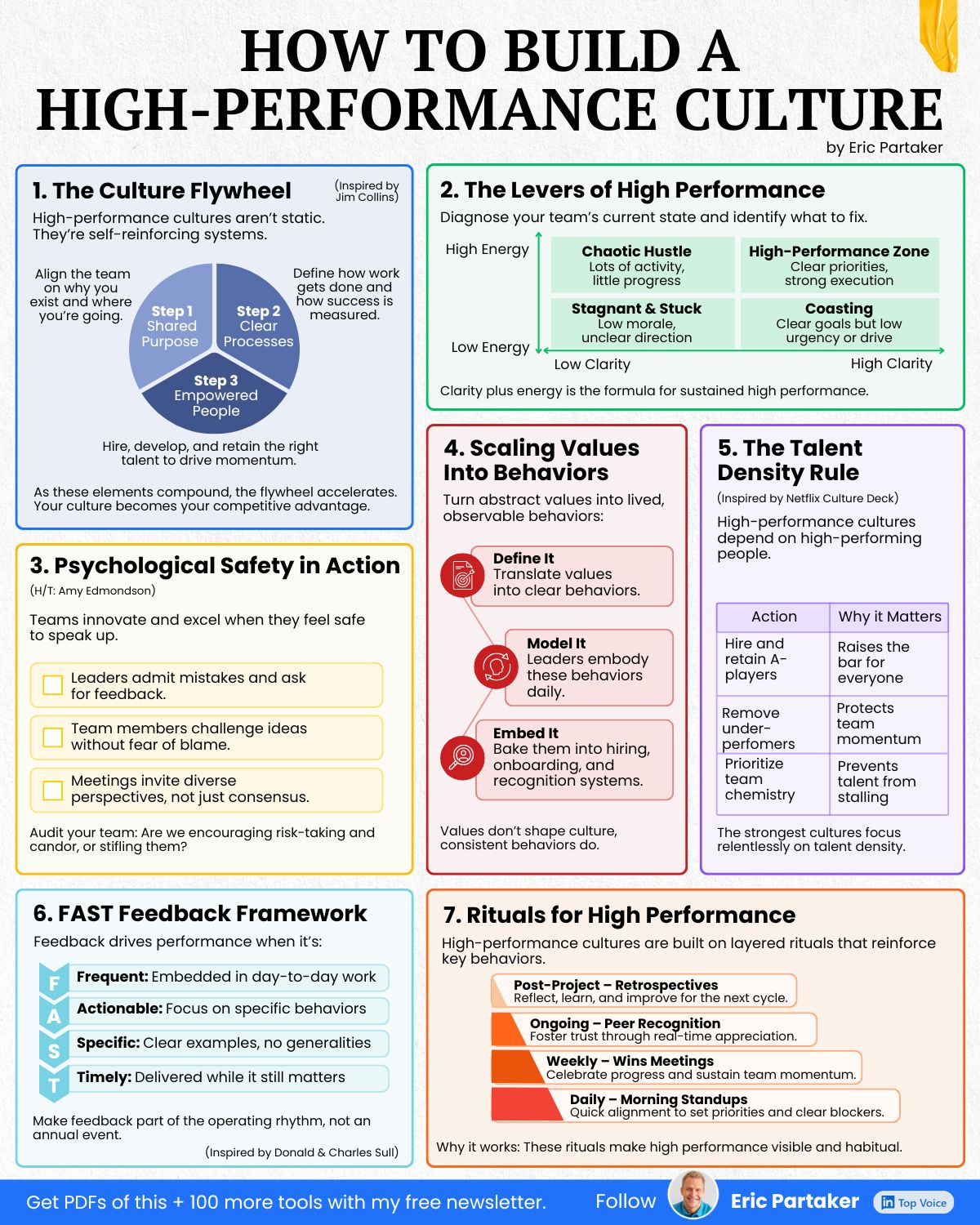
In a recent LinkedIn post, Eric Partaker delves into the critical, yet often overlooked, element that distinguishes top-tier teams: culture. Partaker argues that while many leaders prioritize talent, funding, or product-market fit, the true, inimitable advantage lies in a robust organizational culture.
He highlights the common misconception of culture being a secondary consideration. “Most leaders treat culture like dessert. Nice to have after the “real work.” But culture IS the real work,” Partaker states, emphasizing its foundational role in team success.
Culture as the Engine of Team Performance
Partaker breaks down the essential components of a high-performing culture, positing that purpose, processes, and people are inextricably linked. “Purpose creates direction. Processes create clarity. People create momentum,” he explains. The absence or weakness in any of these areas can bring a team’s progress to a halt, illustrating the interconnectedness of these elements.
To help leaders assess their team’s current state, Partaker presents a diagnostic framework:
- 🔴 Lost and exhausted: low energy, low clarity
- 🟠 Organized chaos: high energy, low clarity
- 🟡 Perfect plans, zero action: high clarity, low energy
- 🟢 Unstoppable force: high clarity, high energy
He observes that the majority of teams struggle in the “lost and exhausted” or “organized chaos” zones. The primary impediment, according to Partaker, is fear, which stifles open communication and innovation.
“Speaking up became dangerous. Challenging ideas feels risky. “Keeping the peace” kills progress.”
Partaker asserts that the onus is on leadership to dismantle this fear-based environment. He proposes actionable steps for leaders to cultivate a healthier culture:
- Admit mistakes publicly.
- Make dissent normal.
- Reward bad news.
He criticizes the disconnect between stated values and actual practices, noting that “‘Innovation’ while punishing failure? Empty. ‘Move fast’ with five approvals? Please.” Partaker advocates for translating abstract values into concrete, observable behaviors that are consistently demonstrated.
The Impact of Player Quality
A significant portion of Partaker’s analysis focuses on the direct impact of employee quality on team dynamics. He presents a stark view on underperformers, stating, “Harsh truth: B-players don’t just underperform. They lower the bar for everyone.” Conversely, he notes that top performers, or “A-players,” seek out environments with other high achievers, and will depart if surrounded by mediocrity. This underscores the necessity of maintaining a high standard for team composition.
The Imperative of Constant Feedback
To support a culture of excellence and continuous improvement, Partaker stresses the importance of immediate, specific, and daily feedback, contrasting it sharply with infrequent or vague annual reviews. “Build rituals that compound: Daily standups that unblock. Retrospectives that improve. Weekly wins that energize. Recognition that connects,” he advises.
In conclusion, Partaker encourages leaders to actively build and engineer their team’s culture rather than passively hoping for positive outcomes. By focusing on observable behaviors, fostering psychological safety, and demanding high standards, leaders can create truly “unstoppable” teams.
📝 About This Content
This article is based on insights shared by Eric Partaker on LinkedIn.
📅 Originally posted on June 29, 2026 | View original post on LinkedIn →