
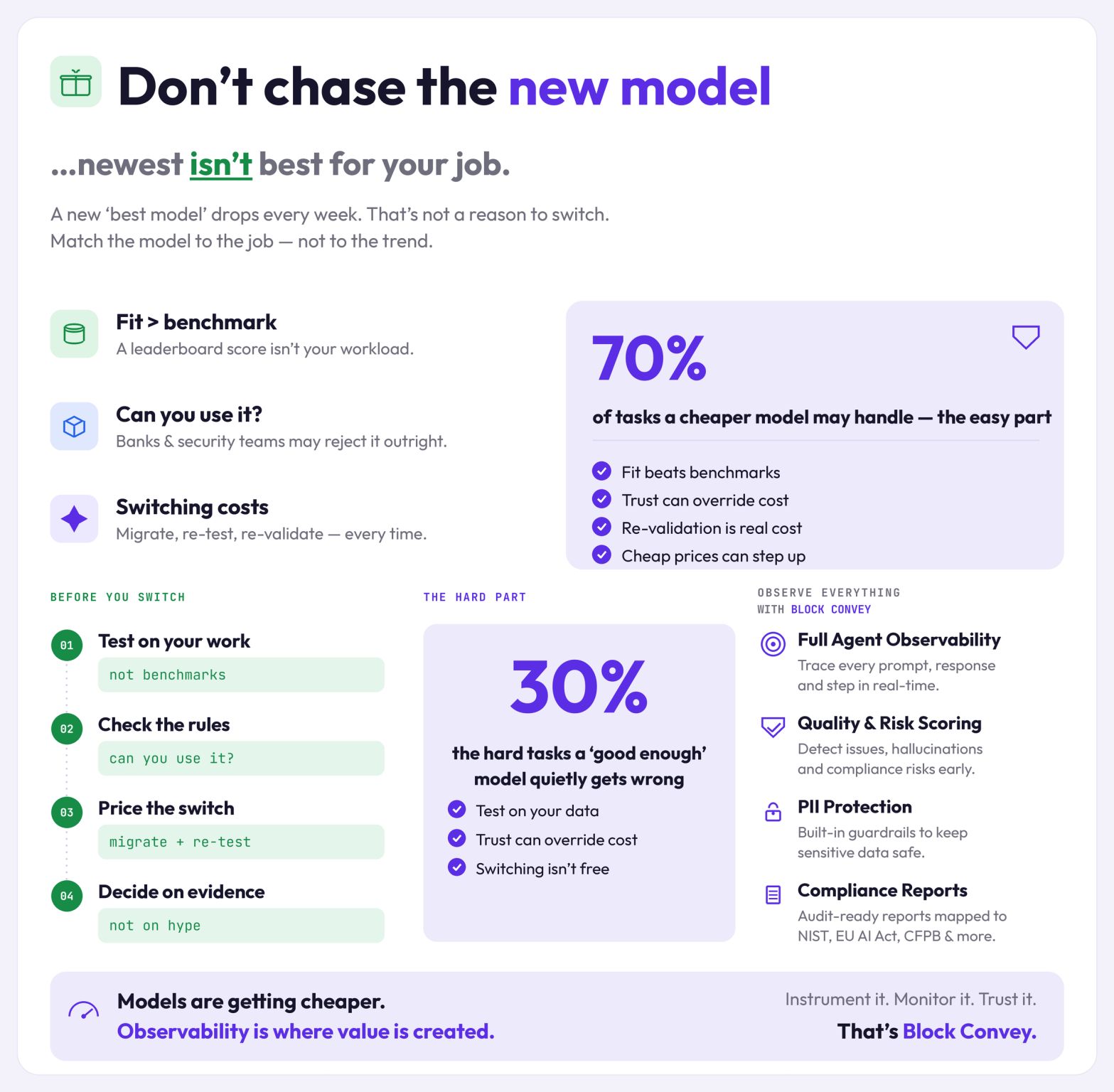
In a recent LinkedIn post, Arun P. cautions business leaders against the allure of constantly switching to the newest trending AI models, emphasizing practical considerations over benchmark performance.
Arun P. highlights the rapid pace at which new AI models are released, noting the near-weekly emergence of a “best model.” However, he argues that this trend should not dictate adoption strategies. As Arun P. states:
“A new ‘best model’ drops almost every week. That does not mean you should switch every week.”
The post, which aims to guide decision-making for AI integration, posits that a headline win in a benchmark test is insufficient justification for overhauling an existing technology stack. Arun P. stresses the importance of evaluating models based on their suitability for specific job functions rather than solely on their comparative scores.
Assessing AI Model Fit Beyond Benchmarks
Arun P. underscores that a model’s performance on a standardized leaderboard does not necessarily translate to real-world effectiveness for a company’s unique workload. He points out a critical flaw in relying solely on benchmarks:
“A cheaper model might nail 60-70% of your tasks and quietly fail the 30% that matter most.”
This perspective suggests that subtle failures in critical, albeit less frequent, tasks can have significant negative business consequences, outweighing any perceived benefits from a top benchmark score.
The Role of Trust and Regulatory Compliance
Beyond functional fit, Arun P. raises concerns about the practical usability and trustworthiness of certain AI models, particularly in sensitive industries. He cites the example of regulated sectors like finance and cybersecurity:
“Analysts note that many banks and cybersecurity firms won’t put a Chinese-origin model in their stack regardless of price or benchmarks. In regulated industries, trust overrides cost.”
This highlights that factors such as geopolitical considerations, data privacy, and regulatory compliance can be non-negotiable prerequisites for adopting new AI technologies, irrespective of their performance metrics or cost-effectiveness.
The Hidden Costs of Model Migration
The author also draws attention to the often-underestimated total cost associated with switching AI models. Arun P. argues that the expense extends beyond the licensing fees, encompassing the resources required for migration, re-testing, and re-validation of risk and compliance protocols.
“Migration, re-testing, and re-validating your risk and compliance work every time you swap. That’s real money and real time.”
Furthermore, Arun P. cautions that introductory pricing for new models may not be stable, citing instances where initial attractive costs have increased post-launch. This volatility adds another layer of financial uncertainty to frequent model switching.
Prioritizing Stability and Understanding
Arun P. concludes by advocating for a pragmatic approach to AI model selection. He suggests that a stable, well-understood, and general-purpose model often provides greater business value than a cutting-edge but less familiar alternative. According to Arun P., the key to confident decision-making lies in gathering empirical evidence of how each model performs on actual business tasks, a process his company’s product, Block Convey, is designed to facilitate.
📝 About This Content
This article is based on insights shared by Arun P. on LinkedIn.
📅 Originally posted on July 7, 2026 | View original post on LinkedIn →