
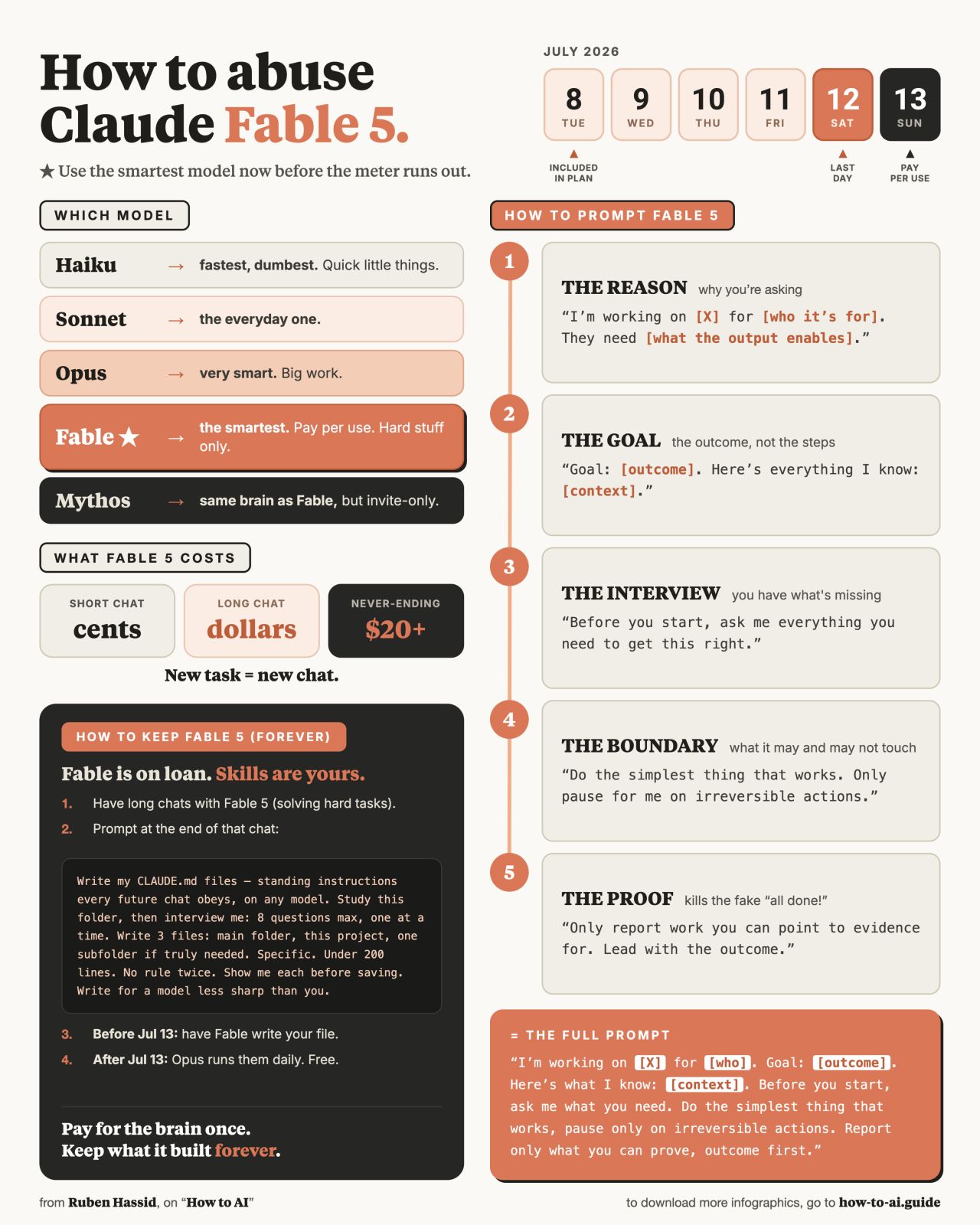
In a recent LinkedIn post, Ruben Hassid explores the strategic implications and cost-saving measures associated with Anthropic’s Fable-5 model, particularly in light of its impending transition from a free tier to a paid service. Hassid emphasizes the need for users to adopt a different approach to interacting with the advanced AI to manage costs effectively.
Hassid highlights the immediate financial impact of continued use post-July 13th, stating:
“On July 13, 𝗙𝗮𝗯𝗹𝗲-𝟱 leaves your Claude plan. After that, every single message becomes a bill.”
He details the potential costs, noting that even a single quick question could amount to $0.15, with more extensive usage escalating rapidly. Hassid tested the pricing himself, observing that 40 turns could cost $14 on top of an existing $100 plan, a consequence he attributes to Claude’s method of re-reading the entire chat history for each interaction.
Strategic Usage of Fable-5
To navigate these changes, Ruben Hassid advises a shift in how users spend their time with Fable-5. He recommends treating it as a tool for high-impact, complex tasks, limiting interactions to one or two turns maximum per session. This leads to his core advice:
Treat Each Task as a New Chat
Hassid stresses the importance of initiating a new chat for every new task. This segmented approach is crucial for cost management. He frames this as a non-negotiable tactic for users aiming to optimize their spending.
Optimize Prompting for Efficiency
Beyond chat structure, Hassid also focuses on prompt engineering. He suggests that users should be direct about their needs and encourage the AI to ask clarifying questions upfront. Hassid argues:
“I need [task] for [goal]. Ask me questions first.”
This interview-style prompting, according to Hassid, ensures that the AI gathers all necessary information before proceeding, making each interaction more valuable and reducing the need for iterative refinement, which translates directly to cost savings.
Leveraging Different AI Models Strategically
A key strategy proposed by Hassid involves a tiered approach, using Fable-5 for high-level strategy and other models for execution. He likens Fable-5’s role to that of a highly paid consultant:
“Fable-5 defines the strategy ($1,000/h lawyer). Opus 4.8 (High) executes it (intern, free in plan).”
In this model, Fable-5 is utilized for its strategic prowess, while a more cost-effective model like Opus 4.8, which is often included in existing plans, handles the execution, such as drafting emails. This prevents users from incurring high costs for tasks that can be managed by less expensive or free resources.
Preserving Fable-5’s Capabilities for Future Use
Hassid also introduces a method for retaining the essence of Fable-5’s advanced capabilities even after the free access ends. He calls this the ‘KEEP DIFFERENT’ strategy:
Creating Persistent Instructions
The core of this strategy involves using Fable-5’s final interactions to generate a comprehensive set of standing instructions. Hassid suggests ending a chat with the prompt:
“Write my CLAUDE .md – standing instructions every future chat obeys.”
These generated instructions, saved as a file, can then be utilized by other models, like Opus, on a daily basis, effectively allowing users to continue benefiting from Fable-5’s strategic output without incurring ongoing per-message charges.
Bonus: A Prompt Generation Skill
As a practical aid, Hassid shares details about a custom skill he developed to simplify the creation of Fable-5 prompts. Users can download this skill from how-to-ai.guide by following a four-step process involving accessing a welcome email, navigating to his Claude Skill Library, searching for the “fable prompt” skill, and uploading it into Claude’s settings. Once installed, users can generate sophisticated prompts by typing a brief idea after the `/fable-prompt` command.
📝 About This Content
This article is based on insights shared by Ruben Hassid on LinkedIn.
📅 Originally posted on July 9, 2026 | View original post on LinkedIn →