
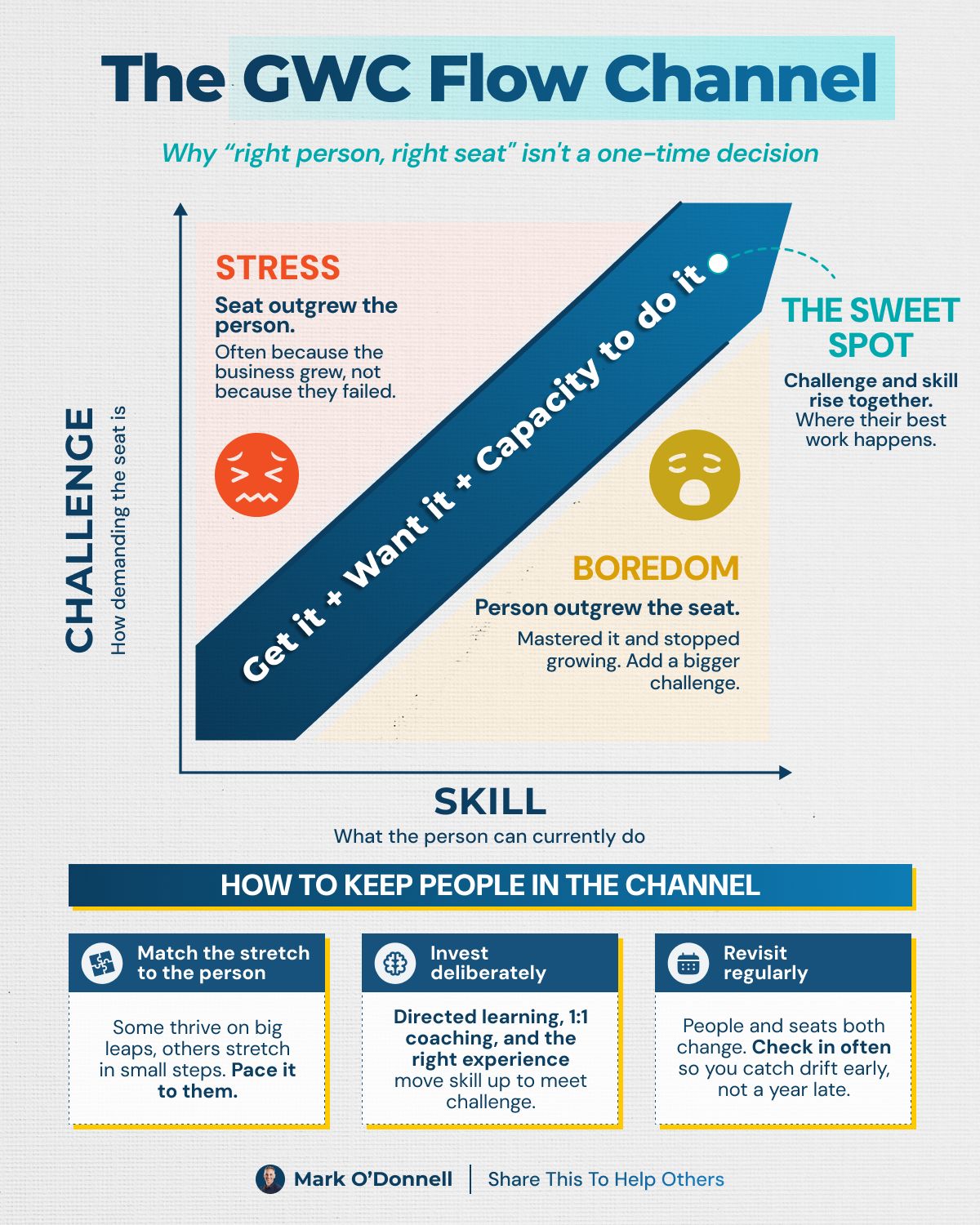
In a recent LinkedIn post, Mark O’Donnell discusses a common leadership pitfall: assuming that once an employee is placed in the ‘right seat,’ their performance will remain optimal indefinitely. O’Donnell argues that this perspective, often stemming from a static view of the “Get, Want, Capacity” (GWC) hiring framework, fails to account for the dynamic nature of both people and their roles within a growing business.
Rethinking ‘Right Person, Right Seat’ as a Dynamic Concept
O’Donnell challenges the notion that GWC is a one-time check. He explains that successful placement requires ongoing attention, as both the demands of a role and an individual’s capabilities are constantly in flux. This dynamic is best understood by visualizing two lines on a graph: one representing the increasing demands of a job, and the other representing an individual’s current capabilities.
“When the two climb together, you get what Csikszentmihalyi called flow, the channel where people do their best work.”
According to O’Donnell, the ideal state for peak performance is this ‘flow channel,’ where the challenge of the role aligns closely with the person’s abilities. However, he points out that employees can fall out of this channel in two primary ways.
The Pitfalls of Boredom and Stress
The first scenario occurs when an individual’s skills surpass the demands of their role, leading to boredom. As O’Donnell notes, “They’ve mastered the role and quietly started mailing it in.” This can result in disengagement and a decline in motivation. The second scenario is the inverse: the demands of the seat outpace the individual’s capabilities, causing stress. In this case, as O’Donnell puts it,
“The seat now asks more than they can give, and the pressure starts to show.”
He emphasizes that both situations are fixable and, crucially, often not the fault of the employee.
The Business as the Moving Target
A key insight from O’Donnell’s post is that the primary driver of these imbalances is often the business itself. As companies grow and evolve, the expectations and demands of every role naturally increase. O’Donnell argues that a role which was a perfect fit a year or two ago may now require more than the incumbent employee, even if that employee has performed flawlessly.
“The role that fit perfectly two years ago now demands more, even though the person sitting in it hasn’t done a single thing wrong. The seat moved, and hey didn’t.”
This perspective reframes the issue from a ‘people problem’ to a ‘growth problem,’ necessitating a proactive approach from leadership.
Strategies for Maintaining Flow and Performance
To keep employees within their flow channel and performing at their best, O’Donnell advocates for intentional, ongoing management rather than passive observation. He outlines several key strategies:
- Matching the ‘stretch’ of a role to the individual’s capacity.
- Investing purposefully in directed learning, 1:1 coaching, and appropriately paced stretch experiences.
- Regularly revisiting role alignment and development through quarterly conversations.
O’Donnell concludes by stressing the profound impact of sustained flow, stating that when individuals are in their optimal channel, they achieve the best work of their careers. Furthermore, when an entire team operates in this state, both trust and overall output significantly increase, leading to a high-performing unit.
He prompts leaders to consider whether they have recently reassessed the ‘right person, right seat’ alignment, especially in light of business growth.
📝 About This Content
This article is based on insights shared by Mark O'Donnell on LinkedIn.
📅 Originally posted on July 9, 2026 | View original post on LinkedIn →