
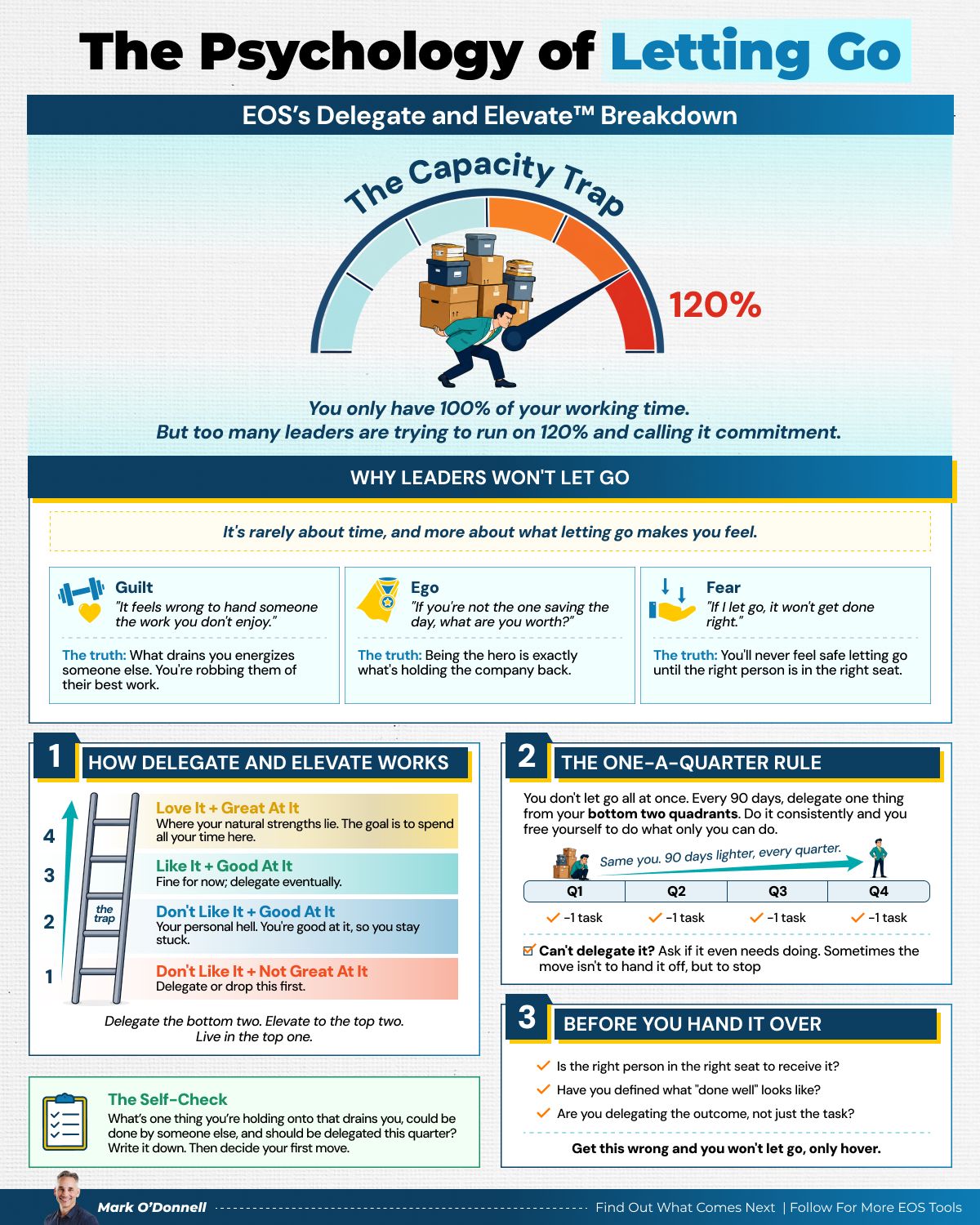
In a recent LinkedIn post, Mark O’Donnell explores a common paradox faced by many business leaders: the struggle to delegate effectively, despite recognizing its necessity. O’Donnell posits that the perceived “time problem” many leaders experience is often, in reality, a “letting-go problem” rooted in emotional rather than logical barriers.
The Misconception of Leadership Time Constraints
O’Donnell challenges the notion that leaders are simply overloaded with work, suggesting instead that they often operate at an unsustainable 120% capacity, wearing this overextension as a badge of honor. He highlights that the solution – delegation – is often understood intellectually but resisted emotionally. “Nine times out of ten, what they’ve actually got is a letting-go problem,” O’Donnell writes, emphasizing that this issue resides “in your gut” rather than on a calendar.
“So many leaders think they’ve got a time problem. Nine times out of ten, what they’ve actually got is a letting-go problem.”
Unpacking the Emotional Barriers to Delegation
According to O’Donnell, three primary emotional factors keep leaders from delegating effectively: guilt, ego, and fear.
Guilt
The first hurdle, guilt, stems from the feeling that it’s wrong to assign unpleasant or difficult tasks to others. However, O’Donnell argues that tasks that burden a leader might energize the right team member. As he puts it:
“It feels wrong to hand someone the work you can’t stand. But the stuff that flattens you will light the right person up.”
Ego
Ego presents another significant obstacle. Leaders may feel their value diminishes if they are not the one constantly “riding in to save the day.” O’Donnell contends that this need to be the hero can inadvertently stunt company growth, stating, “And being the hero is the very thing keeping your company small.” This perspective suggests that true leadership involves empowering others, not solely demonstrating personal capability.
Fear
Fear, particularly the concern that tasks “won’t get done right without me,” is a pervasive issue. O’Donnell believes this fear is only overcome when the right individuals are in the correct roles, capable of handling responsibilities effectively.
The “Delegate and Elevate” Framework
To address these challenges, O’Donnell introduces a framework he calls “Delegate and Elevate.” He likens it to a ladder, categorizing tasks based on enjoyment and proficiency:
- Bottom Rung: Stuff you don’t like and aren’t great at. These should be delegated first.
- Second Rung: Stuff you don’t like but are good at. This is a common trap where competence leads to inaction.
- Third Rung: Stuff you like and are good at. These can be delegated later.
- Top Rung: Stuff you love and are great at. This is where leaders should ideally focus their energy.
O’Donnell proposes a simple discipline: every 90 days, leaders should delegate one task from their bottom two rungs. He stresses a crucial caveat: this process is only successful if the right person is in place to receive the delegated task. Without the right team, delegation can lead to micromanagement.
“You already know delegating would fix it… But you still won’t do it. Because the reasons aren’t logical, but emotional.”
Ultimately, Mark O’Donnell’s insights, shared on LinkedIn, encourage leaders to confront the emotional roots of their delegation reluctance. By understanding and addressing guilt, ego, and fear, and by systematically applying a “Delegate and Elevate” approach, leaders can move beyond 120% capacity towards the freedom and strategic focus they initially sought when building their businesses.
📝 About This Content
This article is based on insights shared by Mark O'Donnell on LinkedIn.
📅 Originally posted on July 11, 2026 | View original post on LinkedIn →