
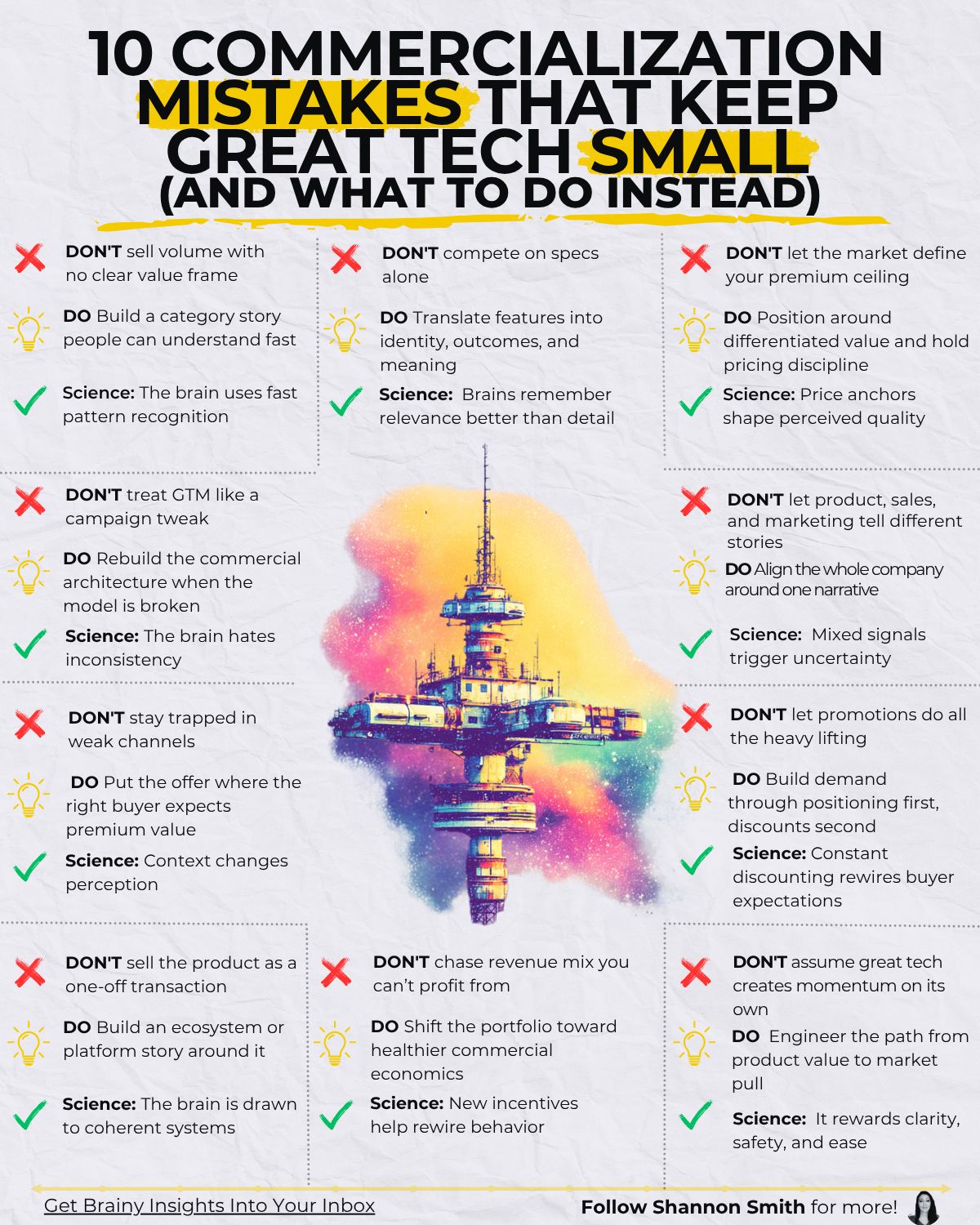
In a recent LinkedIn post, Shannon Smith, J.D., M.S. discusses a common pitfall for technology companies: brilliant products undermined by flawed commercialization strategies. Smith, J.D., M.S. argues that many tech firms succeed in innovation but falter when bringing their creations to market, often by treating them as commodities or resorting to heavy discounting.
“Most tech companies fail the same way. Brilliant product. Broken commercialization,” Smith, J.D., M.S. states, setting the stage for an analysis grounded in neuroscience. The core of the issue, according to Smith, J.D., M.S., lies in understanding how the brain processes information, particularly in purchasing decisions.
“They build something the world needs then sell it like a commodity, discount it into the ground, or let three different teams tell three different stories.”
Understanding the ‘Brain-Based Map’ for Commercialization
Smith, J.D., M.S. outlines a ten-point strategy, framed as a “brain-based map,” to address these commercialization failures. This approach emphasizes leveraging cognitive science to improve go-to-market (GTM) strategies.
Avoiding Volume-Based Sales Without Clear Value
One key point highlighted by Smith, J.D., M.S. is the danger of selling based on volume without a clear value proposition. The brain, as Smith, J.D., M.S. explains, relies on fast pattern recognition. If potential buyers cannot quickly categorize or understand the value of a product, hesitation is inevitable. Smith, J.D., M.S. advocates for building a clear “category story” that is easily grasped.
Translating Features into Meaningful Outcomes
Another critical area addressed is the tendency to compete solely on technical specifications. Smith, J.D., M.S. argues that this approach misses the mark because “brains remember relevance better than detail.” Instead, features should be translated into tangible identity markers, desirable outcomes, and deeper meaning for the customer. This resonates more effectively than technical depth alone.
“Utility and status land faster than technical depth.”
The Perils of Discounting and Market-Defined Pricing
Smith, J.D., M.S. also warns against allowing the market to dictate the premium pricing ceiling, particularly through aggressive discounting. According to Smith, J.D., M.S., “Discounting trains the brain to expect less value.” The recommended approach is to position products around differentiated value and maintain pricing discipline to preserve the perception of premium quality.
Aligning Internal Narratives for Consistent Messaging
A significant challenge identified is the fragmentation of messaging across product, sales, and marketing teams. Smith, J.D., M.S. stresses the importance of aligning the entire company around a single, cohesive narrative. This is crucial because, as Smith, J.D., M.S. points out, “Mixed signals trigger uncertainty,” which in turn slows down the decision-making process for buyers.
“The brain hates inconsistency. Small surface fixes don’t resolve structural confusion.”
Building Demand Through Positioning, Not Just Promotions
Furthermore, Smith, J.D., M.S. advises against relying heavily on promotions to drive sales. The post suggests that demand should be built primarily through strong positioning, with discounts serving a secondary role. Constant discounting, in Smith, J.D., M.S.’s view, “rewires buyer expectations” and can weaken long-term brand value.
Commercialization as Revenue Architecture
Ultimately, Shannon Smith, J.D., M.S. concludes that effective commercialization is not merely a marketing enhancement but fundamental “revenue architecture.” This involves engineering a clear path from product value to market pull, recognizing that innovation alone does not guarantee market momentum. The brain, Smith, J.D., M.S. reiterates, rewards clarity, safety, and ease, not just novelty.
📝 About This Content
This article is based on insights shared by Shannon Smith, J.D., M.S. on LinkedIn.
📅 Originally posted on July 14, 2026 | View original post on LinkedIn →