
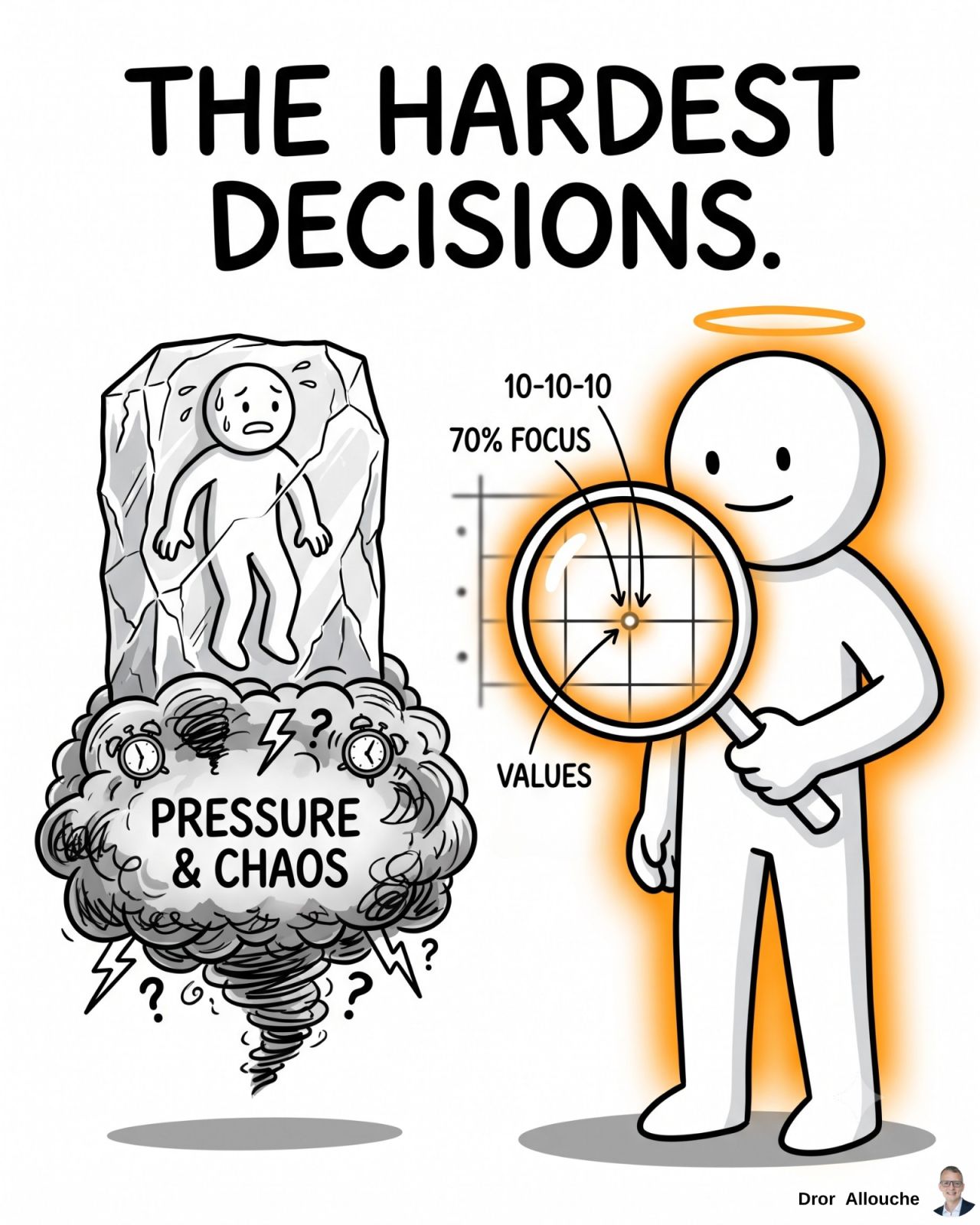
In a recent LinkedIn post, Dror Allouche delves into the decision-making processes that distinguish elite leaders from their average counterparts, particularly when faced with high-stakes situations. Allouche contends that the key differentiator is not innate talent but a deliberately cultivated and “weaponized” decision-making framework.
Allouche highlights that while many leaders might falter or freeze under intense pressure, the most effective ones actually become sharper. This enhanced performance, according to the post, stems from a strategic approach to decision-making that has been honed through practice and specific techniques.
“Elite leaders have a secret weapon. It’s not what we think. Charisma. Experience. Intelligence. It’s how they make decisions under pressure.”
The Elite Leader’s Decision-Making Arsenal
Dror Allouche outlines six distinct techniques that elite leaders employ to navigate high-pressure environments effectively. These methods are designed to provide clarity, mitigate risk, and ensure long-term viability of decisions, even when time is of the essence.
1. The 10-10-10 Rule for Temporal Perspective
One of the core strategies shared by Allouche is the 10-10-10 rule. This technique prompts leaders to consider the implications of a decision across different time horizons: how they will feel about it in 10 minutes, 10 months, and 10 years. This framework encourages a move away from immediate emotional reactions towards a more balanced, long-term perspective.
2. Information Sufficiency Threshold for Efficiency
Allouche also introduces the concept of an ‘Information Sufficiency Threshold.’ This involves setting a clear deadline for decision-making before analysis begins and defining the precise data needed. The goal is to avoid analysis paralysis by acting once a predetermined level of certainty, around 70%, is reached. As Dror Allouche notes, “Set your decision deadline before you start analyzing.” This approach ensures timely action without being bogged down by excessive data gathering.
3. Pre-Mortem Analysis for Risk Mitigation
To proactively address potential failures, Allouche suggests employing a ‘Pre-Mortem Analysis.’ This involves imagining a decision has failed and then identifying the top three reasons for that failure. By anticipating these risks, leaders can build specific safeguards. This proactive risk assessment is a hallmark of robust leadership, as it allows for challenges to be addressed before they materialize.
“If this decision fails, what went wrong? Identify the top 3 failure scenarios Build specific safeguards for each risk.”
4. Reversibility Assessment for Scaled Scrutiny
The ease with which a decision can be undone is also a critical factor, according to Allouche. The ‘Reversibility Assessment’ guides leaders to spend less time on easily reversible decisions and to dedicate more scrutiny to those that are irreversible. This practical consideration optimizes the allocation of analytical resources.
5. The Regret Minimization Framework for Value Alignment
When faced with difficult choices, Dror Allouche points to the ‘Regret Minimization Framework.’ This involves asking which choice will lead to the least regret at an advanced age, typically 80. This principle encourages leaders to prioritize long-term impact and value alignment over short-term comfort or ease.
“Which choice will I regret least at 80? Focus on long-term impact over short-term comfort Choose the path that honors your values.”
6. Pressure Breathing Protocol for Physiological Control
Finally, Allouche emphasizes the physiological aspect of decision-making with the ‘Pressure Breathing Protocol.’ This simple yet effective technique involves taking three deep breaths before making a major decision. According to Allouche, this practice helps to calm the mind by controlling physiology, leading to clearer thinking under duress.
In conclusion, Dror Allouche’s insights underscore that effective leadership under pressure is not about avoiding stress, but about rigorous preparation and the strategic application of proven decision-making techniques. As Allouche states, “Pressure reveals character. Preparation reveals leaders.” The post serves as a practical guide for leaders aiming to enhance their performance when it matters most.
📝 About This Content
This article is based on insights shared by Dror Allouche on LinkedIn.
📅 Originally posted on July 17, 2026 | View original post on LinkedIn →