
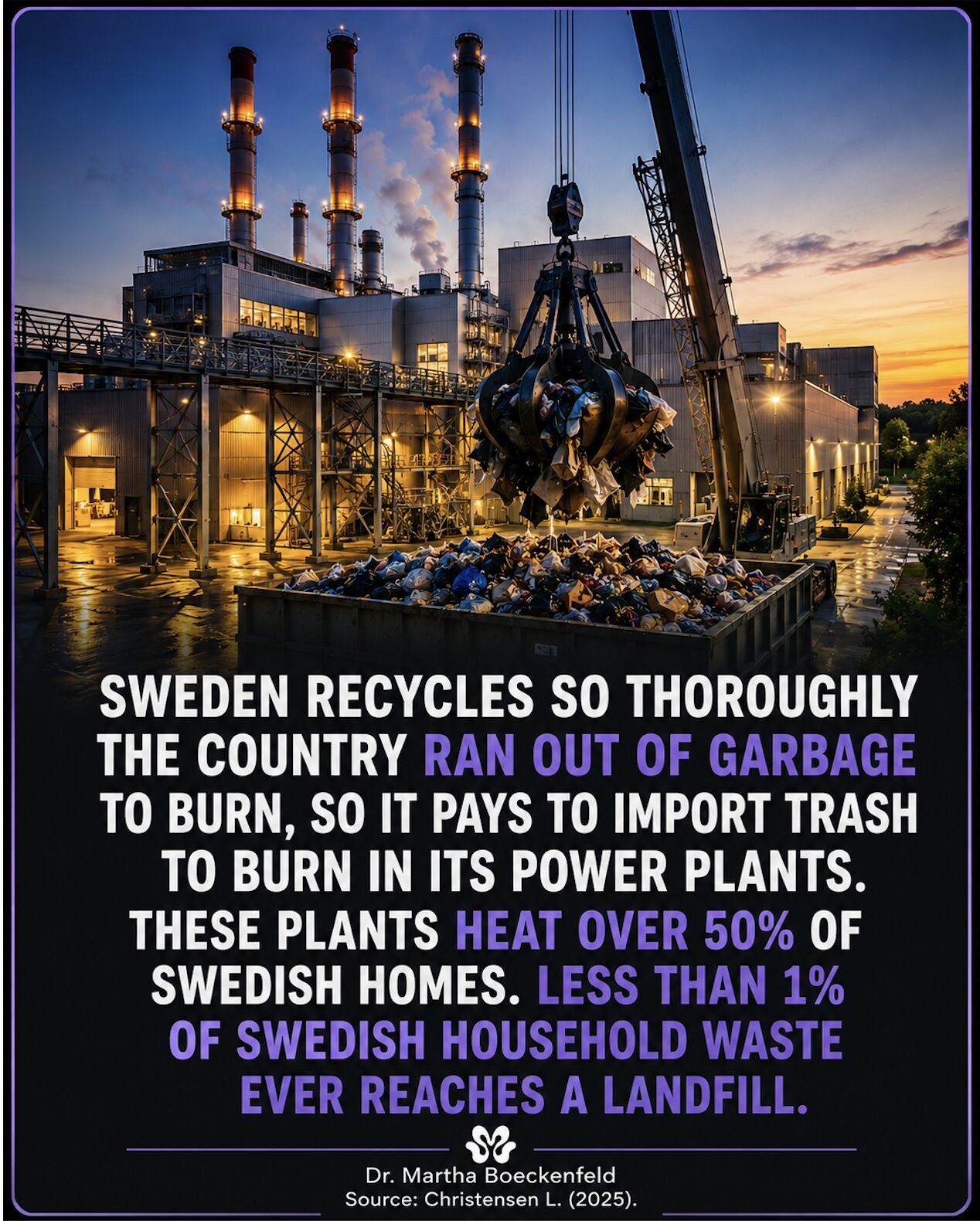
In a recent LinkedIn post, Dr. Martha Boeckenfeld discusses Sweden’s remarkable transformation in waste management, highlighting how decades of consistent public participation and habit formation led to a system where waste is now a valuable resource for energy. Dr. Boeckenfeld contrasts the past, where neighborhoods suffered from the stench of overflowing landfills, with the present, where household waste is a key component in heating homes and generating electricity.
Dr. Martha Boeckenfeld opens by painting a vivid picture of the past:
The stench filled her stairwell and clung to laundry drying on the balcony. That was the 1970s. Swedish landfills were overflowing, waterways were polluted, and trust in the waste system was falling apart.
The shift, as detailed by Dr. Boeckenfeld, was not the result of a single policy or technological breakthrough, but rather a sustained, multi-generational effort involving public education and infrastructure development.
The Long Road to Sustainable Waste Management
Dr. Martha Boeckenfeld emphasizes that the current success in Sweden, where less than 1% of household waste goes to landfill and a significant portion is recycled or used for energy, was a gradual process. This involved introducing color-coded bags, establishing neighborhood sorting stations, and implementing extended producer responsibility laws that made companies accountable for their packaging waste. Crucially, these systems were taught and reinforced in schools, workplaces, and residential buildings over many years.
As Dr. Martha Boeckenfeld points out:
One law or one piece of technology did not create that result. Millions of people repeated the same household habit for 30 years.
This highlights a core theme of the post: the power of ingrained societal habits. While sorting waste is mandatory in Sweden, Dr. Boeckenfeld argues that compliance has endured because the routine has become deeply embedded in daily life, supported by social reinforcement from neighbors and apartment buildings.
Habit Formation Over Mandates
A key takeaway from Dr. Boeckenfeld’s analysis is that while regulations provide the framework, sustained behavioral change relies on habit formation. The example of a young child diligently sorting waste since the age of six illustrates how these practices are learned and become second nature. This long-term commitment has led to a situation where Sweden now operates 34 waste-to-energy plants and even imports waste from other countries to maintain their operational capacity.
Dr. Martha Boeckenfeld reflects on the scale of this achievement:
Still, Sweden went from overflowing landfills to having more incineration capacity than domestic waste. That shift began with people putting rubbish in the right bag, day after day.
The post also acknowledges the complexities and potential trade-offs, such as the concern that importing waste might disincentivize other nations from improving their own systems, and the CO₂ emissions associated with waste incineration. However, Dr. Boeckenfeld frames these as important considerations within the broader success story of transforming waste from a problem into a resource.
Lessons for the Future
Dr. Martha Boeckenfeld concludes by posing a question to readers about their own family’s habits, inviting reflection on the challenges and persistence required for long-term behavioral change. The insights from Sweden’s waste management journey offer a compelling case study in how societal challenges can be addressed through sustained public engagement and the cultivation of deeply ingrained habits, a perspective relevant as societies grapple with various environmental and technological shifts.
📝 About This Content
This article is based on insights shared by Dr. Martha Boeckenfeld on LinkedIn.
📅 Originally posted on July 20, 2026 | View original post on LinkedIn →