
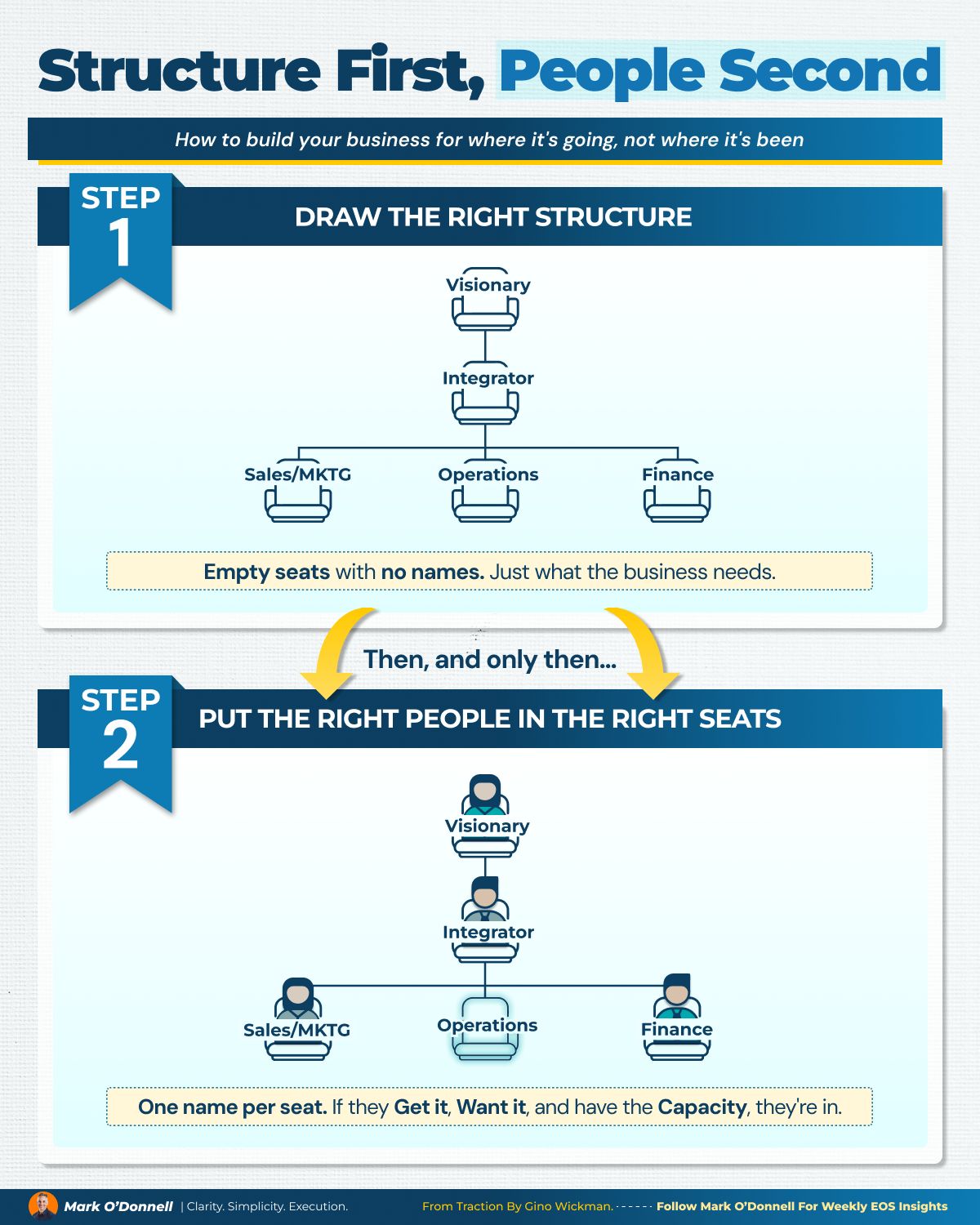
In a recent LinkedIn post, Mark O’Donnell offers a strategic framework for organizational design, emphasizing the critical importance of defining roles and responsibilities before assigning individuals. O’Donnell argues that a common pitfall for businesses is prioritizing people over structure, leading to suboptimal organizational charts that hinder growth.
He begins by suggesting a thought experiment: remove all names from an organizational structure. “What’s left is either clarity or a mess you’ve been hiding,” O’Donnell states, underscoring the need for an objective view of the business’s needs.
The Primacy of Structure
O’Donnell highlights that the sequence of building an accountability chart is paramount, a step often rushed by teams. “Structure first. People second,” he asserts, a principle derived from the EOS (Entrepreneurial Operating System) methodology, as popularized in the book “Traction.” This approach, he explains, is crucial because the presence of names can cloud judgment.
“The second a name lands in a box, your judgment bends. You start designing around history, loyalty, and who you’d rather not upset, instead of what the business actually requires.”
As Mark O’Donnell points out, the temptation to build a structure around existing employees, based on tenure or personal relationships, can be detrimental. This practice, while seemingly considerate, ultimately holds back both the company’s progress and the individuals placed in unsuitable roles.
Defining the Ideal Structure
The core question, according to O’Donnell, that an organizational structure must answer is: “What shape does this business need to move forward over the next six to twelve months?” He outlines three guiding rules from “Traction” to achieve this clarity:
- Look ahead, not behind. Past practices should not dictate future needs.
- Step out of your own role and set your ego down. Be prepared for the possibility that your own role might not exist in the new structure.
- Decide for the long-term good of the whole company, not any one person in it. Prioritize the collective benefit over individual comfort.
Mark O’Donnell emphasizes that adhering to these principles ensures the structure is designed for the business’s future success, not its current personnel.
Filling Seats with the Right Fit
Once the ideal structure is defined, the process of filling roles becomes more straightforward. O’Donnell introduces the “GWC” (Get it, Want it, Capacity to do it) test. This assessment focuses on whether an individual possesses the necessary understanding, desire, and capability for the role.
“For each one you ask a single thing: does this person Get it, Want it, and have the Capacity to do it? That’s GWC, the right-seat test.”
He cautions against conflating this with the “Right Person” assessment, which relates to core values. O’Donnell insists these are distinct evaluations, with core values being foundational and GWC being role-specific. This separation, he argues, leads to cleaner decision-making.
Accountability and Honest Assessment
Mark O’Donnell concludes by noting that when each seat is clearly owned by one individual, accountability becomes tangible. The ambiguity that arises when multiple people share responsibility, he states, leads to a diffusion of ownership.
“And when one person owns each seat, accountability turns real. The moment two people share it, nobody actually holds it.”
He issues a final warning: implementing this process correctly may unearth long-standing issues concerning personnel. However, O’Donnell frames this not as a flaw in the methodology, but as evidence of its effectiveness in revealing and addressing organizational weaknesses. The critical question for leaders, he prompts, is whether their current structure serves the business’s needs or merely accommodates existing staff.
📝 About This Content
This article is based on insights shared by Mark O'Donnell on LinkedIn.
📅 Originally posted on July 20, 2026 | View original post on LinkedIn →