
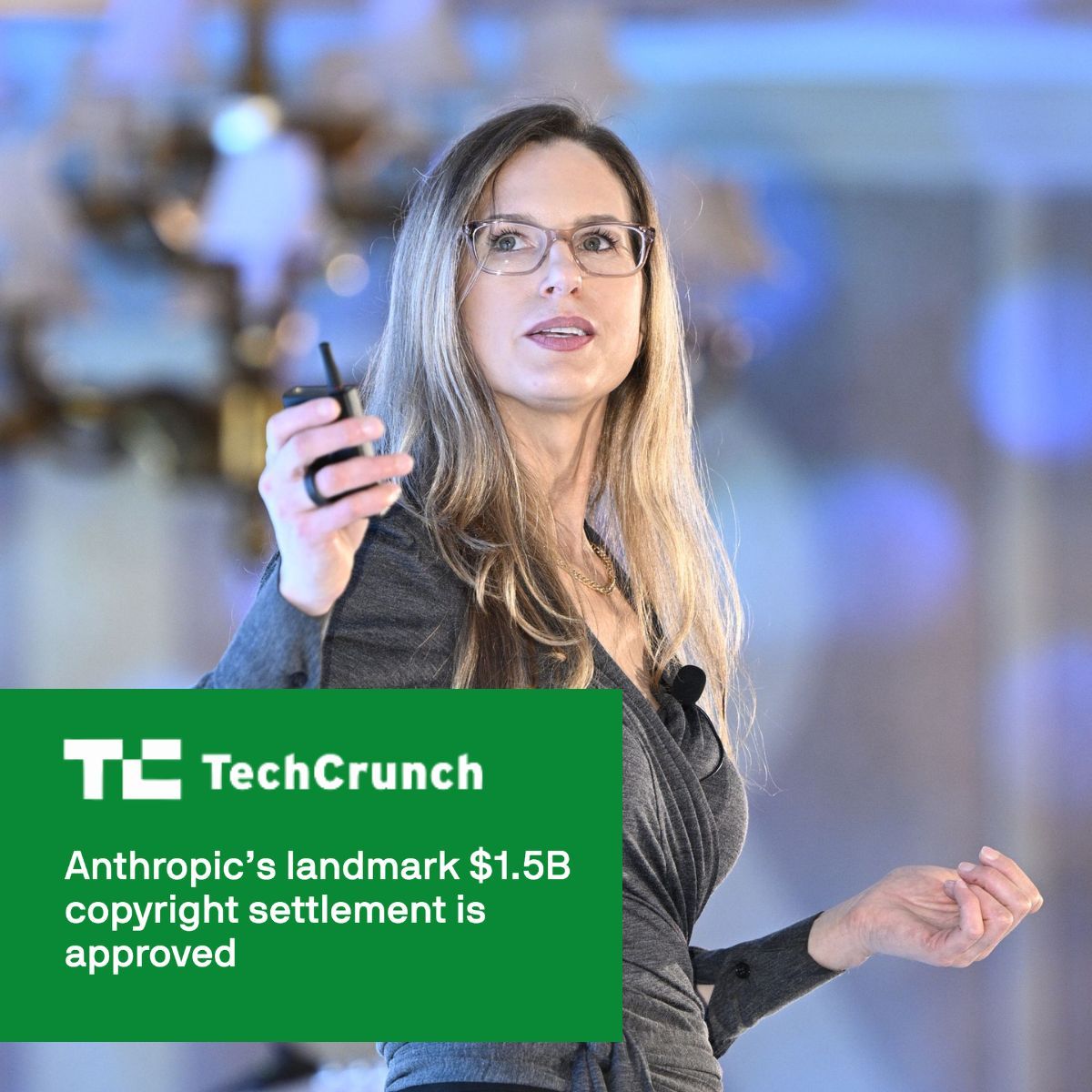
In a recent LinkedIn post, author Alison McCauley delves into the complex implications of Anthropic’s $1.5 billion copyright settlement, sharing her mixed feelings as a creator and AI industry insider.
McCauley begins by framing the settlement as a catalyst for broader conversations about digital creation and intellectual property in the age of AI. She notes the court’s ruling that training AI on books constitutes fair use, drawing a parallel between AI models and readers learning from literature to foster their own creativity.
“The court ruled that training AI on books is fair use. The judge compared the AI model to ‘any reader aspiring to be a writer,’ who studies existing literature not to replicate it, but to learn how to create something new.”
However, McCauley quickly identifies a core issue: the source of the training data. She points out the irony that Anthropic’s settlement stems from the use of pirated libraries, and that she, as an author whose work has been pirated, is now receiving payment from an entity for that very act, albeit through a legal settlement.
The Velocity Mismatch in AI Development
A central theme in McCauley’s analysis is the significant gap between the rapid advancement of AI technology and the slower pace of our societal, systemic, and institutional responses. She highlights the challenge of keeping up with AI’s evolution.
According to McCauley, this disparity creates a situation where creators struggle to adapt and find appropriate compensation models. She observes the narrow scope of the Anthropic settlement, which only covers works registered with the Copyright Office within a specific timeframe, leaving millions of other pirated books ineligible.
“There is a velocity mismatch between the AI market and our ability (us, our systems, and our institutions) to keep up with that pace, and I’m not seeing anything that comes close to fixing that.”
Navigating Personal and Professional Conflicts
McCauley reveals her unique position as both a creator and someone deeply involved in the AI industry. Having worked with AI founders since 2010 and assisted others in understanding the technology, she finds the settlement’s framing of her as a victim somewhat misplaced.
She argues that the settlement, while offering a financial payout, does not address the fundamental economic shifts impacting future generations of creators. As AI becomes an increasingly dominant layer for content distribution, McCauley questions how new creators will be compensated.
“It does nothing about the shifting economics of the future. We do not have structural answers about how the next generation of creators gets compensated as AI becomes the default distribution layer for creation.”
Ultimately, McCauley concludes by posing a personal question stemming from this complex situation: given the circumstances and her role within the evolving AI landscape, what is the most appropriate action to take with the settlement check she is due to receive?
📝 About This Content
This article is based on insights shared by Alison McCauley on LinkedIn.
📅 Originally posted on July 21, 2026 | View original post on LinkedIn →