
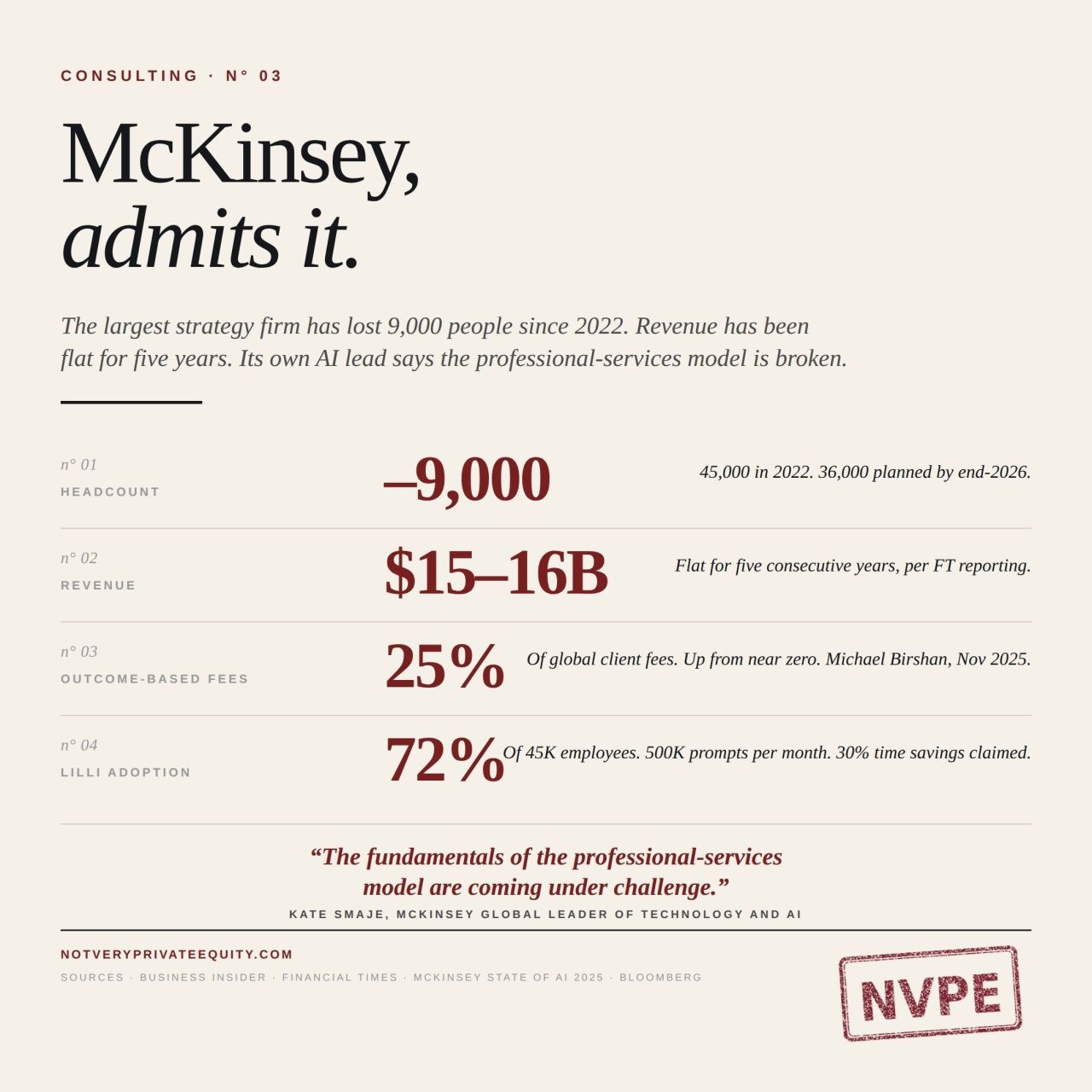
In a recent LinkedIn post, Lee McCabe delves into the profound implications of artificial intelligence for the traditional professional services model, using recent reports from McKinsey & Company as a stark illustration. McCabe highlights McKinsey’s own data, which indicates significant shifts in their operations and client engagement, suggesting a fundamental challenge to established consulting practices.
The Shifting Sands of Consulting Economics
McCabe points to several key indicators from McKinsey’s performance that signal a disruption. He notes the reported headcount reduction of 9,000 since 2022 and flat revenue over five years as critical data points. Furthermore, the increasing adoption of outcome-based fees, now representing a quarter of global client fees, and the high utilization of AI tools like ‘Lilli’ (72% of employees) are presented not as isolated events, but as symptoms of a larger transformation.
The core of McCabe’s analysis hinges on a quote from McKinsey’s Global Leader of Technology and AI, which he emphasizes is a significant admission from a leading firm:
“The fundamentals of the professional services model are coming under challenge.”
As Lee McCabe elaborates, the historical profitability of consulting was built on a foundation of inefficiency. He outlines this traditional model:
“Lots of people. Lots of hours. Lots of meetings. Lots of slides. Lots of expensive ambiguity.”
McCabe argues that AI directly undermines this model by accelerating research, reducing analysis costs, automating synthesis, commoditizing benchmarks, and making the reliance on junior labor less justifiable. Clients, he suggests, will increasingly question the value derived from lengthy, resource-intensive engagements.
The Imperative for Strategic Adaptation
According to Lee McCabe, firms that recognize this shift must adapt by focusing on tangible outcomes, proprietary data, software solutions, execution capabilities, and genuine accountability. He contrasts this forward-thinking approach with what he terms the less-adaptable strategy:
“The less smart ones will rebrand the same model as “AI-enabled transformation” and hope nobody notices the invoice still smells of 2014.”
McCabe extends his analysis to the realm of private equity, warning that any advisory model predicated on activity rather than demonstrable impact is vulnerable. He critiques a scenario where value creation plans rely on consultants producing superficial deliverables while portfolio companies suffer from systemic issues.
The ‘Screensaver’ Approach to Value Creation
In Lee McCabe’s view, such a strategy is not a plan for value creation but merely an expensive facade. He frames it critically:
“If your value creation plan depends on external consultants producing decorative PDFs while the portfolio company slowly suffocates under bad data, bad systems and bad accountability, you do not have a plan. You have a very expensive screensaver.”
McCabe’s post serves as a wake-up call for the consulting and advisory industries, urging them to embrace efficiency, deliver measurable impact, and leverage AI constructively, rather than clinging to outdated models that are increasingly being challenged by technological advancements and evolving client expectations.
📝 About This Content
This article is based on insights shared by Lee McCabe on LinkedIn.
📅 Originally posted on July 21, 2026 | View original post on LinkedIn →