
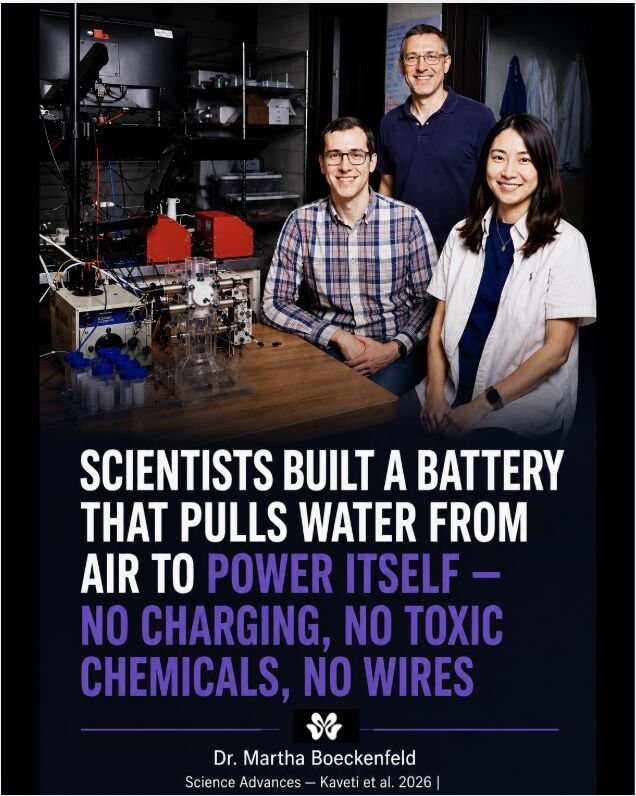
In a recent LinkedIn post, Dr. Martha Boeckenfeld highlights a significant advancement in battery technology that could redefine portable power, particularly for medical applications. Dr. Boeckenfeld discusses the work of materials scientist Rajaram Kaveti and his team at North Carolina State University, who have developed a novel battery that activates itself using ambient moisture, eliminating the risks associated with liquid electrolytes.
Rethinking Battery Design for Enhanced Safety
Dr. Boeckenfeld emphasizes that traditional batteries, often worn on the body for medical devices like heart monitors and oxygen sensors, contain chemicals that pose risks of leakage, burning, or skin corrosion. This conventional approach, she notes, has been accepted despite these inherent dangers. Kaveti and his collaborator Amay Bandodkar challenged this status quo by questioning the necessity of liquid electrolytes altogether.
As Dr. Boeckenfeld explains, the innovation lies in a battery that ships in a completely dry state, remaining inert and possessing an indefinite shelf life until activated. The activation process is remarkably simple: upon opening, salts within the battery draw moisture from the air, dissolving lithium chloride to form a saltwater electrolyte. This self-activating mechanism negates the need for charging or external power sources.
“We wanted to avoid toxic electrolytes. The best case is water.”
This statement, attributed by Dr. Boeckenfeld to Kaveti, encapsulates the core philosophy behind the invention – prioritizing safety and simplicity by utilizing the most benign and readily available element: water.
Key Performance Metrics and Applications
Dr. Martha Boeckenfeld details several impressive performance metrics for this new battery technology. According to her post, it reaches a steady voltage in approximately seven minutes and functions effectively in environments with humidity as low as 10%, making it suitable for extremely dry conditions like deserts. The battery boasts an open-circuit voltage of 1.6V and successfully powered a wireless pulse oximeter for 30 consecutive hours. Furthermore, the materials used are non-toxic, non-flammable, and biodegradable.
The potential applications, as highlighted by Dr. Boeckenfeld, extend far beyond immediate medical use. She points out:
- The ability to bend without cracking, inspired by pangolin scales, allows the battery to conform to body movements.
- Its self-activating nature makes it ideal for remote sensors where battery replacement is impractical.
- It could be crucial for emergency medical devices shipped to disaster zones, activating on-site when needed.
- The technology could even enable moisture-triggered kill switches for hardware.
The Power of a Reframed Question
A central theme in Dr. Boeckenfeld’s analysis is the profound impact of how a problem is framed. She notes that the research team did not focus on making existing liquid-filled batteries safer but instead questioned whether carrying liquid was a necessary component of a battery at all.
“What interested me most was the question behind the design. The team did not ask how to make a liquid filled battery safer. They asked whether the battery needed to carry liquid in the first place.”
Dr. Boeckenfeld concludes by posing a question to her audience, reflecting on the broader implications of this design philosophy: “When has a simpler ingredient helped you rethink a familiar problem?” This prompts readers to consider how fundamental re-evaluation of core components can lead to breakthrough innovations, a perspective she frequently explores in her own work on leadership and AI.
📝 About This Content
This article is based on insights shared by Dr. Martha Boeckenfeld on LinkedIn.
📅 Originally posted on July 22, 2026 | View original post on LinkedIn →