
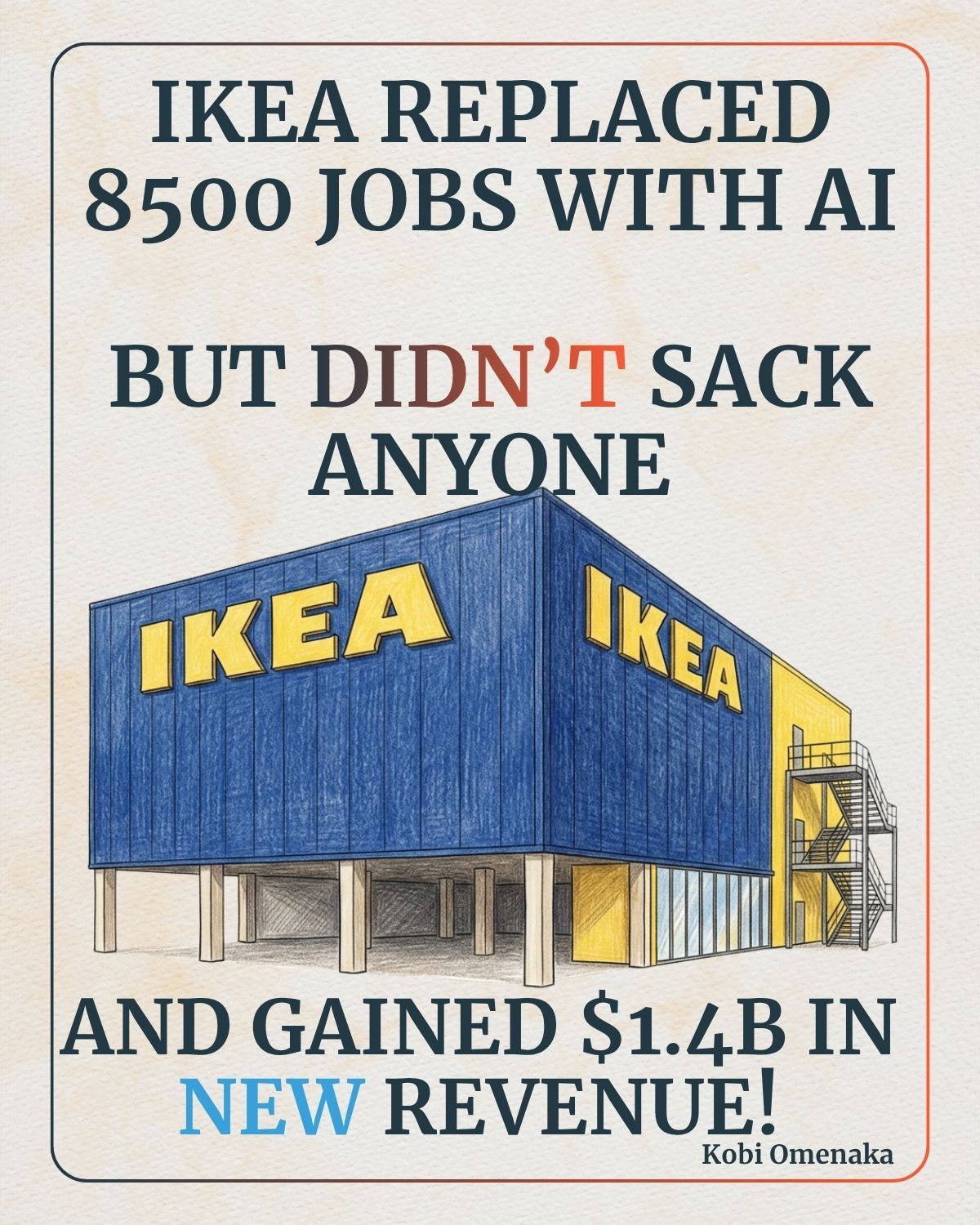
In a recent LinkedIn post, Kobi Omenaka discusses how IKEA successfully integrated AI into its customer service operations, not by eliminating jobs, but by retraining its existing workforce and creating new revenue streams.
Kobi Omenaka highlights a specific initiative where IKEA utilized an AI chatbot, named Billie, to handle routine customer inquiries. As Kobi Omenaka points out:
IKEA used AI to replace 8,500 customer service roles. Not one of those people lost their job.
The chatbot, Billie, was designed to manage frequently asked questions such as order status, delivery times, and store hours. However, Kobi Omenaka emphasizes that a significant portion of customer interactions still required human empathy and expertise, particularly for complex queries related to product styling and customer experience.
The Human Element in AI-Driven Customer Service
Kobi Omenaka argues that IKEA recognized the limitations of AI for certain customer needs. While Billie could manage transactional queries efficiently, it lacked the nuanced understanding required for questions like, “What goes with this sofa?” or “How do I make this tiny flat feel warm?” This distinction, according to Kobi Omenaka, is crucial for understanding how AI can augment, rather than replace, human capabilities.
Instead of resorting to layoffs, IKEA offered its 8,500 customer service employees retraining opportunities to become remote interior design advisors. This strategic move, as Kobi Omenaka details, transformed a potential challenge into a significant business advantage.
The rest needed something Billie hasn’t got. […] So IKEA offered all 8,500 retraining as remote interior design advisers.
AI as a Value Generation Opportunity
The success of this approach is evident in IKEA’s financial performance. Kobi Omenaka shares that IKEA reported $1.4 billion in sales through this new channel in 2022, demonstrating the potential for AI to drive substantial revenue growth when implemented thoughtfully.
Kobi Omenaka contrasts this with companies that view AI primarily as a tool for cost reduction and job cuts. In Kobi Omenaka’s view, the true opportunity with AI lies in its ability to generate new forms of value that were previously unattainable.
The companies that win with AI will see the opportunity for what it is. A great opportunity to generate value in a way that humans never could do.
Kobi Omenaka stresses that success with AI hinges on automating the right processes and leveraging human employees in conjunction with technology. The focus should be on enhancing capabilities and creating new avenues for growth, rather than simply cutting costs.
Strategic Automation for Business Growth
According to Kobi Omenaka, the key takeaway is that successful AI integration requires a strategic vision that prioritizes value creation and employee development. By retraining staff and empowering them with new skills, companies can harness AI to not only improve efficiency but also to unlock new markets and revenue streams.
Kobi Omenaka concludes by suggesting that companies that embrace this holistic approach will be the ones to truly thrive in the evolving business landscape, turning AI from a perceived threat into a powerful engine for growth and innovation.
📝 About This Content
This article is based on insights shared by Kobi Omenaka on LinkedIn.
📅 Originally posted on July 23, 2026 | View original post on LinkedIn →