
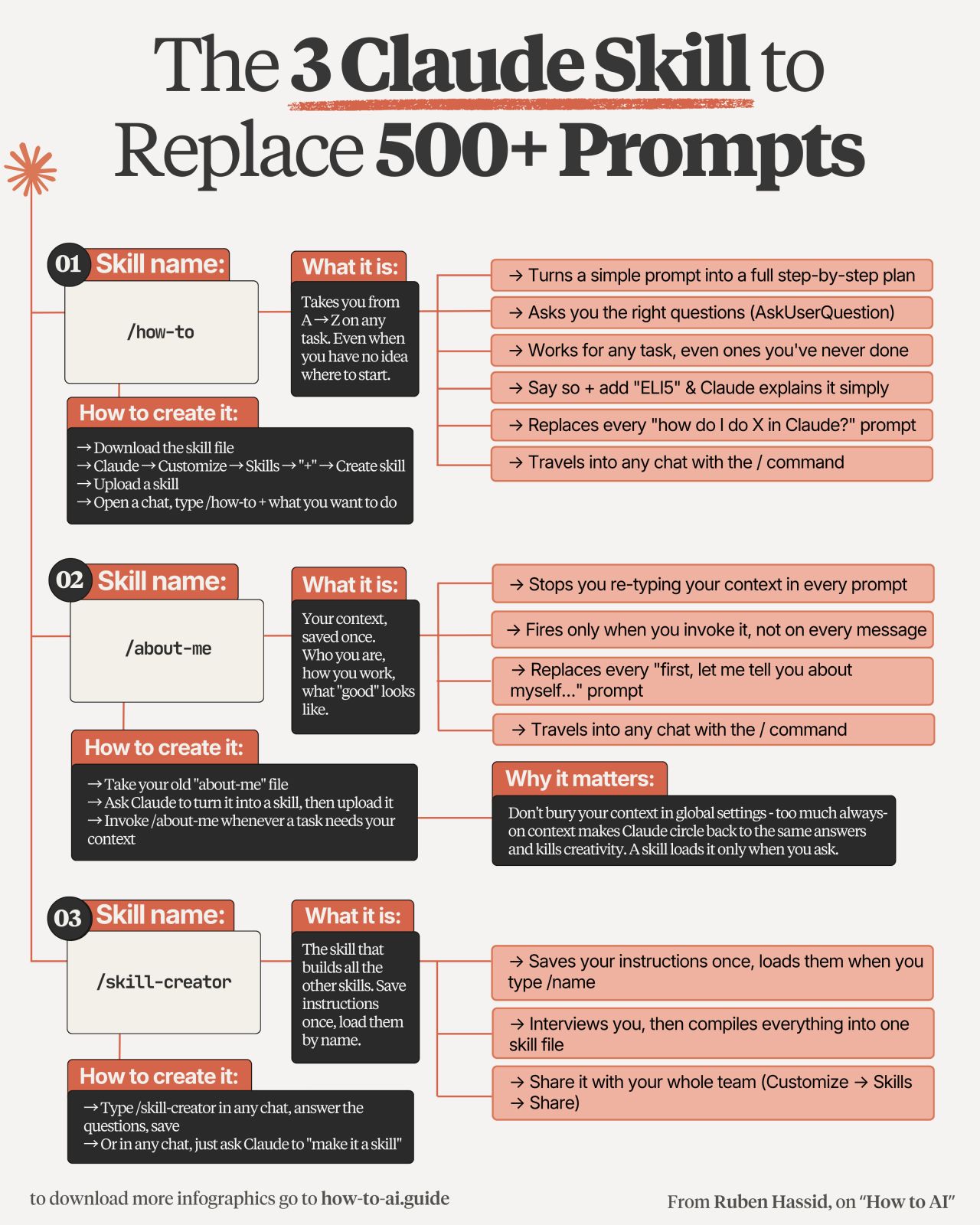
In a recent LinkedIn post, Ruben Hassid proposes a radical simplification of how users interact with AI models like Claude, advocating for a shift away from extensive prompt templates towards a more structured, skill-based approach. Hassid asserts that the current reliance on numerous saved prompts is inefficient and that a focused set of core “Skills” can replace the vast majority of user-generated instructions.
The Case for Claude Skills Over Prompt Templates
Ruben Hassid begins by challenging users to “Delete every prompt template you ever saved,” setting a provocative tone for his argument. He contends that instead of accumulating a multitude of specific prompts, users should focus on mastering a few core AI capabilities, which he terms “Skills.” This approach, according to Hassid, leads to more effective and consistent AI interactions.
“You only need these 3 Claude Skills: 1. /how-to SKILL, 2. /about-me, 3. /skill-creator”
Hassid details three primary Skills essential for leveraging Claude effectively. The /how-to Skill is presented as a universal guide, capable of breaking down any task by having Claude ask clarifying questions to build a plan. This replaces the common need for “how do I do this?” prompts. The /about-me Skill allows users to define their persona, thinking style, and writing voice, either through an interview process or by converting existing documentation, ensuring the AI responds in a personalized manner. Finally, the /skill-creator Skill is described as the meta-tool for building other Skills, streamlining the process of creating reusable AI capabilities.
Beyond Skills: Voice Input and Project-Based Organization
Hassid’s simplification strategy extends beyond just the core Skills. He also emphasizes the importance of voice input for faster and more honest interaction.
Dictation for Efficiency and Honesty
Under the heading “Dictate, don’t type,” Hassid recommends using tools like Wispr.ai. He argues that voice input is inherently faster than typing and encourages a more candid approach, stating, “Vagueness won’t survive Claude’s follow-ups.” This suggests that spoken commands, being less prone to overthinking, lead to clearer instructions for the AI.
Skills and Projects: The Only Organizational Tools Needed
Further distilling the approach, Hassid advocates for organizing AI interactions solely around “Skills + Projects.” He dismisses traditional methods like folders, files, and global instructions.
“Forget folders, files & global instructions: Skill = a capability you can teach someone. Project = a specific context (a client, a campaign).”
In Hassid’s view, a Skill represents a teachable capability, while a Project defines a specific context, such as a client engagement or a marketing campaign. This binary organizational structure, he believes, is sufficient for managing AI workflows, advising users to “Turn everything OFF. No settings is the best one.” This radical simplification aims to reduce cognitive load and enhance focus on core AI functionalities.
Accessing Hassid’s Framework
For those interested in adopting this streamlined approach, Ruben Hassid directs readers to his resource at how-to-ai.guide. He offers a free download of his Skills library, requiring users to subscribe and follow a simple three-step process to access the resources within Claude’s settings.
📝 About This Content
This article is based on insights shared by Ruben Hassid on LinkedIn.
📅 Originally posted on July 25, 2026 | View original post on LinkedIn →