
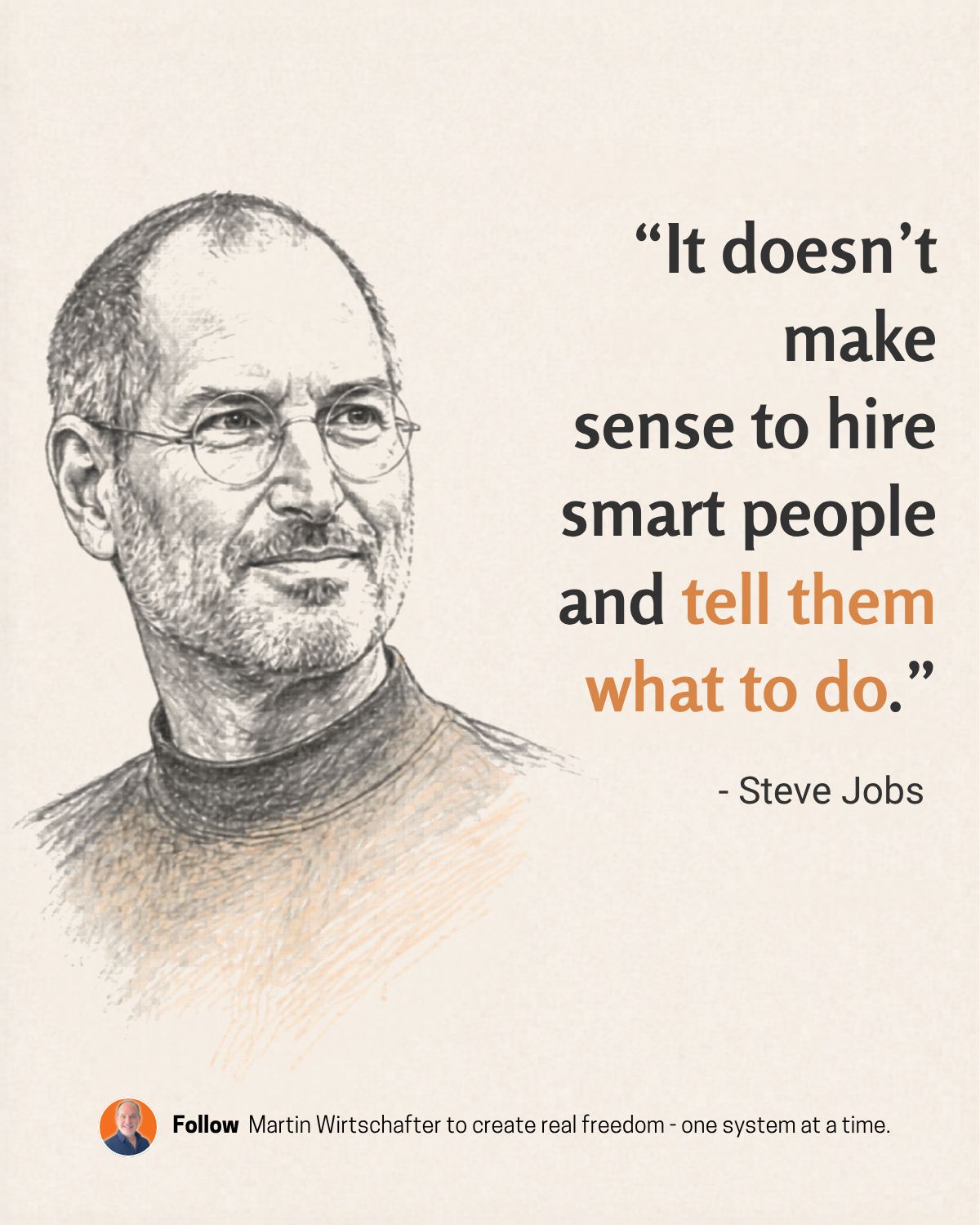
In a recent LinkedIn post, Martin Wirtschafter discusses a common pitfall for founders: mistaking headcount growth for true business scalability. Wirtschafter argues that while many founders focus on hiring more people, they often fail to delegate decision-making authority, leading to continued bottlenecks and founder dependency. He highlights that simply adding more employees does not automatically reduce a founder’s central role.
Wirtschafter shares his observations from working with over 200 companies in private equity, noting a recurring pattern. He recounts the experience of a founder who had grown a SaaS company to 22 employees. Despite having a capable team, the critical issue was a lack of clarity regarding decision-making autonomy. As Wirtschafter observed:
“The issue was that nobody was fully sure what they could decide without him. So when something unusual came up, they waited. By the end of the day, he was still carrying the decisions that were supposed to leave his plate.”
This anecdote illustrates a key point Wirtschafter makes: the advice to “hire good people and step back” often omits a crucial element. According to Wirtschafter, simply increasing the number of employees does not inherently make a business less reliant on the founder. He emphasizes the necessity for clear ownership, defined judgment areas, and established protocols for when founder approval is not required.
The Crucial Shift: From Task Delegation to Decision Delegation
Wirtschafter contends that the fundamental shift required for true scalability lies in how founders approach delegation. He differentiates between handing off tasks and handing off decisions, asserting that the latter is the catalyst for a business that can operate independently.
He explains that the founder in his example only began to see a significant change when he reoriented his approach.
“The real shift came when he stopped treating delegation as handing off tasks. He started handing off decisions.”
This strategic pivot, Wirtschafter suggests, empowered the team to truly own outcomes, thereby reducing the founder’s centrality to daily operations. He posits that the true measure of a scalable business isn’t just its size but its capacity to function and advance in the founder’s absence.
Measuring True Scalability
Wirtschafter proposes a more accurate metric for assessing a business’s growth beyond mere headcount. He suggests founders should evaluate:
“The better measure is how much can move forward when you are not in the room.”
This perspective challenges the conventional wisdom that equates a larger team with a more autonomous business. As Martin Wirtschafter points out, an expanded organizational chart does not guarantee a lighter load for the founder if decision-making power remains concentrated.
The Importance of Autonomy and Clarity
For a team to effectively take ownership and drive outcomes, Wirtschafter stresses the need for explicit boundaries and permissions. He notes:
“People need to know what they own, where they can use their judgment, and when they do not need to ask.”
Without this clarity, employees are likely to default to seeking founder approval, perpetuating the very dependency the founder sought to escape through hiring. Wirtschafter’s insights offer a valuable framework for founders aiming to build businesses that can thrive and grow without being perpetually tethered to their initial visionaries.
📝 About This Content
This article is based on insights shared by Martin Wirtschafter on LinkedIn.
📅 Originally posted on July 31, 2026 | View original post on LinkedIn →