
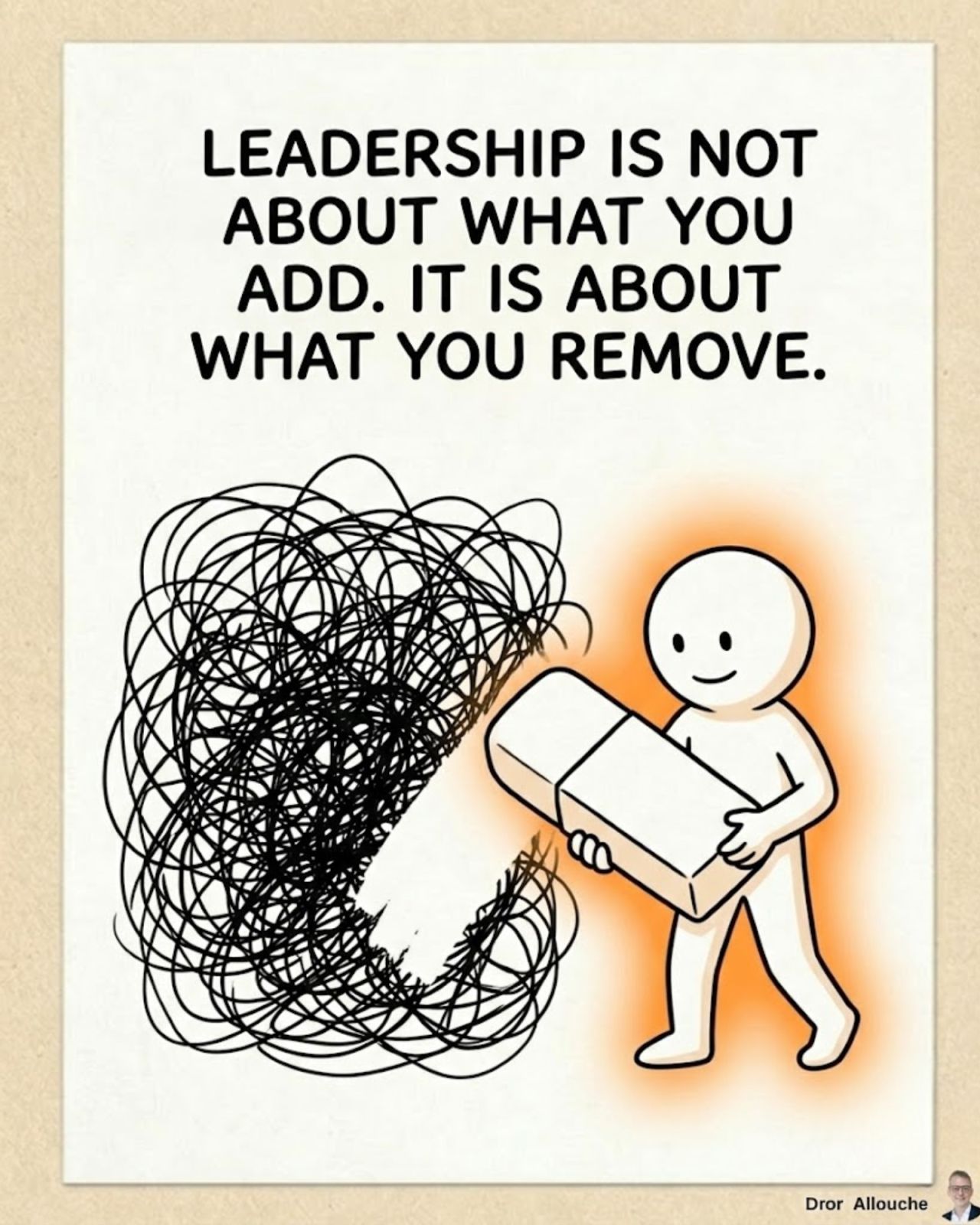
In a recent LinkedIn post, Dror Allouche discusses a counterintuitive approach to enhancing leadership effectiveness: subtraction rather than addition. He challenges the common perception that growth and improvement in leadership solely stem from acquiring new skills, knowledge, or ideas.
Challenging the ‘More is More’ Mentality
Dror Allouche argues that the relentless pursuit of adding more elements to one’s leadership toolkit can paradoxically lead to negative outcomes. He highlights several common pitfalls associated with this additive approach:
- Increased overwhelm and stress
- A proliferation of unfinished projects
- Diminished focus and wasted energy
Instead of adding, Allouche suggests that leaders should consider what can be removed to achieve greater clarity and impact. He posits that strategic subtraction can free up mental and temporal resources, allowing for a more focused and effective leadership style.
“We often think growth means adding more: Skills, Training, New ideas. But it often leads to: Overwhelm, Unfinished projects, More stress.”
The Strategic Advantage of Subtraction
According to Dror Allouche, removing non-essential tasks, commitments, or even mindsets can unlock significant leadership potential. This less-is-more philosophy, as he frames it, enables leaders to concentrate their efforts on what truly matters. This can result in:
- Sharper focus on key priorities
- More efficient use of time and energy
- Enhanced clarity in decision-making and direction
Allouche emphasizes that this principle isn’t about stagnation but about intelligent prioritization. By identifying and eliminating what hinders progress, leaders can create space for more meaningful work and strategic thinking.
Actionable Steps for Leaders
To facilitate this shift towards subtractive leadership, Dror Allouche offers practical advice. He encourages leaders to engage in self-reflection to identify personal obstacles and actively seek feedback from their teams. He notes the value of 360-degree assessments as a tool for uncovering areas where leaders might need to cease certain behaviors or practices.
“What if removing something could be the key to improving? More focus, less wasted energy. More time for what matters. More clarity.”
He reinforces this point by referencing the wisdom of management consultant Peter Drucker, who famously stated:
“Half the leaders I have met don’t need to learn what to do. They need to learn what to stop.”
Dror Allouche’s message is a compelling call for leaders to re-evaluate their approach, advocating that true growth can often be found not in accumulation, but in intentional reduction. His insights suggest that by strategically subtracting the superfluous, leaders can amplify their effectiveness and achieve greater success.
📝 About This Content
This article is based on insights shared by Dror Allouche on LinkedIn.
📅 Originally posted on July 31, 2026 | View original post on LinkedIn →