
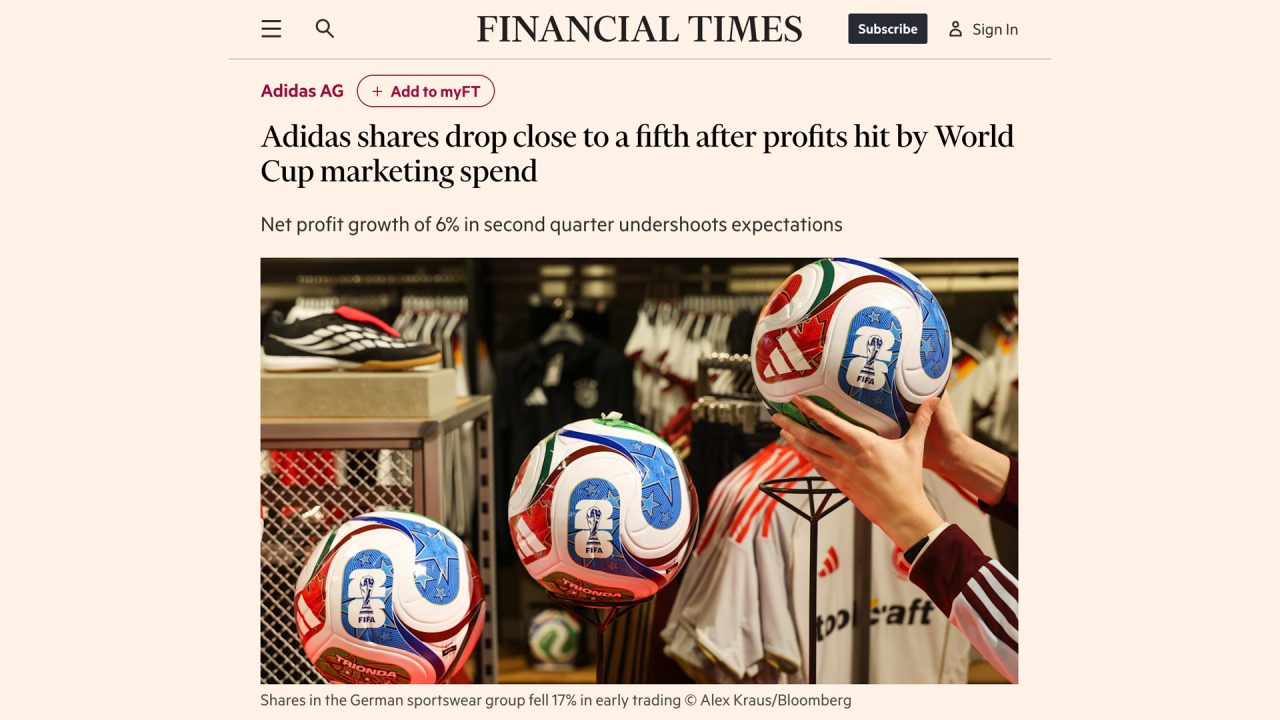
In a recent LinkedIn post, James Hurman discusses the market’s perception of Adidas’s marketing investments, suggesting a significant misunderstanding of how brand marketing truly impacts the bottom line over time. Hurman contends that current market analysis fails to account for the long-term value generated by such campaigns.
Challenging Market Perceptions
Hurman’s core argument centers on the delayed but substantial returns from brand marketing. He posits that the market is too focused on immediate, in-quarter impacts, overlooking the profit generation that accrues over a longer horizon. According to Hurman, the true value of marketing initiatives, particularly for a brand like Adidas, is often underestimated by financial analysts.
Once you understand how future demand is created and how brand marketing returns show up, it’s obvious that the market has read adidas all wrong.
As Hurman points out, the conventional view among market watchers may be too short-sighted. He emphasizes that understanding the mechanisms of future demand creation is key to appreciating the full impact of brand marketing efforts. Hurman suggests that this is not just a matter of opinion, but a logical conclusion derived from a deeper understanding of marketing economics.
The Long-Term Value of Brand Marketing
Delving deeper into the financial implications, Hurman highlights the phased return on marketing investment. He asserts that while marketing spend does affect immediate financial results, its most significant value is realized much later.
Yes, marketing investment impacts the bottom line in-quarter. Then returns 4x in profit over 24 months.
This statement from Hurman suggests a specific multiplier effect, indicating that for every dollar invested in marketing, there is a potential for a fourfold increase in profit within a two-year period. He implies that this is a predictable outcome, driven by the cumulative effect of brand building and sustained consumer engagement. Hurman’s analysis contrasts with a purely performance-marketing-driven approach, advocating for a more holistic view that values brand equity and long-term growth.
A Call for Future Re-evaluation
The post concludes with a forward-looking statement, suggesting that a shift in market perspective is inevitable. Hurman anticipates a future where analysts will adopt a more nuanced understanding of marketing’s financial contributions.
One day analysts will wake up to this reality.
In Hurman’s view, this awakening will lead to a more accurate valuation of companies that invest strategically in brand marketing. He credits Jonathan Bell and Brent Smart for their contributions, possibly indicating a broader conversation or shared perspective on this topic within the industry. Ultimately, Hurman’s post serves as a commentary on the current state of market analysis and a prediction for its future evolution, urging a re-evaluation of how marketing’s true economic value is measured.
📝 About This Content
This article is based on insights shared by James Hurman on LinkedIn.
📅 Originally posted on August 2, 2026 | View original post on LinkedIn →