
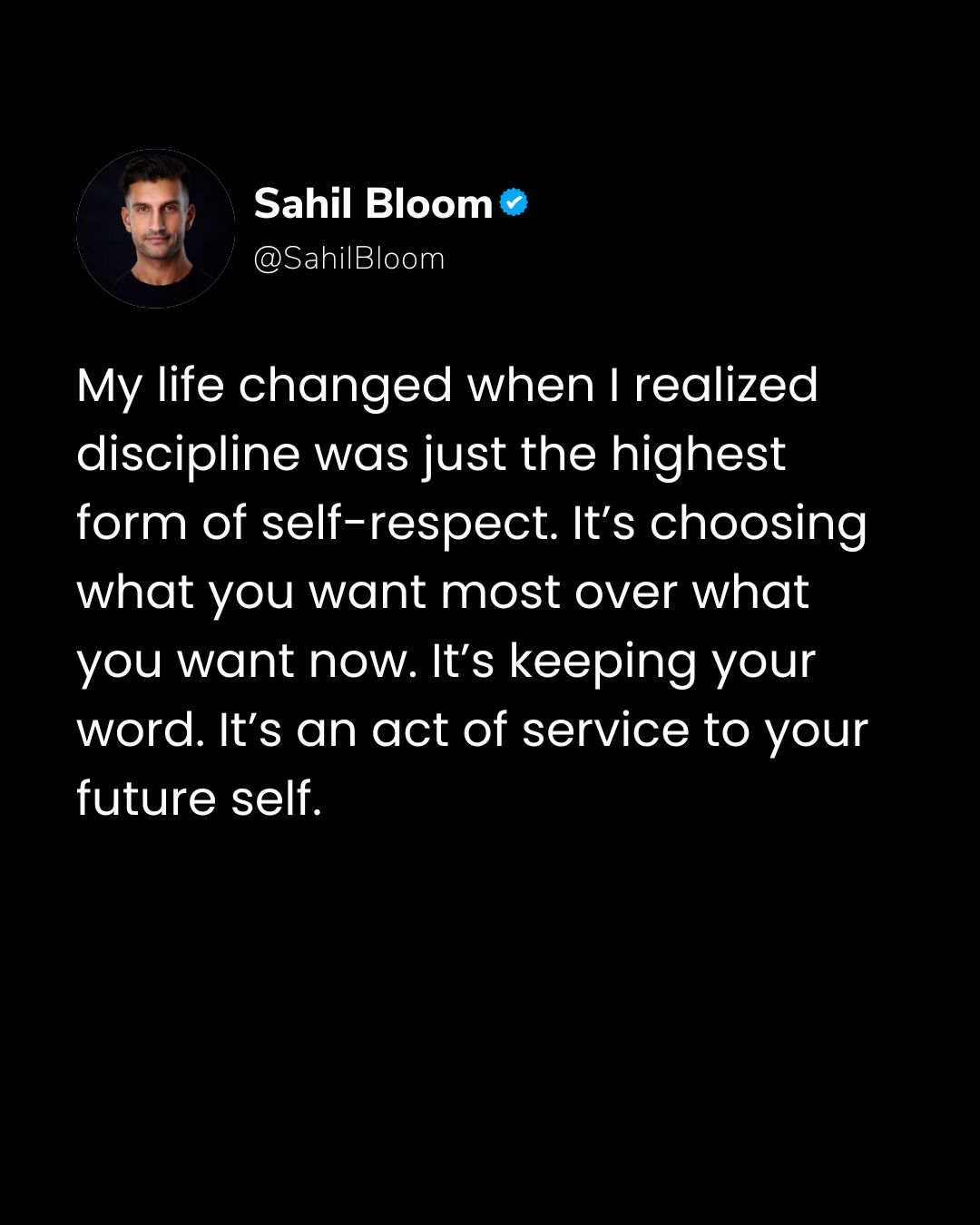
In a recent LinkedIn post, Sahil Bloom offers a compelling reframing of discipline, moving beyond its common association with punishment to present it as a fundamental act of self-respect. Bloom argues that true discipline is not about enduring hardship for its own sake, but rather about a conscious choice that honors one’s future self.
Redefining Discipline as Self-Respect
Sahil Bloom challenges the conventional view of discipline as a negative or punitive experience. Instead, he posits that it is rooted in a deep sense of self-worth and a commitment to one’s own well-being. According to Bloom, the most admirable individuals are those who extend the same level of commitment to their personal promises as they do to their professional obligations.
“Discipline isn’t punishment.
(It’s the deepest form of self-respect.)”
Bloom elaborates on this core idea, suggesting that discipline is essentially a strategic decision-making process. It involves prioritizing long-term goals over immediate gratification. This perspective elevates discipline from a mere behavioral modification technique to a cornerstone of personal integrity.
The Future Self as a Stakeholder
A key theme in Sahil Bloom’s post is the concept of serving one’s future self. He views adherence to personal commitments, especially when unobserved, as a critical act of honoring the person one aspires to become. This notion implies that consistent, disciplined action today builds the foundation for a more successful and fulfilling tomorrow.
“It’s choosing what you want most over what you want now.
It’s keeping your word to yourself when no one is watching.
It’s an act of service to your future self.”
Bloom emphasizes that this internal consistency is a hallmark of those he admires. The ability to maintain one’s word, even in the absence of external accountability, is presented as a powerful indicator of character and self-mastery. This internal locus of control, as highlighted by Bloom, is what differentiates passive wishful thinking from active self-creation.
Integrity in Personal Commitments
The post further underscores the importance of reliability in personal endeavors. Sahil Bloom points out that the most respected individuals demonstrate a parallel commitment to both their external promises and their internal resolutions.
“The people I admire most treat their commitments to themselves the same way they treat their commitments to others.
They keep their word. To themselves. Every single day.”
This perspective from Bloom suggests that our relationship with ourselves is as significant as our relationships with others. By consistently meeting our own expectations, we build a reservoir of trust within ourselves, which, in turn, fuels greater achievement and resilience. The act of keeping one’s word, particularly to oneself, is framed as a daily practice essential for long-term growth and fulfillment.
📝 About This Content
This article is based on insights shared by Sahil Bloom on LinkedIn.
📅 Originally posted on August 2, 2026 | View original post on LinkedIn →