
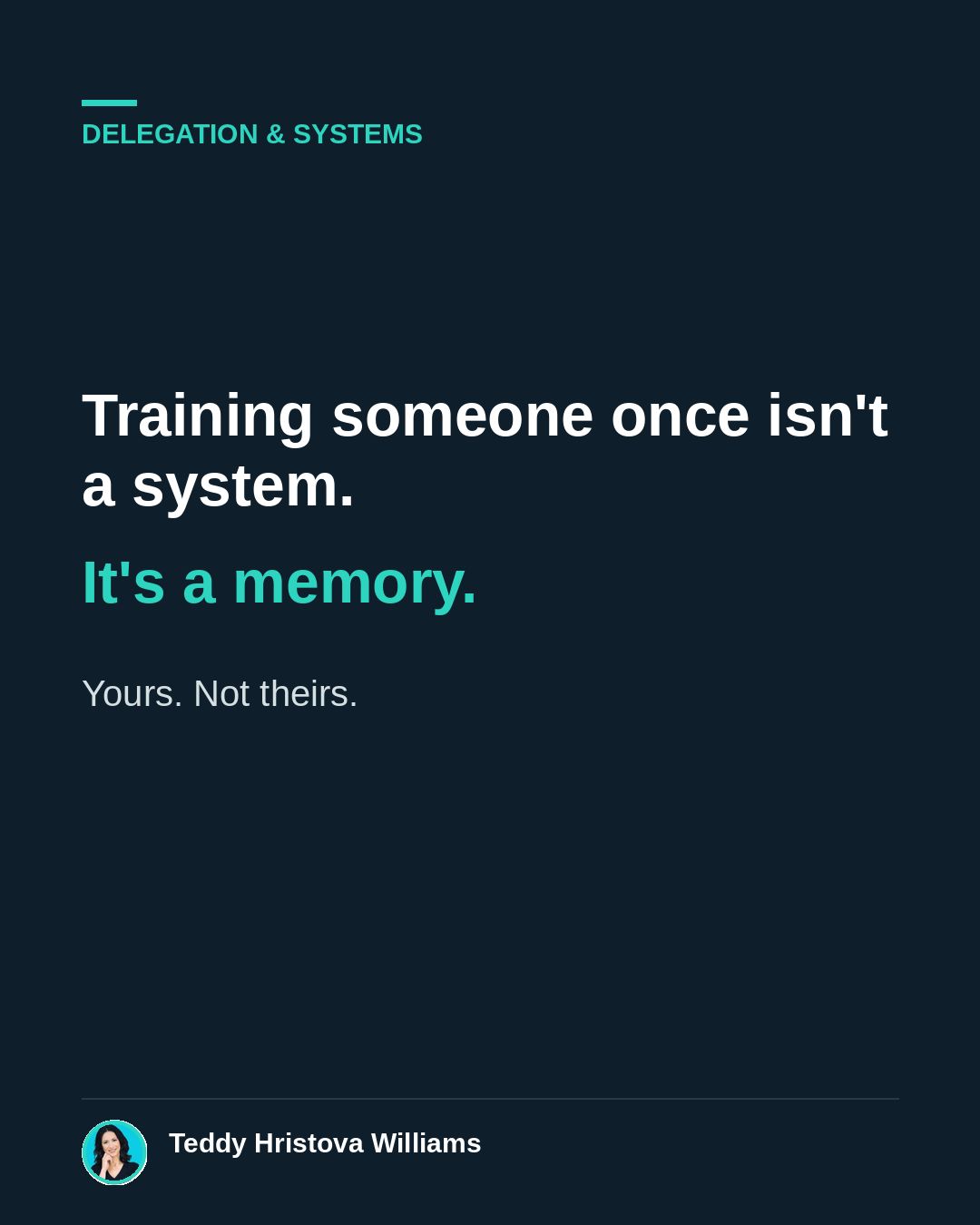
In a recent LinkedIn post, Teddy Hristova Williams challenges the common reliance on individual memory within teams, advocating for the creation of robust systems instead. The post, which has garnered attention for its practical insights into team efficiency, addresses the frustration often felt by trainers when individuals forget information long after a session.
Teddy Hristova Williams argues that this frustration is misplaced, suggesting that the issue lies not with the learner, but with the inadequacy of the training method itself. The core of the argument is that relying solely on a single explanation or demonstration is insufficient for true knowledge transfer.
“You showed them once. That’s not a system, that’s a memory, and it was never going to survive you being on vacation, in a different meeting, or just having a slow morning.”
The Fallacy of Memory-Based Knowledge Transfer
Teddy Hristova Williams posits that what is often mistaken for learned knowledge is, in reality, simply a temporary retention of information. This reliance on individual memory, as Teddy Hristova Williams points out, creates a fragile dependency that crumbles under the slightest disruption. Whether it’s an absence from work, a shift in priorities, or even just a moment of distraction, these memory-based systems are inherently unstable.
The author emphasizes that a true system is one that is resilient and independent of any single person’s recall. It should function seamlessly even if the original instructor or mentor is unavailable or has forgotten the details themselves.
Defining a True System
According to Teddy Hristova Williams, the benchmark for a successful system is its ability to operate autonomously. A system that truly works is one that can withstand the test of time and human fallibility. Teddy Hristova Williams frames this by asking a pointed question to the reader:
“What’s one thing on your team that only works because you remember it?”
This rhetorical question is designed to prompt self-reflection, encouraging leaders and team members to identify areas where their operations are vulnerable due to an over-dependence on personal memory. The implication is that these are the very areas ripe for systemic improvement.
The Path to Systemic Resilience
Teddy Hristova Williams’s insights suggest a shift in focus from individual memorization to the development of documented processes, clear protocols, and accessible resources. Building a system that survives individual memory requires intentional effort in:
- Documenting procedures clearly and concisely.
- Creating standardized workflows that are easy to follow.
- Ensuring knowledge is accessible and not siloed with individuals.
- Regularly reviewing and updating processes to maintain their effectiveness.
By implementing these strategies, teams can move away from the precarious foundation of memory and build a more robust and reliable operational framework. Teddy Hristova Williams’s post serves as a critical reminder that sustainable success hinges on creating structures that are inherently resilient, rather than relying on the fallible nature of human memory.
The underlying message is clear: true operational strength is built on systems that are designed to endure, independent of any single individual’s knowledge or presence.
📝 About This Content
This article is based on insights shared by Teddy Hristova Williams on LinkedIn.
📅 Originally posted on August 4, 2026 | View original post on LinkedIn →