
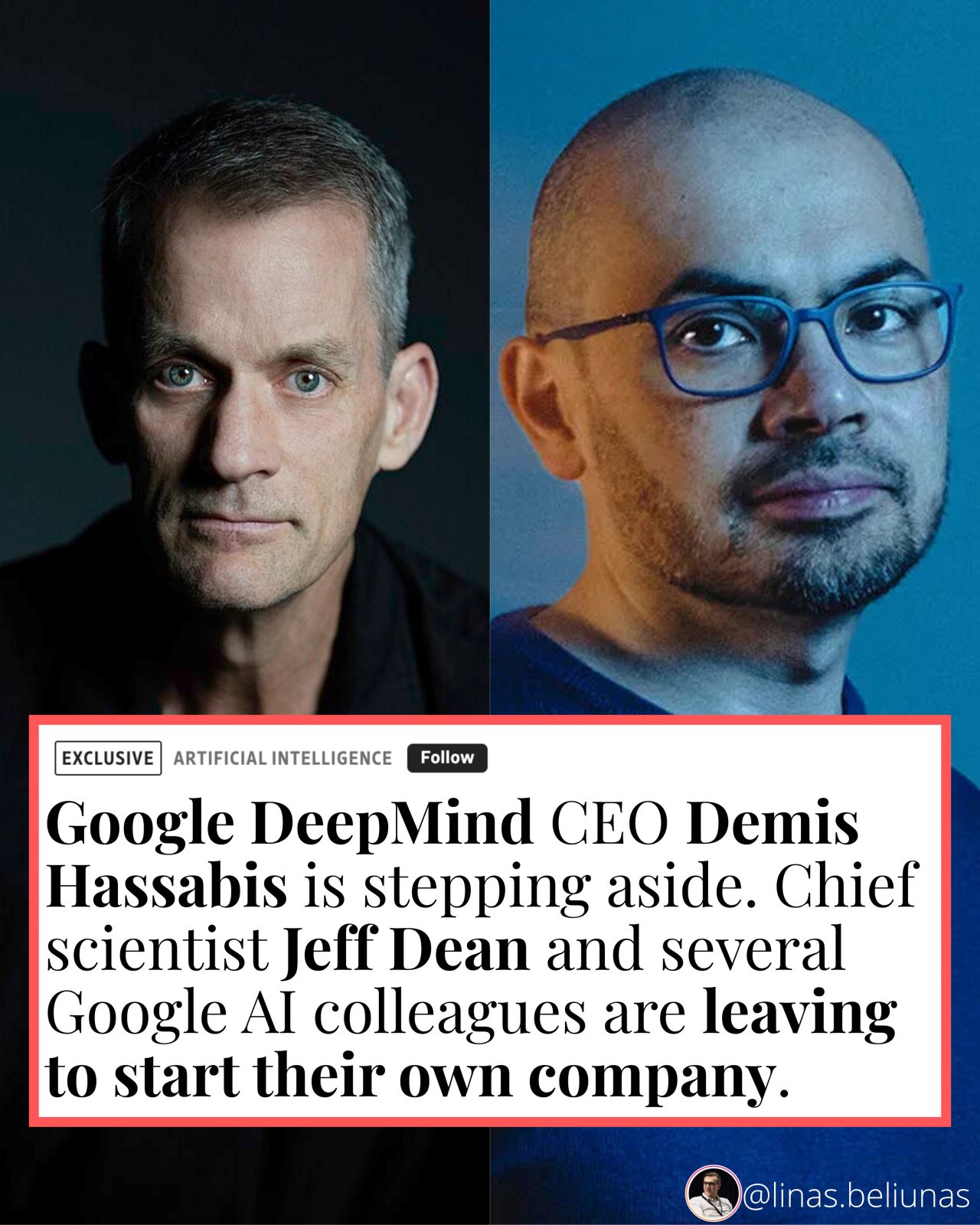
In a recent LinkedIn post, Linas Beliūnas discusses a significant shift occurring at the forefront of artificial intelligence, highlighting the departure of key AI architects from Google to establish a new venture focused on accelerating scientific discovery. Beliūnas frames this move as a critical indicator of the rapid pace required in frontier AI research.
Key AI Talent Departs Google to Pursue Faster Innovation
Linas Beliūnas points to the recent departure of four prominent builders from Google’s AI efforts, including Jeff Dean, Sanjay Ghemawat, Oriol Vinyals, and Quoc Le. These individuals were instrumental in developing foundational AI technologies and infrastructure at Google, such as Google Brain and Gemini. Their new venture, Discovery Loop, aims to automate the scientific discovery process, from hypothesis generation to experimentation and learning.
“Four insiders, some of the most brilliant minds in AI, have decided they need to leave one of the world’s best-resourced AI companies to move at the speed frontier research now demands.”
As Linas Beliūnas notes, the irony is that Google is a founding investor in Discovery Loop and will provide essential computing resources through Google Cloud. However, the core work will be conducted independently of Google’s internal structure. This situation underscores Beliūnas’s central argument: that even a company with immense resources like Google can face challenges when its top talent feels constrained by internal processes and seeks greater agility.
Internal Realignments Amidst Talent Exodus
Beliūnas also touches upon other significant leadership changes within Google’s AI division. He highlights Demis Hassabis stepping back from daily DeepMind operations to concentrate on company-wide AI strategy and Artificial General Intelligence (AGI). Koray Kavukcuoglu is set to lead Gemini and frontier-model development. Furthermore, Beliūnas points out that other notable AI researchers, such as Noam Shazeer and John Jumper, have already departed for competitors like OpenAI and Anthropic, respectively.
“Google still has what almost nobody else can match: custom chips, enormous distribution, proprietary data, research depth, and billions in cash.”
According to Linas Beliūnas, these departures and realignments signal a broader trend where the speed of innovation in AI research is becoming paramount. While Google possesses unparalleled resources, Beliūnas suggests that the organizational structure and pace of a large corporation may not always align with the demands of cutting-edge research.
The Speed vs. Resources Dilemma
In Linas Beliūnas’s view, the situation presents a paradox. Google’s substantial assets—custom hardware, vast distribution networks, proprietary data, deep research expertise, and significant financial backing—are formidable. Yet, as Beliūnas emphasizes, the ability to leverage these assets is contingent on the agility and speed of its builders.
“But owning the full stack means little if your best builders need to leave it behind to move faster.”
Linas Beliūnas concludes by underscoring that the need for speed in frontier AI development is driving even the most accomplished researchers to seek environments where they can operate with greater autonomy and velocity. This dynamic, he implies, will continue to shape the competitive landscape of artificial intelligence, forcing even tech giants to adapt to the accelerated pace of innovation.
📝 About This Content
This article is based on insights shared by Linas Beliūnas on LinkedIn.
📅 Originally posted on August 5, 2026 | View original post on LinkedIn →