
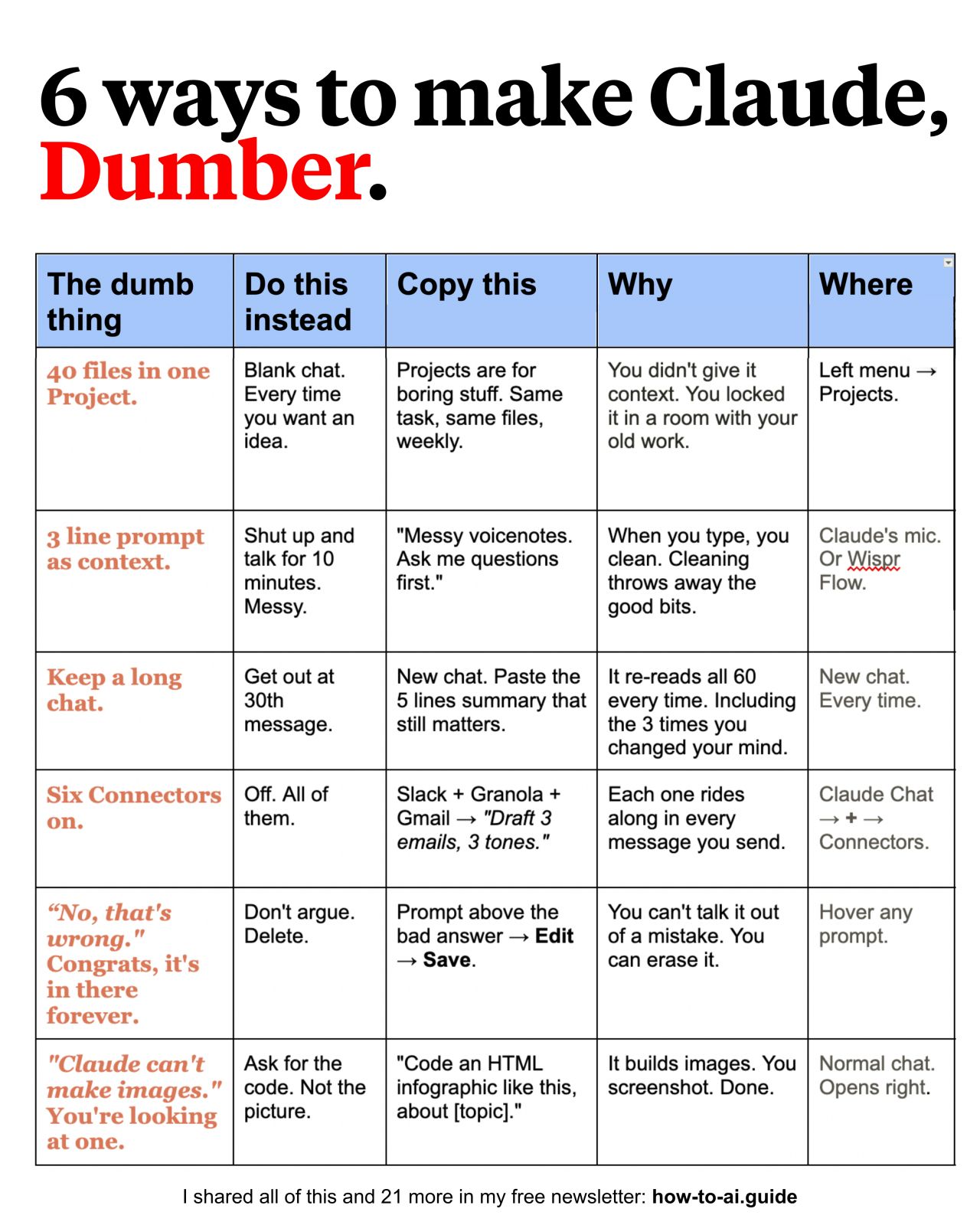
In a recent LinkedIn post, Ruben Hassid discusses common pitfalls that can lead to suboptimal interactions with AI models like Claude, offering practical advice on how to elicit better responses. Hassid frames these issues not as fundamental flaws in the AI, but as consequences of how users interact with it, suggesting that many of these limitations can be addressed quickly.
Hassid highlights that the way users structure their requests and manage information can inadvertently limit the AI’s creative potential. He points out that over-organization can stifle ideation, stating:
“Being organised is the rent that you pay. Files, Projects, skills, a folder of instructions. All of them restrict Claude from exploring more. Perfect for reports. But death for ideas.”
This suggests that for tasks requiring novel thinking, a less constrained environment might be more beneficial. Hassid advocates for a shift in approach, moving away from generic instructions towards more specific feedback.
Beyond Generic Prompts: Specificity is Key
A significant portion of Hassid’s advice centers on moving beyond vague commands. He argues that repetitive, unspecific instructions, such as asking an AI to “make it punchier” multiple times, are ineffective because the AI cannot infer subjective intent. Instead, Hassid proposes a more direct method:
“Claude can’t read your opinion. Paste the thing you hate instead: ‘Never write like this: [paste].'”
This technique, according to Hassid, provides the AI with concrete examples of what to avoid, leading to more precise and useful outputs. He also introduces a prompt enhancement to ensure the AI gathers necessary context before generating a response.
Leveraging Advanced AI Modes
Hassid also draws attention to underutilized features within AI platforms. He specifically mentions a “Research” mode that he claims has been overlooked by many users for extended periods. Far from being a simple search function, Hassid describes this mode as capable of planning, analyzing numerous sources, and delivering comprehensive reports akin to those produced by human analysts.
He illustrates this with a practical example for visual design prompts:
“Screenshot the page you like → ‘Build this, but for [topic].’ Nobody can read a layout. Not even you.”
This approach bypasses the ambiguity of descriptive language for visual elements, enabling the AI to understand and replicate design intentions more effectively. Hassid concludes that the focus should be on refining interaction strategies rather than solely on improving prompts, as users have spent considerable time mastering a system that may not be the core limitation.
Reframing User Interaction with AI
Ruben Hassid’s insights underscore a critical point: the effectiveness of AI tools is heavily dependent on user methodology. By sharing these 27 potential improvements, Hassid aims to equip users with actionable strategies to overcome common AI limitations. His post emphasizes that thoughtful prompting and an understanding of AI capabilities, including specialized modes and direct feedback mechanisms, are crucial for unlocking the full potential of these powerful tools. As Hassid notes, the focus on “a better prompt” might be misplaced, suggesting that the way users frame their requests and engage with the AI is paramount.
📝 About This Content
This article is based on insights shared by Ruben Hassid on LinkedIn.
📅 Originally posted on August 8, 2026 | View original post on LinkedIn →